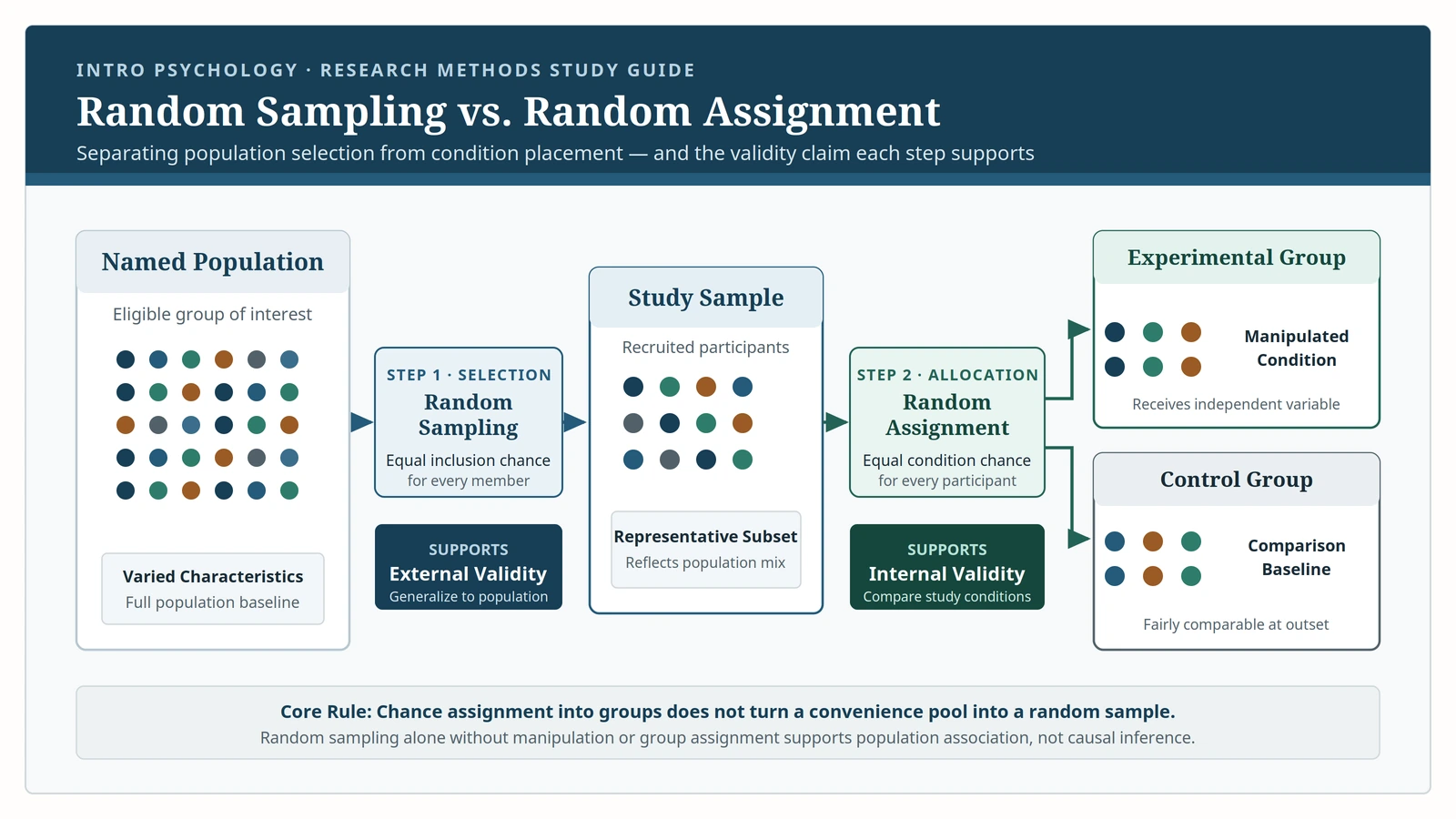
In a psychology study, comparing random sampling vs random assignment separates how people enter a sample from how enrolled participants enter experimental conditions. A random sample is a subset of a larger population in which every member of the population has an equal chance of being selected, recruiting participants so they represent that larger population and supporting generalizability and external validity. Random assignment—also called random allocation—happens after the sample is obtained, splitting participants into experimental and control groups so every participant has an equal chance of being placed in either group.
The two chance procedures answer different methodological questions in our research methods study guides, where random sampling and random assignment solve different problems and neither removes every limitation. Random sampling addresses external validity, the extent to which the results of research can be generalized beyond the sample that generated them, including generalizability from a predefined sample to a broader population and transportability from one sample to another target population. Random assignment addresses internal validity, the extent to which evidence within the controlled conditions of a study supports a cause-and-effect claim between a manipulated independent variable and a measured dependent variable. Both study-design concepts also differ from measurement validity in our guide to reliability vs validity in psychology measures, where validity refers to the extent to which an instrument or tool accurately measures what it is supposed to measure.
| Design Dimension | Random Sampling (Random Selection) | Random Assignment (Random Allocation) |
|---|---|---|
| Timing in study workflow | First stage: selects study participants from a larger population of eligible individuals | Second stage: splits participants already in the sample into experimental and control conditions |
| Equal-probability rule | Every member of the population has the same fixed probability of inclusion in the sample | Every participant or unit in the sample has an equal likelihood of placement in any group |
| Bias or threat reduced | Minimizes conscious or nonconscious researcher bias in who enters the sample | Decreases confounding by making groups fairly comparable on known and unknown confounding variables |
| Primary validity supported | External validity and generalizability from the sample to the larger population | Internal validity for attributing group differences to the manipulated independent variable |
| Key boundary to remember | Does not by itself manipulate a variable or establish cause and effect | Does not turn enrolled participants into a random sample or guarantee that the groups are matched or equivalent |
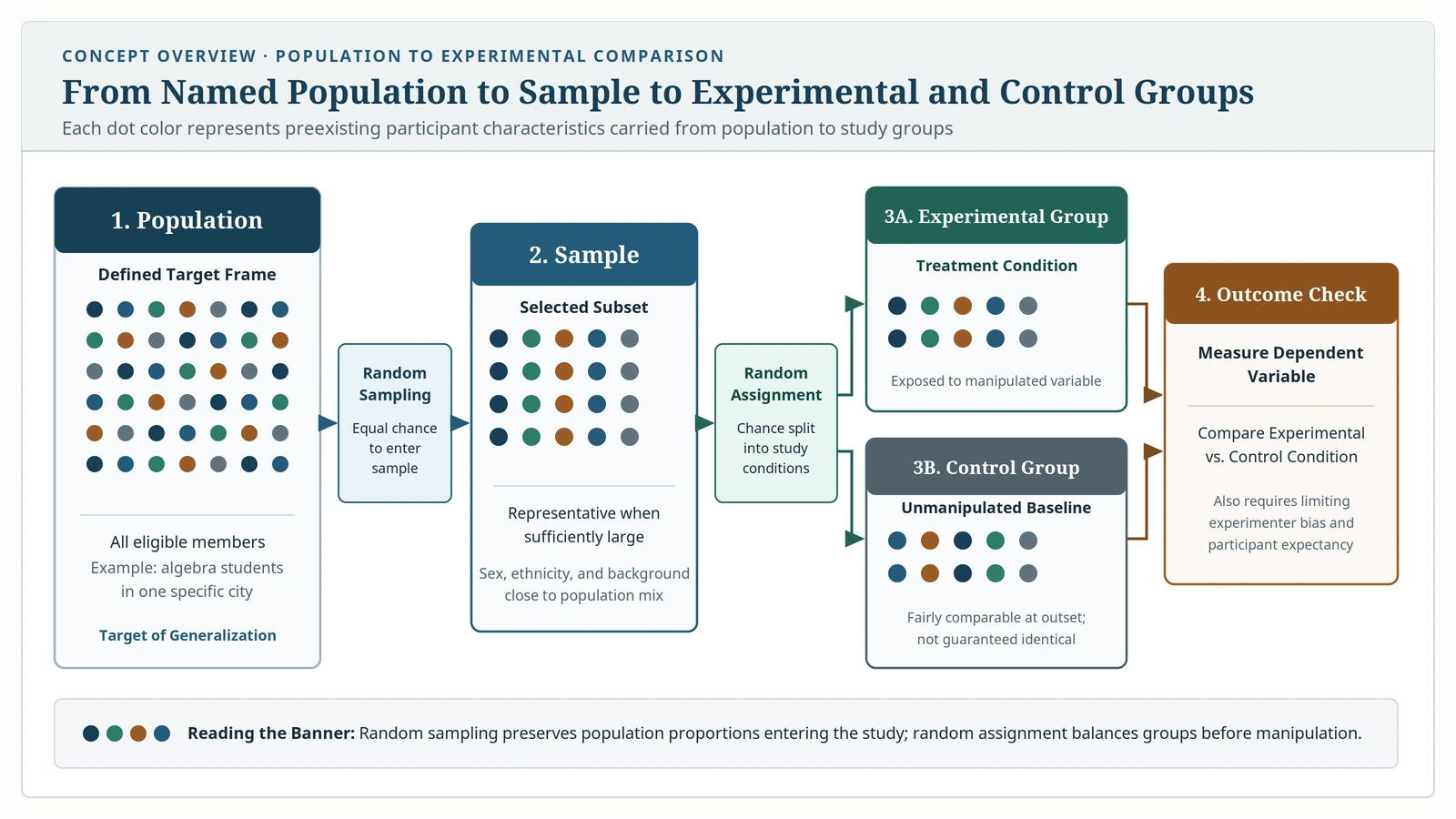 A random sample draws participants from a larger population with equal selection probability, and random assignment then splits that sample into experimental and control groups with equal placement probability.
What Is a Random Sample in Psychology Research?
In OpenStax Psychology 2e, section 2.3 (Analyzing Findings), published Apr 22, 2020 in Houston, Texas by Rose M. Spielman, William J. Jenkins, and Marilyn D. Lovett, a random sample is a subset of a larger population in which every member of the population has an equal chance of being selected. OpenStax notes that researchers should use a random sample if possible and explains that other types of samples exist even though section 2.3 focuses on random samples. Random samples are preferred because when the sample is large enough, researchers can be reasonably sure the participating individuals are representative of the larger population, meaning the percentages of sex, ethnicity, socioeconomic level, and other characteristics that might affect the results are close to those percentages in the larger population. With a representative group, findings can be generalized to that larger population without the sample being biased.
In the APA Dictionary entry updated on 04/19/2018, random sampling is defined as selecting a sample of study participants from a larger potential group of eligible individuals so each person has the same fixed probability of inclusion and a chance procedure determines who is chosen. A group chosen through that process is called a random sample, and its main value as probability sampling is its positive impact on generalizability and external validity.
Survey methodology draws a sharper boundary between member-level equal chance and subset-level probability than introductory textbook summaries do. A sampling method in which each individual unit has the same chance of being selected is called equal probability sampling, or epsem, whereas in a simple random sample each subset of k individuals has the same probability of being chosen as any other subset of k individuals. Using a simple random sample always produces an epsem sample, yet not all epsem samples are simple random samples. Even simple random sampling does not guarantee that one particular sample is a perfect representation of the population, though it allows researchers to draw externally valid conclusions about the entire population based on the sample.
What Is Random Allocation in Psychology?
In random assignment psychology, the APA Dictionary entry updated on 04/19/2018 says random assignment is also called random allocation and randomization. It is defined in experimental design as assigning participants or units to the different conditions of an experiment entirely at random so each unit or participant has an equal likelihood of being assigned to any particular condition. In clinical trials, APA notes that random assignment decreases confounding of the treatment factor with other factors by making the treatment and control groups approximately comparable in all respects except for the treatment.
OpenStax Psychology 2e section 2.3 describes the same equal-chance placement step for introductory psychology experiments: once a sample is obtained, participants are split into experimental and control groups through random assignment so all participants have an equal chance of being assigned to either group. Wikipedia similarly notes that random assignment, or random placement, assigns human participants or animal subjects to groups such as a treatment group versus a control group using a chance procedure or a random number generator so each participant has an equal chance of entering any group.
In the methods article titled How to control confounding effects by statistical analysis (PMCID: PMC4017459, received 2012 Jan 1 and accepted 2012 Feb 15), confounding is identified as a major threat to internal validity—the validity of inferences made about cause and effect. The article names Randomization, Restriction, and Matching as study-design methods applied before data gathering to exclude or control confounding variables, explaining that randomization reduces potential for confounding by generating groups that are fairly comparable with respect to known and unknown confounding variables.
Fairly comparable does not mean identical. With sufficiently large samples, OpenStax notes that random assignment makes systematic differences between groups unlikely—for instance, making it very unlikely to get one group composed entirely of males, one ethnic identity, or one religious ideology—whereas pre-existing systematic differences would leave the origin of later group differences unknown. Even so, random assignment does not guarantee that groups are matched or equivalent, because groups may still differ on some preexisting attribute due to chance.
Does Random Assignment Always Mean an Experiment?
Random assignment is the grouping technique of an experiment and is critical for sound experimental design, yet an experiment also requires manipulating an independent variable and measuring a dependent variable. In OpenStax Psychology 2e section 2.3, true experiments require the experimenter to manipulate an independent variable, which in a well-designed experimental study is the only important difference between the experimental and control groups, while the dependent variable is what the researcher measures to see how much effect the independent variable had. Duke University’s Fall12/sta101.001 lecturette states the same design split concisely: a study is classified as observational when the researcher merely observes the data and as an experiment when treatments are imposed on subjects.
When a researcher compares groups on an attribute that cannot be manipulated or assigned at random, the study is quasi-experimental rather than a true experiment. In OpenStax’s sex and spatial-memory illustration, an investigator cannot directly control a person’s sex, so the research approach is categorized as quasi-experimental and cannot support cause-and-effect claims. Wikipedia likewise defines quasi-experiments as designs that share similarities with experiments and randomized controlled trials while specifically lacking random assignment to intervention and control conditions, meaning that on their own they do not allow definitive causal inferences. The APA Dictionary entry updated on 04/19/2018 matches that boundary, defining quasi-experimental research as research in which the investigator cannot randomly assign units or participants to conditions, cannot generally control or manipulate the independent variable, and cannot limit the influence of extraneous variables. Conversely, a chance process used only to select participants from a larger set is random selection—sampling—not an experiment.
Reference works also differ on whether random selection from a population is treated as part of the strict definition of an experiment, and students should keep both standards visible rather than collapsing them. In the APA Dictionary experiment entry updated on 04/19/2018, an experiment involves manipulating an independent variable, measuring a dependent variable, and exposing participants to one or more conditions being studied, and the entry adds that random selection of participants and their random assignment to conditions also are necessary in experiments. Alongside that dictionary rule, OpenStax Psychology 2e advises using a random sample if possible while noting that psychological research projects often rely on college students—citing Sears, 1986, and Arnett, 2008—who tend to be younger, more educated, more liberal, and less diverse than the general population, making generalization to the larger population difficult.
What Is the Difference Between Random Selection and Random Assignment?
In the APA Dictionary entry updated on 04/19/2018, random selection is a procedure for random sampling of participants or units from a larger set that relies on a chance process to minimize conscious or nonconscious researcher bias. Random sampling and random assignment are related yet distinct processes: random selection governs how people enter the sample so they represent a larger population, whereas random assignment governs how participants already in the study are placed into experimental or control conditions.
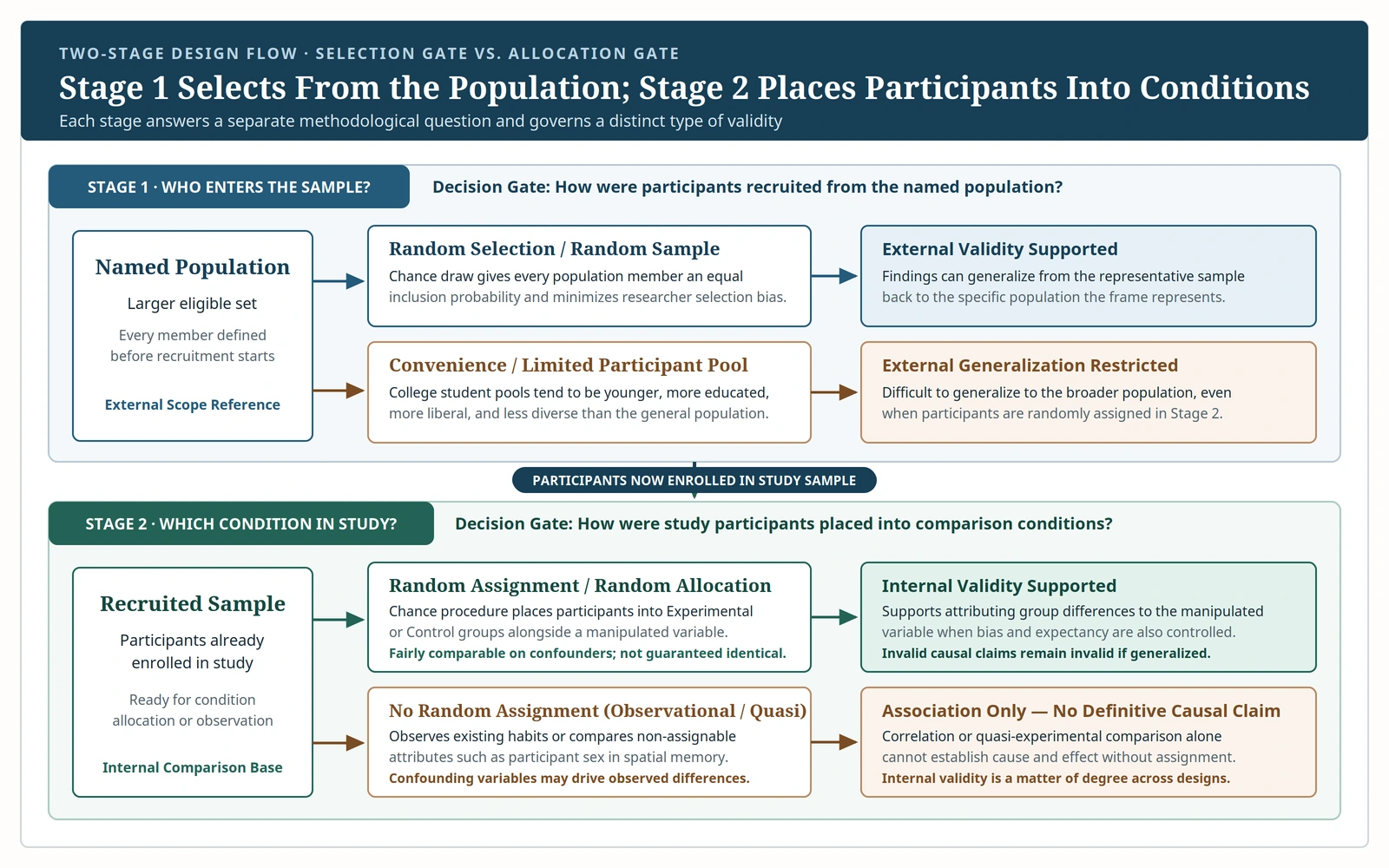 First-stage recruitment governs whether results generalize to the named population, whereas second-stage condition placement governs whether group differences support a causal comparison inside the study.
That operational split maps onto external validity versus internal validity:
- External validity and generalizability: External validity is the validity of applying the conclusions of a scientific study outside the context of that study—the extent to which results can generalize or transport to other situations, people, stimuli, and times. More specifically, generalizability refers to applying a predefined sample to a broader population, whereas transportability refers to applying one sample to another target population. As the APA Dictionary notes, if research has been conducted only with male participants, similar results cannot be assumed to apply to female participants. In our walkthrough on how to read a psychology study, a wrong sample undermines the conclusion whenever a psychology paper’s headline is repeated without naming the people who were analyzed.
- Internal validity and causal comparison: Internal validity pertains to the soundness of results obtained within the controlled conditions of a particular study, specifically the extent to which evidence supports cause-and-effect conclusions among variables. Internal validity is a matter of degree rather than an all-or-nothing label, and research designs other than true experiments may still yield high internal validity, though direct manipulation of an independent variable supports greater internal validity than observing an association without manipulation.
- How the two validities interact: Duke’s sta101.001 slide frames the evaluation as two separate checks—assess whether results can be generalized to the population based on whether random sampling was employed, and determine whether results suggest causation or association based on whether random assignment was employed. Sampling alone without manipulation leaves an observed correlation that does not necessarily imply cause and effect because a confounding variable may cause systematic movement in the variables of interest. Assignment alone does not create a random sample, as emphasized in our psychology research methods practice questions. Furthermore, a study’s external validity is limited by its internal validity: if a causal inference within a study is invalid, generalizing that causal inference to other contexts is also invalid.
Examples of Random Sampling vs Random Assignment Across Four Study Combinations
Crossing population selection with condition assignment produces four distinct study patterns, each with clear limits on what a student or researcher can claim:
- Both random sampling and random assignment (sampling first, assignment second): In OpenStax Psychology 2e section 2.3, if the population of interest is all algebra students in a particular city, the researcher first selects a random sample of around 200 algebra students—finding a group of about 200 that reflects the composition of that city—and then uses statistical software to randomly assign each algebra student in the sample to either the experimental group or the control group, generalizing findings to algebra students in that city. Duke’s sta101.001 slide gives a parallel two-step sequence: ideally, a researcher first randomly samples subjects so the sample is representative of the population, and second randomly assigns half of the sampled subjects to read text in a serif font and the other half to read text in a sans serif font. While the Duke slide concludes that representative sampling permits generalization to the population and random assignment makes font style the difference between groups so causality can be inferred, three methodological guardrails still apply: random assignment does not guarantee matched groups because chance preexisting differences remain possible even though systematic differences are unlikely in sufficiently large samples; OpenStax states that a causal statement rests on random selection, random assignment, and a design that limits the effects of both experimenter bias and participant expectancy, so the groups are similar in composition and treatment; and OpenStax says psychologists generally consider differences statistically significant if there is less than a five percent chance of observing them if the groups did not actually differ from one another.
- Random sampling without random assignment: If a researcher selects a random sample from a defined population and merely observes which font participants already read without imposing treatments or assigning groups, the study is observational. Under the Duke and OpenStax rules, the observed association can be generalized to that sampled population, yet correlation does not necessarily imply cause and effect because a confounding variable may be driving both variables.
- Random assignment without random sampling: Psychological experiments frequently recruit participants from college-student pools—who tend to be younger, more educated, more liberal, and less diverse than the general population—and then randomly assign those enrolled students into experimental and control groups. In a sufficiently large sample, random assignment still makes systematic baseline differences between the experimental and control groups unlikely so observed differences can be attributed to the manipulated independent variable within that study, yet chance assignment does not create a random sample and generalizing to the broader population remains difficult.
- Neither random sampling nor random assignment: When a study compares participant sex and spatial memory without random sampling and without the ability to control or assign a person’s sex, the comparison is quasi-experimental rather than a true experiment. Cause-and-effect claims cannot be made on that basis alone, and if participants come from that limited pool of research participants, it is difficult to generalize findings to the larger population.
How Does Random Sampling Differ from Systematic Sampling?
Introductory definitions that mention only equal selection probability for each individual can make systematic sampling look identical to simple random sampling, even though the two methods differ at the subset level. In one-dimensional systematic sampling, elements are chosen from an ordered sampling frame by selecting a starting element from the list at random and then selecting every kth element in the frame, where k is the sampling interval or skip. In the APA Dictionary entry updated on 04/19/2018, systematic sampling—also called quasirandom sampling and systematic random sampling—lists all members of a population and applies an orderly procedure, such as listing a population alphabetically and selecting every seventh case. Note that quasirandom sampling is a probability-sampling label and is distinct from quasi-experimental research, which lacks random assignment to experimental conditions.
Under systematic sampling with a random start, each individual element in the population has a known and equal probability of selection, making it an epsem method. However, systematic sampling is not the same as simple random sampling because different sets of units have different probabilities of being chosen: in a simple random sample every subset of k individuals has an equal chance of selection, whereas systematic sampling can never select a sample containing two adjacent elements on the list. Researchers using systematic sampling must also ensure the sampling interval does not match a hidden periodic pattern in the frame, which would threaten randomness. In Wikipedia’s street-list example, sampling every 10th household either returns only corner houses when starting at 1 or 10 or has no corner houses from any other starting point, leaving the sample unrepresentative either way.
Two-by-Two Study Design Record: Random Sampling vs Random Assignment
Use the four-cell record below when auditing a psychology methods section to separate population scope from internal causal comparison.
| Study Design Cell | Random Sampling From Named Population | Random Assignment to Study Conditions | Conclusion Supported (Within Design Controls) | Conclusion Not Supported |
|---|---|---|---|---|
| Representative randomized experiment | Yes: chance selection from defined population frame | Yes: chance allocation of sampled participants to manipulated vs control conditions | Supports generalizing results to that defined population and attributing group differences to the manipulated independent variable when the sample is sufficiently large, a design limits the effects of experimenter bias and participant expectancy so the groups are similar in composition and treatment, and psychologists consider a group difference statistically significant if there is less than a five percent chance of observing it if the groups did not actually differ from one another | Does not guarantee that the groups are matched or equivalent, because they may still differ on a preexisting attribute due to chance, and does not make one particular sample a perfect representation of the entire population |
| Representative observational study | Yes: chance selection from defined population frame | No: variables or exposures are merely observed without imposing treatments | Supports generalizing observed associations or correlations from the representative sample to that larger population | Cannot establish cause and effect because without random assignment and manipulation, confounding variables may explain systematic movement |
| Convenience-pool randomized experiment | No: limited pool such as college students | Yes: chance allocation of enrolled participants to experimental vs control conditions | Supports internal comparison attributing group differences to the manipulated independent variable within the studied group when bias and expectancy are controlled | Chance assignment does not create a random sample; college students tend to be younger, more educated, more liberal, and less diverse than the general population, and that limited pool makes findings difficult to generalize to the larger population |
| Non-random observational or quasi-experimental comparison | No: a limited pool of research participants rather than a random sample | No: an attribute such as participant sex cannot be manipulated or randomly assigned | Describes the sex and spatial-memory comparison OpenStax categorizes as quasi-experimental | Cannot support cause-and-effect claims in these circumstances, and relying on that limited pool makes it difficult to generalize findings to the larger population |
Sources
- Random assignment — Wikipedia — Overview of random placement into treatment and control groups, chance preexisting differences, and the distinction from random sampling.
- Simple random sample — Wikipedia — Subset-level equal-probability definition of simple random sampling, external validity scope, and equal probability sampling (epsem).
- Systematic sampling — Wikipedia — Ordered-frame skip-interval procedure, adjacent-element exclusion, and the corner-house periodicity example.
- Internal validity — Wikipedia — Cause-and-effect inference within a study, internal validity as a matter of degree, and contrast with external validity.
- External validity — Wikipedia — Applying study conclusions outside the study context, generalizability versus transportability, and dependence on internal validity.
- Quasi-experiment — Wikipedia — Comparison designs lacking random assignment to intervention and control conditions and their causal inference limits.
- How to control confounding effects by statistical analysis (PMCID: PMC4017459) — Design-stage confounding controls (Randomization, Restriction, and Matching; received 2012 Jan 1, accepted 2012 Feb 15).
- Random sampling vs. random assignment lecturette (PDF) — Duke University Fall12/sta101.001 — Course Fall12/sta101.001 decision framework for observational versus experimental studies, generalization, and font-group assignment.
- Rose M. Spielman, William J. Jenkins, and Marilyn D. Lovett, Psychology 2e, Section 2.3 Analyzing Findings, OpenStax, Houston, Texas, published Apr 22, 2020 (attribution only).
- American Psychological Association, APA Dictionary entries on random assignment, random sampling, random selection, experiment, internal validity, external validity, systematic sampling, and quasi-experimental research, updated on 04/19/2018 (attribution only).