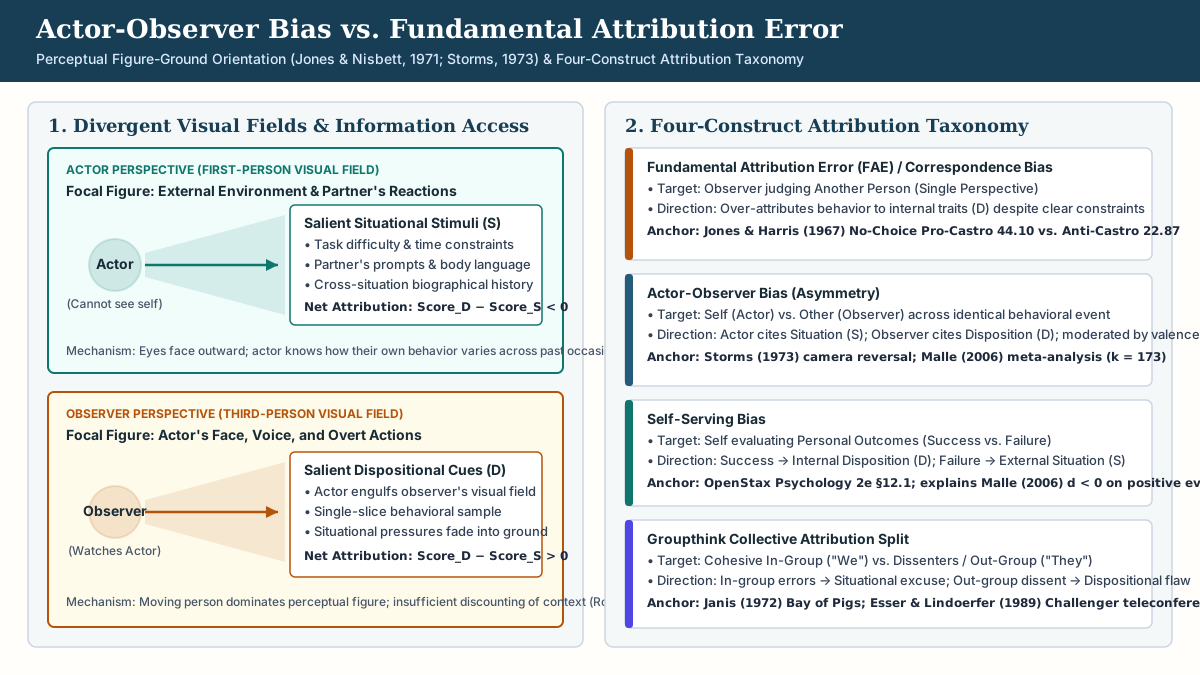
Treating actor-observer bias and the fundamental attribution error as interchangeable synonyms causes students to misclassify self-attributions and fail free-response case analyses. While the fundamental attribution error (correspondence bias) measures an observer’s failure to discount situational constraints when judging another person, actor-observer bias contrasts an actor’s situational explanation of their own behavior against an observer’s dispositional explanation of that same act.
In introductory social psychology courses—and across the Personality & Social study guide—students frequently encounter four overlapping attribution constructs: the fundamental attribution error (FAE), actor-observer bias, self-serving bias, and collective in-group/out-group attribution in groupthink examples. Distinguishing them requires tracking three structural variables before coding any scenario:
- Vantage Point (Who is explaining whom?): Is a third-party observer judging one target (FAE), are an actor and an observer explaining the exact same behavioral event from opposite sides (actor-observer bias), is an individual comparing their own success against their own failure (self-serving bias), or is a cohesive committee rationalizing its own decision while stereotyping dissenters (groupthink)?
- Causal Locus (
Situational vs Dispositional Attribution): Does the explanation locate the cause inside stable internal traits, temperament, and motives (dispositionism, taught alongside personality traits vs types) or inside immediate environmental pressures, role assignments, and task constraints (situationism)? - Event Valence (Negative vs. Positive Outcome): Is the behavior an error, delay, or socially undesirable act (where actors cite situational constraints and observers infer dispositional flaws), or is it an achievement (where self-serving bias flips the actor toward internal dispositional credit)?
| Attribution Construct | Perspective & Target | Causal Direction (Locus) | Primary Mechanism | Event Valence Sensitivity | Foundational Empirical Anchor | Dominant Classroom Failure Mode |
|---|---|---|---|---|---|---|
| Fundamental Attribution Error (FAE) / Correspondence Bias | Single perspective: Observer judging Another Person | Overestimates Dispositional (internal trait/attitude); underestimates Situational mandate | Perceptual figure-ground salience of the actor; anchor-and-insufficient-adjustment when discounting context | Occurs across both neutral/assigned stances and negative behaviors | Jones & Harris (1967) Castro essays (No-Choice gap = 21.23 pts); Ross et al. (1977) Quizmaster study |
Calling an actor’s explanation of their own behavior “fundamental attribution error” |
| Actor-Observer Bias (Asymmetry) | Dual perspective: Self (Actor) vs. Other (Observer) on the same behavior | Actor → Situational (external stimuli); Observer → Dispositional (internal traits) | Visual orientation (actor looks outward at environment; observer looks at actor) + longitudinal biographical history | Strong positive asymmetry (d > 0) on negative events; reverses (d < 0) on positive events |
Jones & Nisbett (1971); Storms (1973) camera reversal; Malle (2006) meta-analysis (k = 173) |
Ignoring event valence or assuming the actor always rejects dispositional credit even after a major success |
| Self-Serving Bias | Single actor evaluating Own Outcomes across Valence | Success → Dispositional (“I prepared well”); Failure → Situational (“The test was unfair”) | Self-esteem maintenance and self-presentation enhancement | Strictly driven by Success vs. Failure outcome valence | OpenStax Psychology 2e §12.1; accounts for the positive-event reversal in Malle (2006) | Labelling a student’s situational excuse for failing an exam “FAE” instead of self-serving / actor attribution |
| Groupthink Collective Attribution Split | Group boundary: Cohesive In-Group (“We”) vs. Out-Group / Dissenter (“They”) | In-Group errors → Situational rationalization; Out-Group dissent → Dispositional stereotyping | Janis (1972) Type II closed-mindedness: collective rationalization + out-group stereotyping + conformity pressure | Triggered under high group cohesion, directive leadership, and external threat | Janis (1972) Bay of Pigs; Esser & Lindoerfer (1989) Challenger launch teleconference | Treating groupthink solely as public line-task conformity (Asch) without coding how the group explains away dissenting warnings |
This guide pairs directly with our social psychology classroom case activities on conformity, compliance, and obedience, extending paper-case instruction from OpenStax Psychology 2e section 12.4 into the attribution frameworks of section 12.1.
How Do Actor-Observer Bias, Fundamental Attribution Error, and Self-Serving Bias Differ?
OpenStax Psychology 2e section 12.1 opens social psychology by contrasting dispositionism—the view that behavior is determined by internal factors such as personality traits, temperament, and genetics—with situationism, the perspective that immediate environmental surroundings, social roles, and institutional rules govern how people act. Every attribution error or bias represents a systematic skew in how human judges weigh dispositional versus situational causes.
1. Fundamental Attribution Error (FAE) and Correspondence Bias: The Observer’s Single-Sided Blind Spot
Coined by Lee Ross (1977) and rooted in Edward E. Jones and Victor A. Harris’s (1967) research on correspondence bias, the fundamental attribution error occurs when an observer explains another person’s behavior by overemphasizing internal dispositional traits while underestimating powerful situational forces. Notice that FAE requires only one vantage point: an observer watching or reading about another person.
In Ross, Amabile, and Steinmetz’s (1977) Quizmaster Study (summarized in OpenStax Psychology 2e section 12.1), student participants were randomly assigned by a public coin flip to play either the questioner (quizmaster) or the contestant, while neutral student observers watched the session:
- Situational manipulation: The quizmaster was instructed to write 10 esoteric, challenging general-knowledge questions drawn from their own unique hobbies, majors, or personal reading (where the quizmaster naturally knew the answers).
- Behavioral outcome: Contestants answered roughly 4 out of 10 questions correctly, struggling visibly on the remaining items.
- Attributional distortion: At the end of the game, both the contestants and the uninvolved observers rated the quizmasters as possessing significantly greater general knowledge than the contestants—failing to discount the obvious, randomly assigned situational advantage of writing one’s own questions.
2. Actor-Observer Bias: Two Divergent Vantage Points on the Same Act
Formulated by Jones and Nisbett (1971), actor-observer bias (also termed actor-observer asymmetry) expands the frame from a single observer to a two-sided comparison between the person performing the action (the actor) and the person watching it (the observer). When an actor and an observer explain the exact same behavioral episode—such as why a speaker stumbled over a presentation or why a customer argued with a cashier—their causal explanations diverge systematically through two mechanisms:
- Perceptual Salience (Visual Figure-Ground Orientation): An actor’s eyes face outward. While speaking or acting, the actor cannot see their own facial expressions, posture, or vocal nervousness; instead, the actor’s visual and attentional field is filled by environmental stimuli—the flickering projector, the clock on the wall, and the conversation partner’s frowns or interruptions. For the actor, the situation is the dynamic figure against a background of self. For the observer watching from across the room, the actor’s moving body and voice are the salient figure that engulfs the visual field, while situational constraints recede into the static background.
- Biographical / Informational Asymmetry: An actor possesses longitudinal data about their own behavior across hundreds of past situations and occasions. The actor knows whether snapping at a lab partner today is highly uncharacteristic (low consistency across time, high distinctiveness across partners). An observer who witnesses only a five-minute slice of behavior lacks that historical baseline and defaults to inferring a continuous dispositional trait.
3. Self-Serving Bias: How Event Valence Moderates Self-Attribution
Why does an actor sometimes claim internal, dispositional credit? OpenStax Psychology 2e section 12.1 defines self-serving bias as the tendency to make dispositional (internal) attributions for personal successes (“I aced the statistics exam because I am analytical and diligent”) and situational (external) attributions for personal failures (“I missed the cutoff because the exam room was freezing and the wording was ambiguous”).
Rule of thumb: If an exam question or classroom scenario describes only an observer inferring a trait from a constrained target’s behavior, code Fundamental Attribution Error. If the scenario contrasts how Person A explains their own behavior versus how Person B explains Person A’s behavior, code Actor-Observer Bias. If Person A alone flips from internal credit on a win to external blame on a loss, code Self-Serving Bias.
Takeaway: Track the perspective count and outcome valence first—one observer judging a target is FAE, an actor-versus-observer split on the same act is actor-observer bias, and a single actor splitting credit by win versus loss is self-serving bias.
What Do Jones & Harris (1967), Storms (1973), and Malle (2006) Measure?
To move beyond textbook definitions and evaluate primary empirical evidence—using the same verification habits practiced in how to read a psychology study—students should inspect the exact independent variables, rating scales, and quantitative scores of the three landmark studies that anchor attribution research.
1. Jones & Harris (1967): Quantifying Correspondence Bias Under Zero Choice
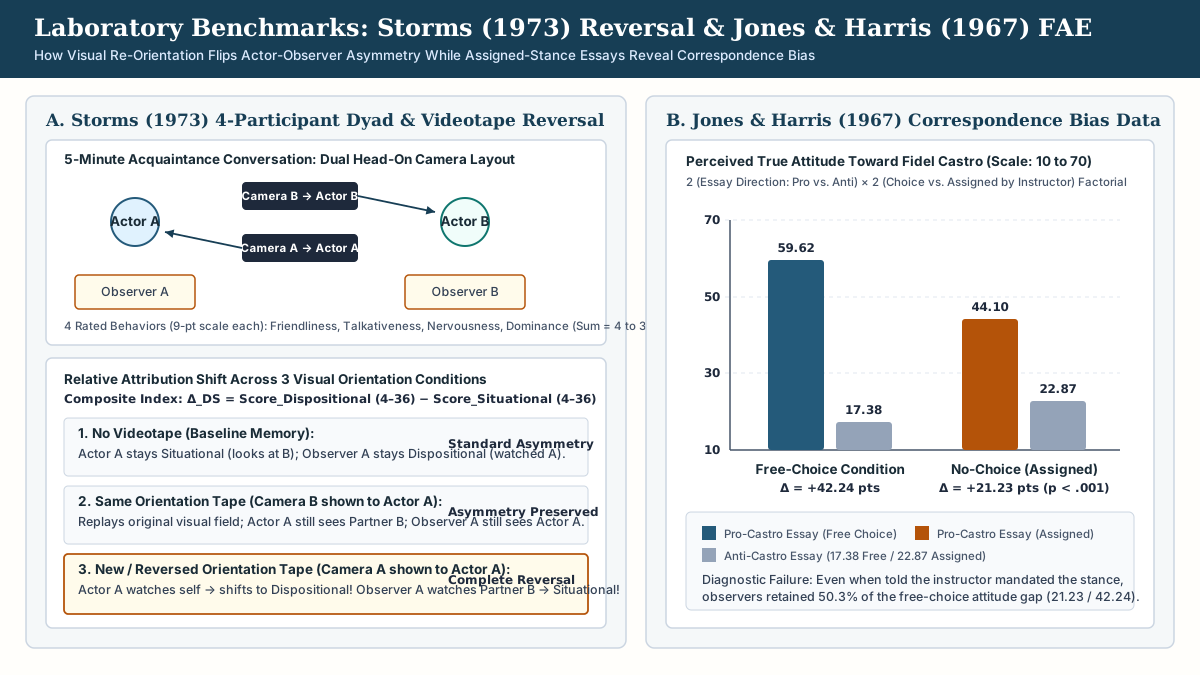
In Jones and Harris (1967, Experiment 1), undergraduate observers read a short political essay that either praised or criticized Cuban leader Fidel Castro. The experiment used a 2 (Essay Direction: Pro-Castro vs. Anti-Castro) × 2 (Choice Condition: Free Choice vs. No-Choice / Assigned) between-subjects factorial design:
- In the Free-Choice condition, observers were told the student writer freely selected which side of the debate to argue.
- In the No-Choice (Assigned) condition, observers were explicitly told that a political science instructor assigned the writer to defend either the Pro-Castro or Anti-Castro position regardless of personal belief.
- Operationalized Dependent Variable: Observers rated the writer’s true personal attitude toward Castro on a 10-item Likert composite ranging from 10 (extremely anti-Castro) to 70 (extremely pro-Castro).
Worked Example 1: Residual Correspondence Bias in Jones & Harris (1967)
Compare the mean perceived attitude scores across the four cells of Jones and Harris (1967, Experiment 1):
- Free-Choice Condition Gap:
Gap_Free = Mean_Pro_Free - Mean_Anti_Free = 59.62 - 17.38 = +42.24 scale points - No-Choice (Assigned) Condition Gap:
Gap_Assigned = Mean_Pro_Assigned - Mean_Anti_Assigned = 44.10 - 22.87 = +21.23 scale points (p < .001) - Residual Undiscounted Attribution Ratio:
Residual_Bias_Ratio = Gap_Assigned / Gap_Free = 21.23 / 42.24 = 0.5026 (50.3%)
Even when observers knew with 100% certainty that an authority figure dictated the writer’s stance, they failed to set the expected difference to zero—retaining 50.3% of the free-choice attitude gap (21.23 points on a 60-point span) and inferring that a student ordered to write a Pro-Castro essay genuinely favored Castro (44.10 vs. 22.87).
2. Storms (1973): Reversing Actor-Observer Bias with Videotape Camera Angles
If perceptual salience drives actor-observer bias, then physically rotating what the actor and observer see should reverse their causal attributions. Michael D. Storms (1973) tested this hypothesis in four-person laboratory sessions consisting of two conversing Actors (Actor A and Actor B) engaged in a 5-minute unstructured getting-acquainted conversation and two silent Observers (Observer A watching Actor A; Observer B watching Actor B).
Two video cameras recorded the dyad head-on: Camera A pointed directly at Actor A’s face, and Camera B pointed directly at Actor B’s face. Before completing attribution questionnaires, participants were placed into one of three visual orientation conditions:
- No-Videotape Control: Participants rated the causes of Actor A’s (or Actor B’s) behavior from memory immediately after the conversation.
- Same-Orientation Videotape: Participants watched a videotape that duplicated their original visual field (Actor A watched Camera B’s tape of Actor B; Observer A watched Camera A’s tape of Actor A).
- New / Reversed-Orientation Videotape: Participants watched the opposite camera angle (Actor A watched Camera A’s tape of themselves speaking; Observer A watched Camera B’s tape of the conversation partner Actor B).
To operationalize attribution (a great model for our psychology variables and operational definitions worksheet), Storms asked participants to rate four specific behaviors—friendliness, talkativeness, nervousness, and dominance—on two separate 9-point scales (1 = not at all important to 9 = extremely important):
- Dispositional Score (
Score_Dispositional): Importance of internal personal characteristics (personality, character, personal style, mood), summed across the 4 behaviors for a composite range of 4 to 36. - Situational Score (
Score_Situational): Importance of external environmental factors (conversation partner’s behavior, experimental setting, discussion topic), summed across the 4 behaviors for a composite range of 4 to 36. - Net Relative Attribution Index (
Delta_DS):Delta_DS = Score_Dispositional - Score_Situational(ranging from-32purely situational to+32purely dispositional).
In both the No-Videotape and Same-Orientation conditions, Storms replicated the classic Jones and Nisbett (1971) asymmetry: observers produced significantly higher net dispositional scores (Delta_DS) than actors. In the New / Reversed-Orientation condition, the effect reversed completely:
- Actors who watched themselves on Camera A shifted sharply toward dispositional self-attributions (seeing their own facial expressions and mannerisms as the salient visual figure).
- Observers who watched the conversation partner on Camera B shifted sharply toward situational attributions for the target actor (seeing the partner’s prompts and reactions as the salient driver of the target’s behavior).
3. Malle (2006): Meta-Analytic Boundary Conditions and Valence Asymmetry
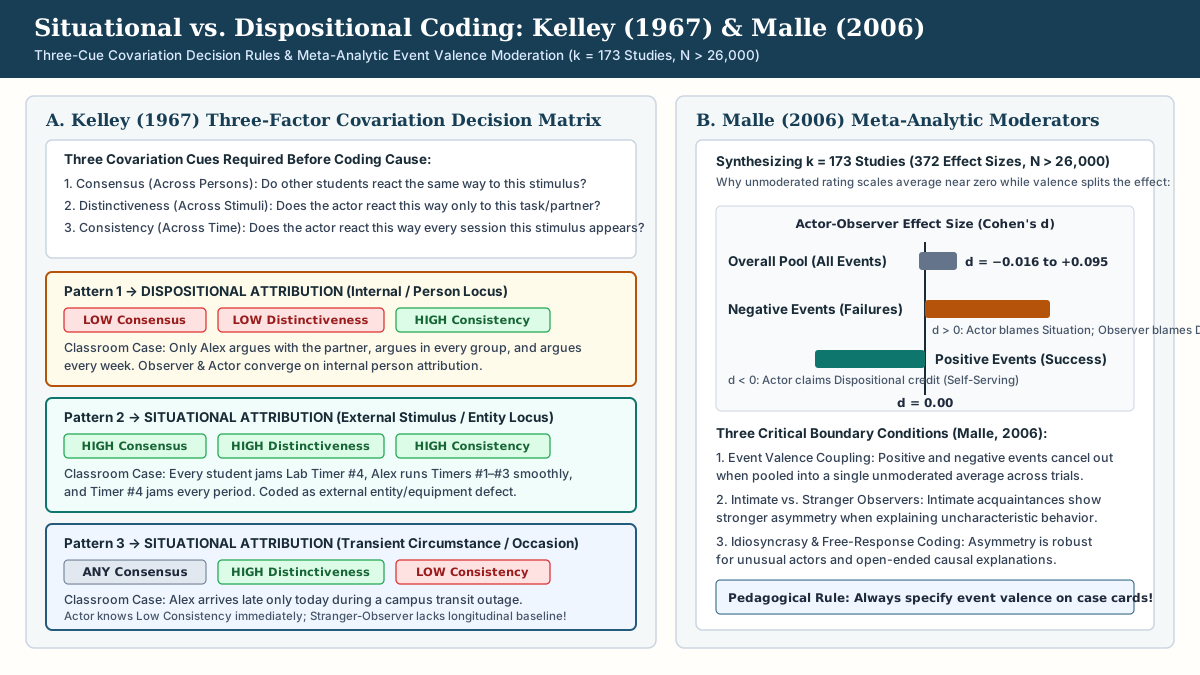
For three decades, textbooks presented the actor-observer bias as a universal main effect across all human behavior. In 2006, Bertram F. Malle published a comprehensive meta-analysis in Psychological Bulletin synthesizing k = 173 published studies (372 effect sizes, total N > 26,000 participants). Malle uncovered a critical boundary condition that every instructor and student must account for:
- Unmoderated Overall Effect Is Near Zero: When positive, neutral, and negative behaviors are pooled together without moderation, the average standardized effect size ranges from
d = -0.016tod = +0.095—statistically indistinguishable from zero across standard rating scales. - Moderator 1 — Event Valence (
Negative vs. Positive): When events are separated by valence, negative events (errors, social awkwardness, failures, rule violations) yield a robust positive actor-observer asymmetry (d > 0): actors blame the situation while observers blame the actor’s disposition. Conversely, positive events (achievements, helpful acts, skilful performance) produce a reverse asymmetry (d < 0): actors claim internal dispositional credit while observers attribute more to situational help—aligning directly with self-serving bias. - Moderator 2 — Intimacy with the Actor: Contrary to the simple assumption that only strangers commit observer bias due to a lack of information, Malle found that actor-observer asymmetry is often stronger when the observer is an intimate acquaintance (friend, spouse, or family member) than a stranger, especially when explaining uncharacteristic negative behavior.
- Moderator 3 — Actor Idiosyncrasy and Free-Response Coding: Asymmetry emerges reliably when the target actor is portrayed as highly idiosyncratic or unusual, and when researchers code open-ended free-response explanations (how people naturally narrate reasons versus causal histories) rather than rigid Likert rating scales.
Takeaway: Jones & Harris (1967) prove observers fail to discount assigned roles (44.10 vs. 22.87), Storms (1973) proves visual camera reversal flips actor and observer scores, and Malle (2006) proves the classic asymmetry holds specifically for negative or idiosyncratic events while reversing on positive achievements.
How Do You Code Situational vs Dispositional Attribution Using Kelley’s Covariation Model?
When students analyze a behavioral vignette—or when an observer has access to multiple observations over time—how should they determine whether a situational vs dispositional attribution is logically warranted? Harold H. Kelley’s (1967) Covariation Model provides the normative three-factor decision matrix used across social psychology.
Kelley proposed that an intuitive scientist evaluates how behavior covaries across three informational dimensions:
- Consensus (Across People): Do other people behave the same way toward this specific stimulus or situation? (High consensus = almost everyone reacts this way; Low consensus = only this actor reacts this way.)
- Distinctiveness (Across Stimuli / Entities): Does the actor behave this way only toward this specific stimulus, or across many different stimuli? (High distinctiveness = happens only with this specific task/partner; Low distinctiveness = actor behaves this way across nearly all tasks/partners.)
- Consistency (Across Time / Occasions): Does the actor behave this way toward this stimulus every time they encounter it across occasions? (High consistency = occurs reliably every session; Low consistency = happened only on this single occasion.)
| Consensus (Others?) | Distinctiveness (Only This Stimulus?) | Consistency (Every Time?) | Warranted Attribution (Situational vs Dispositional) |
Specific Causal Locus | Classroom Scenario Example & Actor-Observer Link |
|---|---|---|---|---|---|
| Low (Nobody else does this) | Low (Actor acts this way in all classes) | High (Actor acts this way every week) | Dispositional Attribution | Internal / Person (stable trait, habit, or temperament) | Only Jordan interrupts the lab partner, Jordan interrupts in every course, and Jordan does so every week → Both Actor and Observer converge on Dispositional. |
| High (Every student does this) | High (Happens only on Apparatus #4) | High (Happens every time Apparatus #4 is used) | Situational Attribution | External Stimulus / Entity (task difficulty, defective tool, instructor rule) | Every lab group stalls on Apparatus #4, Jordan finishes Apparatus #1–#3 quickly, and Apparatus #4 jams every period → Warranted Situational (Stimulus) attribution. |
| Low or High | High (Unusual for this actor across tasks) | Low (Happened only today, never before) | Situational Attribution | Transient Circumstance / Occasion (one-time distraction, illness, transit delay) | Jordan arrives 12 minutes late to lab only today after a campus shuttle breakdown → Actor knows Low Consistency immediately; a first-time Observer lacks the consistency history and commits FAE! |
Why Biographical Asymmetry Triggers Divergent Kelley Coding
Kelley’s matrix explains why actor-observer bias arises even when both parties are trying to be fair:
- The Actor has longitudinal access to Distinctiveness and Consistency: When Jordan snaps at a teammate during a timed lab exam, Jordan knows internally: “I never snap at teammates in other classes (High Distinctiveness), and I have never snapped at this partner in previous weeks (Low Consistency)—I am only reacting this way because the lab timer broke five minutes ago.”
- The Unacquainted Observer sees only a single behavioral slice: Watching Jordan snap once, a first-time observer sees that other students in the room are quiet (Low Consensus) and unconsciously assumes High Consistency and Low Distinctiveness—defaulting to a dispositional attribution (“Jordan is hostile and uncooperative”).
To avoid conflating a single observed correlation with an internal causal trait, students can pair Kelley’s three cues with our correlation vs. causation headline rewrite activity.
Takeaway: Code Dispositional only when Low Consensus, Low Distinctiveness, and High Consistency all hold; when Distinctiveness is High or Consistency is Low, the warranted attribution is Situational.
How Do Groupthink Examples Amplify Actor-Observer Attribution Asymmetry?
How does an individual cognitive distortion scale into institutional failure? In OpenStax Psychology 2e section 12.4, groupthink (Irving Janis, 1972) is defined as the modification of the opinions of members of a cohesive group to align with what they believe is the group consensus. When we examine Janis’s eight symptoms of groupthink—specifically his Type II Closed-Mindedness symptoms (Collective Rationalization and Stereotyped Views of Out-Groups)—we see that groupthink examples operate as a collective actor-observer bias machine:
- The In-Group as Collective Actor (Situational Self-Rationalization): When the cohesive in-group encounters warning signs, intelligence failures, or technical defects in its own plan, members act as a protective collective actor. They discount the problem via situational attributions—blaming temporary operational friction, scheduling pressures, or unrepeatable environmental anomalies.
- The In-Group as Harsh Observer Toward Out-Groups and Dissenters (Dispositional Stereotyping): When an external adversary acts—or when an internal dissenter raises an evidence-based objection—the in-group switches to a rigid observer stance. It attributes the dissenter’s warning or the out-group’s behavior to fixed dispositional flaws (cowardice, disloyalty, bureaucratic pessimism, or inherent incompetence), neutralizing the warning before it can alter the consensus.
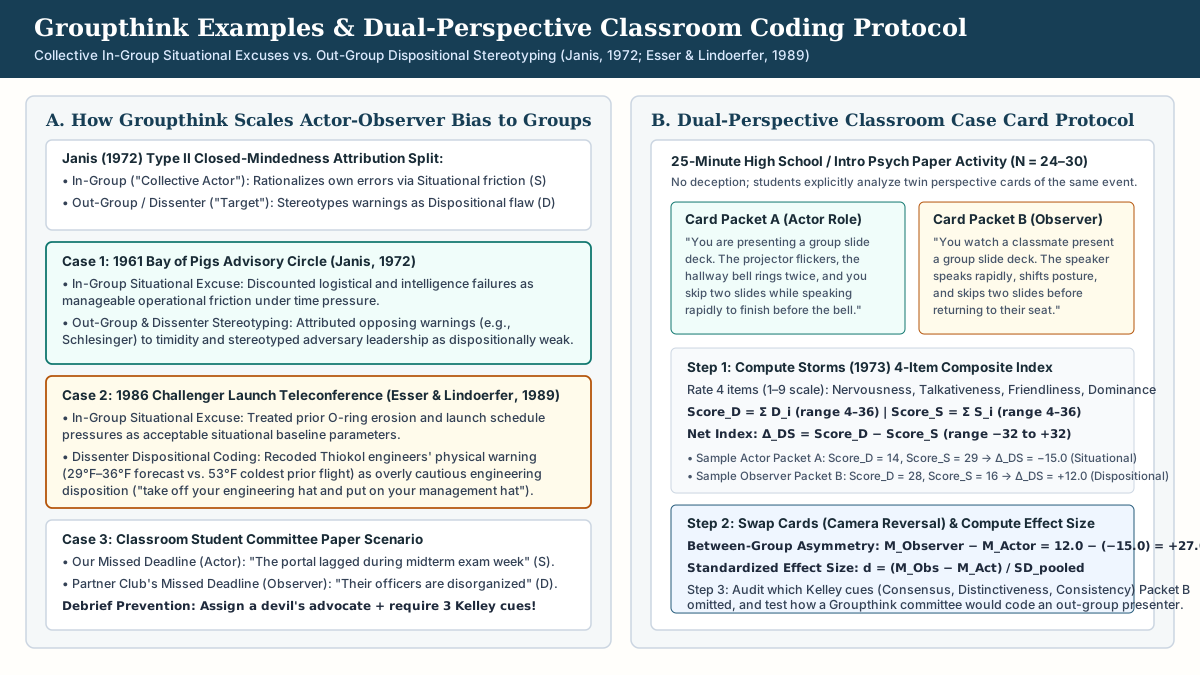
| Groupthink Case Study | Cohesive In-Group & Structural Antecedents | In-Group “Collective Actor” Situational Rationalization | Out-Group / Dissenter “Observer” Dispositional Stereotyping | Documented Corrective / Prevention Mechanism (OpenStax §12.4) |
|---|---|---|---|---|
| 1961 Bay of Pigs Invasion Advisory Circle (Janis, 1972) | Kennedy administration policy circle; high esprit de corps, insulation from field intelligence chiefs, directive framing | Discounted severe logistical obstacles (e.g., the 80-mile Swamp of Zapata escape gap and conspicuous air-strike footprints) as manageable situational friction | Stereotyped Fidel Castro’s military and Cuban public support as dispositionally weak and ready to collapse; treated internal dissenters (e.g., Arthur Schlesinger Jr.) as overly timid | Bring in outside domain experts; require the leader to withhold their preferred stance until all members speak |
| 1986 Space Shuttle Challenger Launch Teleconference (Esser & Lindoerfer, 1989) | NASA Marshall Space Flight Center managers & Morton Thiokol executives on the eve of launch (27 Jan 1986) under acute schedule pressure |
Rationalized prior solid rocket booster O-ring erosion and blow-by on warmer flights as an acceptable situational baseline rather than a disqualifying flaw | Recoded Thiokol engineer Roger Boisjoly’s physical-temperature warning (29°F–36°F ambient launch forecast vs. 53°F coldest prior flight) as overly cautious engineering disposition (“take off your engineering hat and put on your management hat”) |
Assign a formal devil’s advocate; hold a private vote; require quantitative proof of safety across full temperature bounds |
| Campus Event Committee Paper Case (Classroom Simulation) | 6-member student council committee planning a school-wide symposium under midterm exam deadlines | Attributes its own missed room-reservation deadline to situational overload (“the campus portal lagged and midterms were packed”) | Attributes a partner club’s missed media deadline—or a dissenting member’s budget warning—to dispositional traits (“they are disorganized and don’t care about the event”) | Apply Kelley’s 3-cue check to both groups equally before voting on sanctions |
Quantitative Case Analysis: Esser & Lindoerfer (1989) on the Challenger Teleconference
In their quantitative content analysis of the Presidential Commission transcripts of the January 27, 1986 Space Shuttle Challenger teleconference, James K. Esser and Joanne S. Lindoerfer (1989) coded every statement indicating the presence or absence of Janis’s groupthink antecedents and symptoms during the final hours before launch:
- The physical engineering constraint was purely situational: ambient launch-pad temperatures were forecast at
29°F to 36°F(-1.7°C to +2.2°C), whereas the coldest previous flight with O-ring distress had occurred at53°F(11.7°C)—leaving a17°F to 24°Funvalidated thermal gap where rubber O-ring resiliency failed to seal the solid rocket booster field joint. - Rather than treating the
29°F vs. 53°Fthermal gap as an external physical-entity constraint (High Consensus, High Consistency under Kelley’s model), management reframed the engineers’ no-launch recommendation as a dispositional bias of engineers (conservatism and unwillingness to support the schedule), pressuring Morton Thiokol’s senior vice president to reverse the engineering veto.
Takeaway: In groupthink examples, the in-group grants itself situational leniency while weaponizing the fundamental attribution error against dissenters and out-groups.
How to Run the Dual-Perspective Scenario Card Activity in Class
Instructors can demonstrate actor-observer bias, situational vs dispositional attribution, and groupthink examples in a single 25-minute high school or introductory college activity without using deception or singling out real students. Just like the counterbalanced designs in our three-condition order audit and our research methods practice questions, this paper-case protocol uses randomized perspective packets and transparent arithmetic.
Step 1: Distribute Counterbalanced Perspective Packets (8 Minutes)
Divide a class of N = 24 to 30 students into two equal groups (n = 12 per group). Announce upfront that the scenario is fictional and that both halves of the room are reading about the same five-minute classroom presentation from different vantage points:
- Packet A — First-Person Actor Card (
n = 12):“Imagine you are Taylor, presenting a 5-minute group project slide deck. Thirty seconds after you start, the classroom projector begins flickering on and off. Two classmates in the front row whisper loudly while checking their phones, and the hallway bell rings twice due to a schedule test. To finish before the period ends, you speak rapidly, skip two middle slides, and sit down without taking questions.”
- Packet B — Third-Person Observer Card (
n = 12):“Imagine you are an observer seated at the back of the room watching Taylor present a 5-minute group project slide deck. During the presentation, Taylor speaks very rapidly, shifts weight nervously from foot to foot, skips two middle slides without explanation, and sits down abruptly without taking questions.”
Step 2: Score the Storms (1973) 4-Behavior Attribution Rubric (7 Minutes)
Every student rates the importance of Dispositional Causes (Taylor’s personality, preparation habits, composure, and speaking style) and Situational Causes (equipment behavior, room distractions, time pressure, and audience reactions) across four behavioral dimensions on a 1 (not at all important) to 9 (extremely important) scale:
- Speaking Speed / Talkativeness (
D_1: 1–9,S_1: 1–9) - Visible Nervousness / Posture (
D_2: 1–9,S_2: 1–9) - Slide Pacing / Dominance of Floor (
D_3: 1–9,S_3: 1–9) - Audience Engagement / Friendliness (
D_4: 1–9,S_4: 1–9)
Worked Example 2: Computing Net Attribution Index (Delta_DS) and Class Effect Size (d)
Students sum their four Dispositional ratings (Score_Dispositional, range 4 to 36) and their four Situational ratings (Score_Situational, range 4 to 36), then compute their Net Relative Attribution Index (Delta_DS):
-
Formula 1 — Individual Net Relative Attribution Index:
Delta_DS = Score_Dispositional - Score_Situational- Sample Student in Packet A (Actor Role):
Score_Dispositional = 3 + 4 + 4 + 3 = 14Score_Situational = 8 + 7 + 8 + 6 = 29Delta_DS (Actor) = 14 - 29 = -15.0 points(Negative sign = predominantly Situational attribution) - Sample Student in Packet B (Observer Role):
Score_Dispositional = 7 + 8 + 7 + 6 = 28Score_Situational = 4 + 4 + 4 + 4 = 16Delta_DS (Observer) = 28 - 16 = +12.0 points(Positive sign = predominantly Dispositional attribution)
- Sample Student in Packet A (Actor Role):
-
Formula 2 — Class-Wide Actor-Observer Asymmetry & Standardized Effect Size (
Cohen's d): Suppose acrossn = 12Actor cards the class mean isM_Actor = -13.50(SD_Actor = 6.20), and acrossn = 12Observer cards the class mean isM_Observer = +10.50(SD_Observer = 5.80):- Raw Attribution Asymmetry Spread:
Diff_AO = M_Observer - M_Actor = 10.50 - (-13.50) = +24.00 scale points - Pooled Standard Deviation (
SD_pooledfor equaln):SD_pooled = sqrt((6.20^2 + 5.80^2) / 2) = sqrt((38.44 + 33.64) / 2) = sqrt(36.04) = 6.003 - Standardized Effect Size (
Cohen's d):d = (M_Observer - M_Actor) / SD_pooled = 24.00 / 6.003 = +4.00
- Raw Attribution Asymmetry Spread:
Step 3: Camera-Reversal Swap and Groupthink Extension (10 Minutes)
- Perspective Reversal (Storms 1973 Replication): Have Packet A and Packet B partners swap cards so Observers read the projector/bell details and Actors see how their outward behavior looked from the back row. Have students re-score
Delta_DSand verify thatDiff_AOcollapses toward zero or reverses. - Valence Flip Check (Malle 2006 Replication): Ask both groups how their
Score_DispositionalandScore_Situationalratings would change if Taylor’s rapid delivery won “Best Presentation of the Semester” (positive event valence → actors shift toward dispositional credit via self-serving bias). - Groupthink Committee Debrief (Janis 1972): Ask how a cohesive 5-student grading panel would code Taylor’s skipped slides if Taylor belonged to a rival debate team (out-group dispositional stereotyping) versus their own team (in-group situational rationalization), and require the class to list which Kelley (1967) covariation cues (Consensus, Distinctiveness, Consistency) Packet B lacked.
Takeaway: Having half the class score an Actor card (Delta_DS < 0) and half score an Observer card (Delta_DS > 0), then swapping cards, turns Storms (1973), Kelley (1967), and Malle (2006) into a transparent 25-minute classroom calculation.