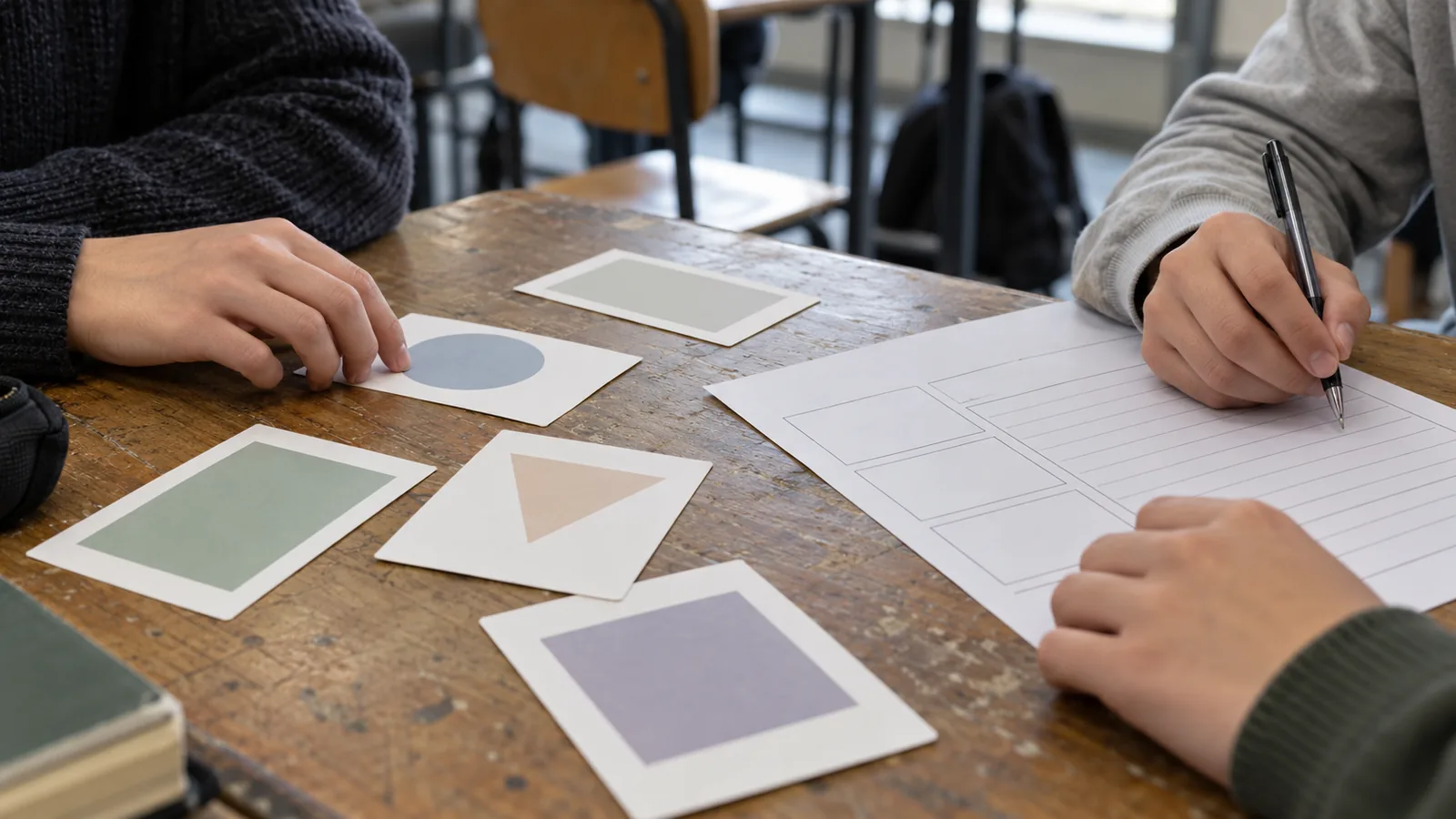
Calling every shared answer “peer pressure” can produce a wrong explanation of what the evidence shows. These social psychology classroom activities for high school use openly fictional paper cases to separate an observation, a possible explanation, and missing information.
Use the cards for a discussion of conformity, social influence, requests, and authority without deceiving classmates or observing strangers. Students work from invented statements, compare alternative explanations, and finish with a bounded conclusion. The contribution is a reusable evidence worksheet and teacher reasoning notes, not a new list of experiments to perform or a tested claim about classroom outcomes.
- Announce that every case is fictional.
- Keep evidence and explanation in separate columns.
- Explain which missing detail would change the judgment.
- Finish without labeling or testing a real person.
Tables scroll sideways on narrow screens.
How should a teacher introduce the paper cases?
Introduce the activity as analysis of invented evidence, not as a covert test of the class. Give learners the cards and the blank worksheet, then ask them to justify an interpretation using a detail from the text. This proposed discussion routine has not been evaluated for teaching effectiveness.
Read this introduction aloud if useful: “These characters and events are invented. We are comparing explanations, not judging classmates. You may answer from the card alone; no personal experience is needed.” Students may work privately, compare written answers, or examine a teacher’s model. Do not create a planted majority, arrange false answers, or hide an observational purpose.
No stage asks students to carry out a real social-influence experiment. At a glance: Paper cases, not reenactments · Read a fictional card · Underline stated evidence · Compare explanations · Write a limited conclusion.
OpenStax’s social-influence chapter provides the concept distinctions. The research-methods practice packet supplies a companion exercise on what a design permits someone to conclude.
Takeaway: Establish the fictional status and the evidence task before discussing any character’s explanation.
What evidence appears in the original scenario cards?
Each card supplies a limited observation and a small amount of contextual information. Read only what is provided. Statements attributed to characters are part of the fictional evidence; they are not independently verified measurements of a motive. Similar-looking actions can fit different explanations.
Card A — Agreement with a private disagreement
In an invented student planning group, Jules initially favors a quiet exhibition. After the other characters favor a music event, Jules publicly supports that option. A fictional private note says: “I still prefer the exhibition, but I don’t want to be the person who breaks the group’s agreement.”
Prompt: Which detail supports considering acceptance by the group? What would remain ambiguous if the private note were removed?
Do not enact: Do not ask actual students to take sides so a classmate can be pressured to change an answer.
Card B — Agreement under uncertainty
In an invented club, Noor is unsure which submission category fits a project. Other characters recommend a category after saying they have read the organizer’s instructions. Noor selects that category and writes: “I followed their recommendation because I thought they understood the rules.”
Prompt: Which detail supports considering reliance on others’ information? What alternative explanation would fit the same selection if the note were absent?
Card C — The same action, different relationship
A fictional team member asks Sam to stack the rehearsal chairs. Sam does so. In a separate version, the fictional rehearsal supervisor gives Sam an instruction to stack the same chairs. Sam does so again. No reason for either action is provided.
Prompt: What changes between a peer’s request and an instruction from someone acting in an authority role? What cannot be inferred from the chair-stacking action alone?
Card D — A before-and-after headline
An invented school bulletin says: “After a new group discussion format began, more submitted plans used the group’s preferred theme.” It describes no comparison group, allocation procedure, or other changes. The editor proposes the headline: “Group discussion caused students to agree.”
Prompt: Identify the observation, the causal claim, and a missing design detail. Could changed instructions, different participants, or a new submission rule also fit the description?

Illustrative photo — generated editorial image, not a real classroom study, participant or result.
The notes provide different stated reasons; matching a group’s answer alone would not establish either reason. At a glance: Two routes to agreement · Card A · Fit in with the group · Card B · Rely on group information · Agreement · Agreement alone is insufficient.
For another kind of limited record, the memory demonstration example separates task responses from ability claims. The developmental presentation matrix shows how to turn a similar evidence boundary into a presentation question.
Takeaway: Underline the decisive detail and identify what becomes uncertain if it disappears.
How should students separate evidence from explanation?
Put the observation in the first column, a candidate explanation in the second, and an alternative plus missing information in the remaining columns. A definition can help name an explanation, but does not make it proven. OpenStax’s analysis-of-findings section provides the correlation and causation distinction behind Card D.
| Case | Stated observation | Candidate explanation | Alternative explanation | Missing information | Bounded conclusion |
|---|---|---|---|---|---|
| A | ______ | ______ | ______ | ______ | ______ |
| B | ______ | ______ | ______ | ______ | ______ |
| C | ______ | ______ | ______ | ______ | ______ |
| D | ______ | ______ | ______ | ______ | ______ |
A useful sentence pattern is: “The card states ____. That is consistent with ____ because ____. It does not establish ____; we would need ____ to distinguish the explanations.” This is an editorial writing aid, not a scientific scale.
The research-methods causal-inference question gives another example of an alternative influence. If learners want to design a presentation around the case, use the bounded-question planning template to keep the task narrow.
Common mistake: Writing a motive in the observation column. “Jules agreed publicly” is a stated action; “Jules has a conformist personality” adds a trait the card never measured.
Takeaway: Preserve the distinction between what the case reports and what an analyst proposes.
What belongs in the teacher answer notes?
Model a defensible explanation and its limit rather than giving a psychological label as the entire answer. The notes below apply the cited textbook concepts to original fiction. They are not a validated rubric, a participant assessment, or evidence that only one explanation is possible.
| Case | Reasoned teacher note | Alternative to retain | Missing information to discuss | Conclusion to avoid |
|---|---|---|---|---|
| A | The invented private note makes a normative influence explanation plausible: public agreement is linked to wanting group acceptance. | If the note were removed, a judgment changed during discussion could fit the action; the initial exhibition preference still remains part of the card. | What reasons would be available without the note? With the note, its statement favors acceptance as an explanation but is not an independent measure of motive. | “Jules always follows crowds.” |
| B | Uncertainty and reliance on supposedly informed peers make informational influence plausible. | If the note were removed, independent reading could explain the same choice. In the full card it is only an unverified possible shared influence, not a reason to discard the stated explanation. | Did the peers actually read the relevant rule, and did the rule support their recommendation? Their claimed knowledge does not establish correctness. | “The group must have been correct.” |
| C | A peer request and an authority’s instruction distinguish the relationships relevant to compliance and obedience; authority figures can also make requests. | Cooperation, convenience, or an existing plan could also explain chair stacking. | Was the action taken because of the request or instruction, or had Sam already planned it? The card supplies no verified motive. | “Sam obeyed because of fear.” |
| D | The bulletin reports that the number of submitted plans using the theme increased. It neither isolates a cause nor measures private agreement. | Instructions, participants, or submission rules may also have changed. | What were the total submission counts and counting rules? Was there a comparable contemporaneous comparison and allocation process? How was agreement defined and measured? | “The format caused agreement” or “the proportion agreeing increased.” |
Card C keeps the action constant while the described relationship changes; it contains no verified motive. At a glance: Same action, different relationship · Peer request · Authority instruction · Stacking chairs · Motive not measured.
For Card D, a bounded sentence is: “The fictional bulletin reports more plans using the theme after the format changed; it does not establish the proportion, private agreement, motive, or cause.” The questions in the missing-information column are paper-analysis prompts, not instructions to run a student experiment.
Ask which words in a student’s answer are supported by the card. Replace “proves” with a task-specific explanation when the evidence only makes an interpretation plausible. Do not replace every conclusion with a vague “anything is possible”: some details do favor a particular interpretation, and the student should explain which.
The memory observation worksheet uses the same discipline for measured responses. A task-specific count and a case-specific statement both need boundaries before they are generalized.
Takeaway: A teacher explanation should identify the supporting detail, an alternative, and the claim that goes beyond the evidence.
How should the discussion end?
Close with a rewritten conclusion rather than a vote about which fictional character behaved best. Ask each learner to produce a supported statement, a remaining question, and a reason a stronger claim would need more evidence. This turns the paper worksheet into a visible reasoning product.
Illustrative photo — generated editorial image, not a real classroom study, participant or result.
Original discussion-close checklist; it does not score personality or social behavior. At a glance: Close the discussion · Supported statement · Alternative explanation · Missing detail · Claim removed.
Use this closing record:
| Check | My sentence |
|---|---|
| The case explicitly states | ______ |
| The strongest explanation and its supporting detail | ______ |
| Another explanation still worth considering | ______ |
| The missing information that would matter | ______ |
| A claim I removed because it went too far | ______ |
Common mistake: Treating the closing discussion as permission to reenact the case next lesson. A paper analysis and research involving people are different activities.
Browse Study Guides for related teaching resources and Research Methods for study-design and evidence interpretation, or use the research-methods answer explanations for additional practice rejecting unsupported options.
Takeaway: End with a better evidence sentence, not a character judgment or a proposed covert experiment.
When this does not apply
The cases do not justify deception, staged public mistakes, obedience reenactments, observations of strangers, or psychological profiles of students. They do not supply evidence of classroom effectiveness or replace an institution’s requirements for research involving people. Learners need not disclose personal experiences of pressure or authority.
OpenStax’s ethics section describes safeguards relevant to actual research. Read the site’s independent educational identity when distinguishing these newly written materials from former domain contributors’ work or official school resources.
Takeaway: Keep the activity on paper and reserve claims about people for appropriate evidence and processes.
Method and sources
The characters, scenario cards, worksheet and teacher notes are original to this page; the photos are generated illustrations. The concepts were checked against OpenStax Psychology 2e, sections 12.4, 2.3, and 2.4, accessed October 8, 2026. No APA/TOPSS lesson text or historical site lesson is reproduced. The material has not been classroom tested and reports no actual student results.
Takeaway: Use the textbook as the concept source and identify this page’s cases as newly written fiction.
Related reading
- Research-methods questions — Practice design details and causal limits through explained options.
- Memory demonstration cards — Keep measurement records separate from explanations about ability.
- Developmental presentation topics — Build a short presentation around a source and an explicit inference boundary.
Takeaway: Continue with the resource that matches the reasoning task the discussion revealed.