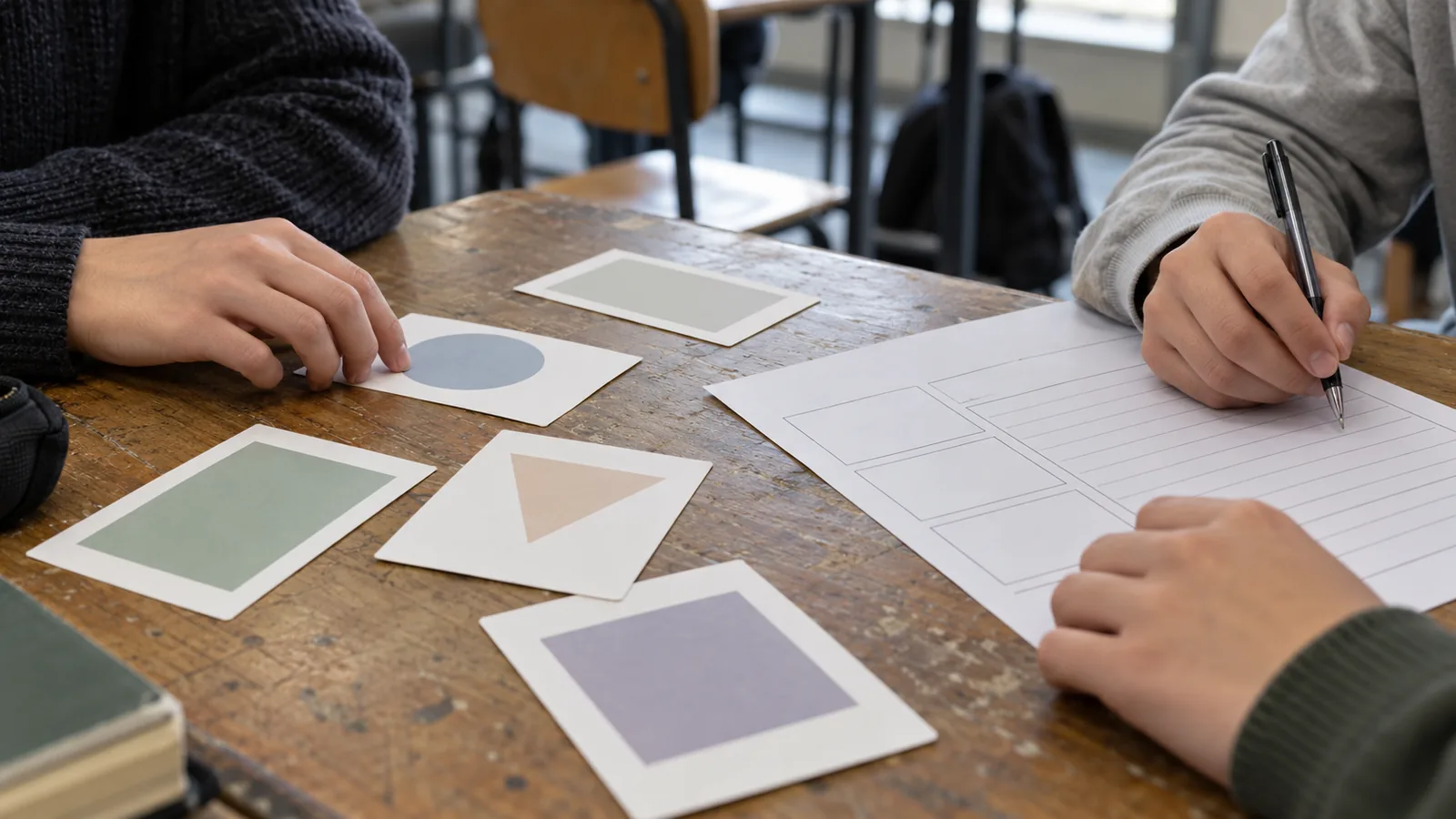
A topic as broad as “child development” can waste a short presentation on a theme with no answerable question. Choose a bounded developmental psychology presentation topic by pairing one concept with a comparison, a readable source, and a conclusion the evidence cannot support.
The matrix below offers a small set of nonclinical questions for an introductory presentation. Each question has a textbook route, a comparison axis, an outline cue, and an inference boundary. Use it to prepare your own explanation rather than a finished assignment. A theory illustration is not a test of a child, a diagnostic tool, or proof that a developmental stage applies uniformly to everyone.
- Keep one question in the title.
- Read the relevant textbook subsection before drafting slides.
- Separate a theory illustration from empirical evidence.
- Include a boundary in the main argument.
Tables scroll sideways on narrow screens.
Which bounded presentation questions can you choose?
Choose the question whose source and contrast you can explain within your assignment’s scope. Do not choose by an assumed “best” theory or by the number of slides it could fill. These proposed topics use OpenStax’s lifespan-theories section as the starting source, not as proof of every theory it describes.
| Bounded question | Textbook route within section 9.2 | Comparison axis | Outline cue | Do not infer |
|---|---|---|---|---|
| How do assimilation and accommodation differ in Piaget’s account? | Cognitive theory: schema discussion | Applying a category versus changing it | Define a schema; contrast two invented descriptions; state a limit | A real child’s developmental stage from one example |
| What stays constant in a conservation illustration? | Cognitive theory: conservation discussion | Appearance versus the specified quantity | Show the unchanged quantity; explain the altered appearance; separate illustration from evidence | That every learner follows a fixed age threshold |
| How do Piaget and Vygotsky frame learning and development? | Cognitive theory and sociocultural theory | Cognitive-stage account versus social/cultural emphasis | Compare the explanatory focus using the same question | That either brief account explains all development |
| How do Piaget and Erikson ask different developmental questions? | Cognitive theory and psychosocial theory | Reasoning changes versus psychosocial tasks | Name each question; compare scope; identify what each leaves out | That psychosocial tasks are clinical diagnoses |
| Why does a moral judgment need its stated reason? | Moral-development theory and its criticisms | Chosen action versus reasoning for the action | Compare invented reasons; explain the theory’s focus; discuss its limits | A person’s morality, character, or universal stage |
The route names are subsection cues: open section 9.2 and locate the corresponding heading or term. The matrix is an original organizing aid, not a reproduced syllabus. For a different teaching format, the social-psychology paper cases show how a bounded evidence question can guide a discussion rather than a talk.
The final output is an answerable question, not a larger list of themes. At a glance: From theme to question · Broad theme · One concept · One contrast · Source route · Bounded question.
Takeaway: Select a question whose comparison and limit can both be made visible.
How do you build a source route for a topic?
Find the exact subsection that supports the concept, then note what kind of support it provides. A textbook explanation can establish how a theory is described; a claim about a particular study’s result needs the underlying research. Do not turn a textbook example into a measured observation from your own presentation.
Use this proposed route:
| Source note | What to write |
|---|---|
| Concept and subsection | ______ |
| Textbook URL and access date | ______ |
| Claim the passage directly supports | ______ |
| Whether it describes a theory, example, or study | ______ |
| Additional claim needing another source | ______ |
| Claim removed because it remains unsupported | ______ |
For a theory-focused introductory talk, keep the claims within the cited explanation. If the assignment requires empirical articles, follow the citations to the original papers and read the relevant methods and findings before quoting a result. No statistic or research conclusion is needed simply to make a slide look substantial.

Illustrative photo — generated editorial image, not a real classroom study, participant or result.
At a glance: Attach the claim to a source · Read the subsection · Theory or study? · Identify supported claim · New claim: read its source.
The research-methods design questions help check what a study description permits. When a talk includes a word-list example, the memory demonstration limits clarify why a classroom illustration does not validate a claim about memory ability.
Takeaway: Keep the claim attached to the passage that actually supports it, and remove unsupported extensions.
How can a comparison axis shape the presentation?
Use one question to compare the ideas on the same dimension. “Piaget versus Erikson” is too open unless the audience knows what is being compared. “What kind of developmental change does each account try to explain?” gives the talk a stable axis without ranking either theory.
Original fictional example for the assimilation topic: an invented learner uses a category rule, “striped tiles belong in the wave-pattern group.” A new blue-striped tile is placed in that group using the unchanged rule: this illustrates assimilation. The learner then encounters a tile labeled “wave pattern” that has curved, unstriped lines. The fictional learner revises the rule to “wave-pattern tiles may have stripes or repeated curved lines.” Changing the category rule illustrates accommodation. These descriptions are invented concept illustrations; they contain no observation of a child and establish no developmental stage.
A proposed outline for that question is:
- Question and direct answer: State the apply/change contrast.
- Terms: Explain “schema” in your own words using the cited subsection.
- Illustration: Use the fictional tile descriptions and label them as invented.
- Comparison: State what stays the same and what changes in the category.
- Boundary: Explain why this illustration cannot classify an individual.
For conservation, specify the quantity before drawing the image. A row of counters can be rearranged without changing their number; that drawing illustrates an unchanged count. It does not show what an actual learner understood or prove a developmental trajectory. For moral-development theory, compare reasons for an invented nonclinical choice, rather than assigning moral worth to a person.
Question, source, example, contrast, and boundary. At a glance: Keep the axis constant · Question · Source · Contrast · Boundary · Category applied · Category changed.
Common mistake: Comparing a theory’s full scope with one vivid example from another theory. Keep the comparison on the same explanatory question.
The social-case teacher notes offer a model for presenting an explanation alongside an alternative. The memory observation record models the separate step of recording what a task actually measured.
Takeaway: Make the comparison axis explicit before adding an example or a theory label.
What belongs in the blank presentation plan?
A useful plan records the question, direct answer, source, contrast, illustration status, and boundary. These are proposed planning fields, not a required slide count or a scoring system. Adapt them to the assignment while preserving the difference between explanation and evidence.
| Planning field | My entry |
|---|---|
| One-sentence question | ______ |
| My provisional answer | ______ |
| Audience and assignment scope | ______ |
| Concept that needs defining | ______ |
| Exact source subsection and URL | ______ |
| Comparison axis | ______ |
| Illustration and its fictional/source status | ______ |
| Claim needing an empirical paper | ______ |
| What this presentation cannot establish | ______ |
| Closing question for discussion | ______ |
Copy the table into your notes or print the page; no download or contact form is required. Do not fill “claim needing an empirical paper” with an unsupported percentage. Write “not used” if the talk stays within a conceptual comparison.

Illustrative photo — generated editorial image, not a real classroom study, participant or result.
Original planning checklist; fill it with your own question and evidence rather than submitting a completed model as your assignment. At a glance: Plan a sourced presentation · My question · My answer · My source · My comparison · My limit.
If the project depends on age-group comparisons, use the research-methods overview of design features before interpreting them. Cross-sectional differences and changes within the same participants are different kinds of evidence.
Takeaway: Complete the evidence and boundary fields before designing the slides.
How should you check the outline before presenting?
Read only the title, direct answer, comparison heading, and conclusion. They should address the same question. Then inspect every factual statement: determine whether it comes from the cited passage, an original fictional illustration, or a study you have actually read.
For a theory-stage talk, attribute the stages to the theory rather than presenting them as an individual assessment. Section 9.2 also discusses criticisms and alternative accounts. Include that context in the argument instead of using an age label as a universal rule.
For a research-design talk, OpenStax’s approaches to research distinguishes comparing age groups at a point in time from following participants across time. A group difference does not show that each individual changes that way; a longitudinal observation does not isolate its cause merely because time passed. The causal-design discussion in section 2.3 explains why alternative influences still matter.
Common mistake: Ending with “this is how all children develop.” Rewrite the ending to describe the account’s claim and the limits of your evidence.
The research-methods explained answers can help audit an inference. Browse Study Guides for planning resources, and Core Topics when your main need is a concept explanation.
Takeaway: Keep the conclusion no broader than the question and the evidence supporting it.
When this does not apply
These topics are for general educational presentations. They do not evaluate a child’s development, diagnose a condition, prescribe parenting or treatment, or provide a ready-to-submit assignment. Do not interview, classify, or test children using a classroom illustration from this page.
If an assignment requires original data or professional assessment, follow its actual requirements rather than expanding this template into an unauthorized study. The site’s independent educational identity explains that these materials are newly written and are not official school or former-maintainer resources.
Takeaway: Keep the presentation conceptual unless the assignment and evidence support a different scope.
Method and sources
The questions, matrix, source-route record, tile illustration and blank plan were independently written; the photos are generated illustrations for this page. The lifespan introduction in section 9.1 supplies the field’s definition and lifelong scope. Concept descriptions were checked against OpenStax Psychology 2e, sections 9.1, 9.2, 2.2, and 2.3, accessed October 8, 2026. The matrix does not rank theories or report classroom testing. Original examples are labeled fictional and do not establish developmental norms.
Takeaway: Use the matrix to organize a sourced argument, not to claim new developmental findings.
Related reading
- Research-methods practice — Distinguish study design and causal inference before using a research result.
- Memory demonstration cards — Explain the difference between an illustration, a task response, and an ability claim.
- Social-psychology paper activities — Build discussion around a stated observation and competing explanations.
Takeaway: Choose the follow-up that helps resolve your plan’s remaining evidence question.