A causal verb can turn a modest psychology observation into an unsupported promise. Rewrite the headline around the actual design, measured outcome and remaining explanations.
This correlation-versus-causation activity asks learners to revise original fictional psychology headlines, not collect personal information. Each card supplies a design and an assumed result. Students record the claim, design, alternative explanations and a better headline; the teacher key explains which words the evidence can support. An association alone leaves direction and third-variable explanations open, while an experimental claim still needs its population, procedure and outcome kept in view.
| Input | Source or activity choice | Why it matters |
|---|---|---|
| Headline verb | Original fictional card | Identifies the implied causal claim |
| Observed or assigned exposure | Card’s design description | Distinguishes grouping from manipulation |
| Outcome measure | Card’s stated record | Keeps “attention” or “creativity” tied to the task |
| Alternative explanation | Learner’s proposed possibility | Shows what the design has not ruled out |
| Rewrite | Evidence-matched sentence | Delivers the activity’s final product |
Use the Research Methods guide for background. The activity is narrower than the existing general methods practice: the output is a revised headline with an explanation of its evidence boundary.
Match headline strength to design
Find the verb and ask what design would justify it. OpenStax’s analyzing-findings section explains that correlation does not by itself establish cause and effect. Its research-approaches section distinguishes observational and experimental approaches.
“Is associated with” reports a relationship. “Causes,” “makes” and “improves” attribute a change to a factor. A positive association describes direction of covariation, not whether an outcome is desirable or whether one variable produced the other.
This reading ladder is a teaching tool, not a guarantee that every experiment settles a causal question. At a glance: Match the verb to evidence · Assigned manipulation · Temporal sequence · Observed association · Keep the task boundary.
Before rewriting, replace broad labels with the actual recorded measures. The operational-definition worksheet helps when “creativity” or “attention” is mentioned without a task. For a published report rather than a fictional card, the paper reading sheet provides source locators.
Takeaway: Read the design and measure before deciding which headline verb to keep.
Work through the original psychology headline cards
All cards and results below are stipulated fiction. They are not news reports, published effect claims or student data. Discuss them on paper; no learner needs to disclose study habits, grades or personal circumstances.
Card A — “Doodling makes learners more imaginative.” Volunteers report how often they doodle. They also submit a short invented-story task rated with the same originality rubric. The fictional record describes an association between reported doodling and task ratings. No doodling schedule is assigned.
Card B — “Music improves attention.” Participants choose whether to use their usual playlist or work in silence while completing a symbol-search sheet. The fictional playlist group has shorter completion times, with no stated difference in recorded errors. Group choice is voluntary; earlier search skill is not established.
Card C — “Grouped symbols improve search on this sheet.” Willing participants are randomly assigned to a version with symbols enclosed in visible groups or a version without those outlines. Symbols, reading instructions and timing procedure are otherwise the same. The fictional grouped version has shorter completion times, with comparable errors. The card specifies assignment, manipulation and the narrow outcome; it does not supply evidence about everyday attention.
Card D — “Daily sketching causes better imagination later.” A randomly selected sample from one college reports sketching frequency before completing a later story task. The fictional record describes an association. Sampling is random, but sketching is not assigned. Temporal order is supplied; prior originality and other influences remain unaddressed.

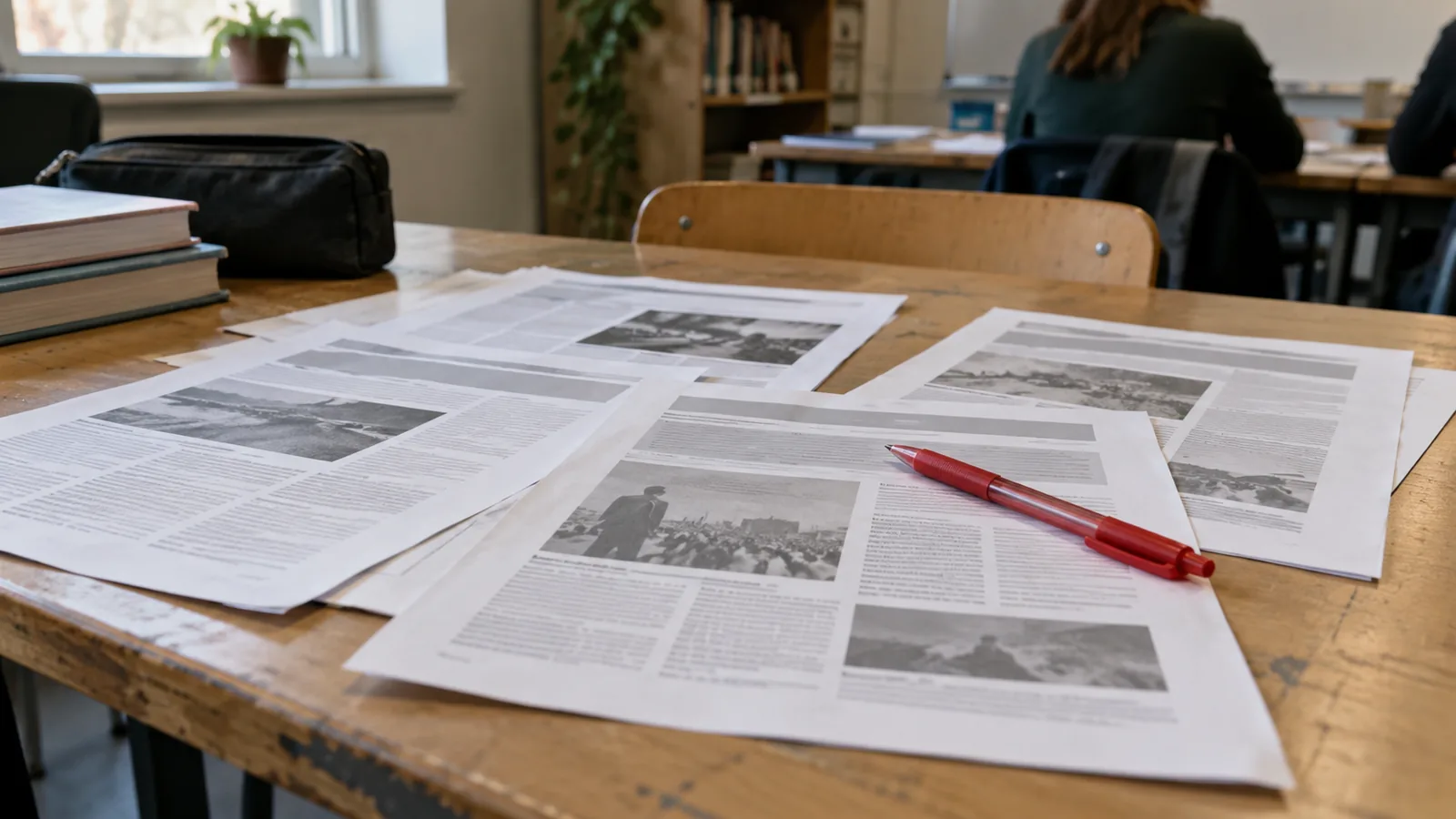
Illustrative photo — generated editorial image, not a real classroom study, participant or result.
The same attractive verb can have different support depending on the procedure. At a glance: Read the card design · A: observed doodling · No doodling schedule is assigned · B: self-selected music · Group choice is voluntary · C: assigned grouping · Willing participants are randomly assigned · D: random sample · Sketching is not assigned.
For each card, underline the verb, circle the measured outcome and identify how the exposure arose. Write a possible reverse-direction or third-variable explanation only as a possibility. The activity does not claim that your proposed explanation is the true cause. The personality dimension comparison shows another context where a broad label needs its specific measure retained.
Takeaway: Analyze what the card supplies rather than adding a study design that would make the headline true.
Use the teacher key and evidence ladder
Several rewrites can be defensible if they preserve the design and outcome. The key below is an explanation route, not an exact sentence students must reproduce. Ask learners to justify a word they removed and a detail they retained.
| Claim and design | Possible alternative explanation or limit | One defensible rewrite | Evidence needed to strengthen the claim |
|---|---|---|---|
| A: reported doodling, observed association | Earlier imaginative interest could relate to both doodling and story ratings; direction is unresolved | “Reported doodling is associated with originality ratings on this story task among the volunteers.” | Better evidence on temporal order, prior differences and a design addressing alternatives |
| B: self-selected music groups | More practiced searchers might select music; other group differences remain | “Self-selected playlist users finish this symbol-search sheet faster in the fictional record.” | Assignment to a specified sound condition, comparable procedure and adequate outcome evidence |
| C: assigned outlines, matched task | The result concerns this layout and search procedure, not general attention | “Participants assigned to the grouped sheet finish sooner in the stipulated comparison; uncertainty is not supplied.” | Inspect implementation and uncertainty before a causal interpretation of this task difference; additional measures and replication are needed for broader claims |
| D: random sample, unassigned sketching | Sampling does not rule out confounding or earlier ability differences | “Reported sketching predicts later story-task ratings in the sampled college group.” | A design addressing alternatives; random sampling alone does not create experimental assignment |
Here, “predicts” in Card D means a statistical or descriptive relation to a later outcome, not proof of causation or a tested forecasting service. If that wording would confuse the audience, use “is associated with later ratings” instead. No numeric association, significance level or effect estimate has been supplied.
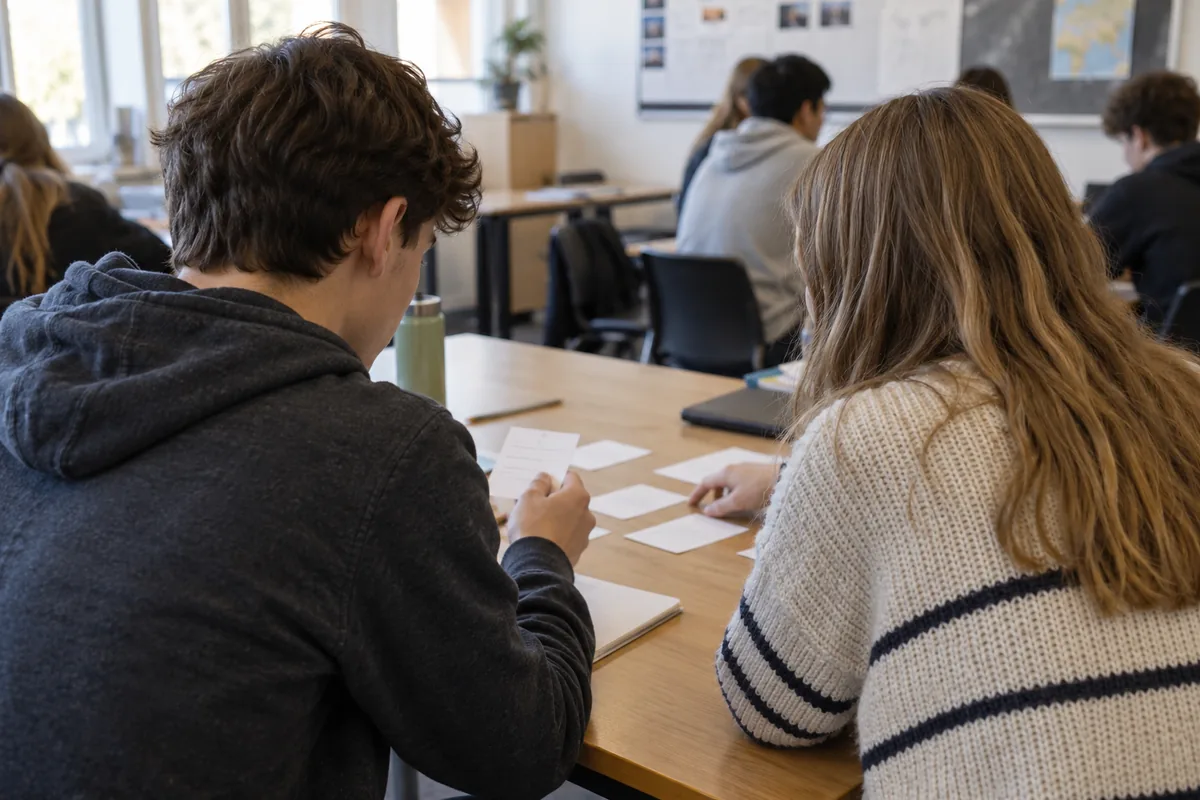
Illustrative photo — generated editorial image, not a real classroom study, participant or result.
Alternative explanations remain hypotheses until evidence distinguishes them. At a glance: An association leaves routes open · X to Y? · Y to X? · Shared third factor?
Common mistake: Replacing “correlation” with “proof” because a sample is large, randomly selected, or measured at more than one time.
The claim-and-evidence sheet helps keep sample and design separate. The variables worksheet checks whether a factor was actually manipulated rather than merely used to define groups.
Takeaway: Strengthen a claim by improving its evidence, not by strengthening its verb.
Complete the blank headline rewrite sheet
Use one row per headline. An adequate answer includes a changed sentence and a reason linked to the design. After pairs compare their rewrites, ask which additional evidence would change the wording and which detail would still need to remain.
| Headline claim | Actual design and measure | Alternative explanation or boundary | Revised headline and reason |
|---|---|---|---|
| _____ | _____ | _____ | _____ |
| _____ | _____ | _____ | _____ |
| _____ | _____ | _____ | _____ |
The output is an evidence-matched headline plus a reason, not a causal verdict from a scatterplot. At a glance: Write the reason too · Claim · Design · Alternative · Rewrite and reason.
Suggested debrief: “Which verb implied more than the design supplied? Which recorded variable did your rewrite preserve? What would random assignment change, and what would it leave unresolved? Can a cautious headline still communicate a meaningful finding?” Use the personal explain-and-check routine if a learner wants to revisit a mistaken assignment-versus-sampling distinction after class.
For another teacher planning tool, the Stroop condition-and-order sheet supports a different demonstration task. This exercise needs no personal data, fixed session duration or class performance ranking.
Takeaway: Assess the explanation behind the rewrite as well as the finished sentence.
When this evidence ladder does not settle causation
The ladder is an introductory reading aid, not a complete hierarchy for every kind of causal research. A randomized comparison still needs credible implementation, appropriate measurement and uncertainty considered. Conversely, this page does not claim that every observational result is scientifically useless; it focuses on what the supplied cards alone establish.
Do not use the activity to prescribe studying with music, sketching schedules or any clinical intervention. The assumed patterns exist only in the cards. For published material, return to the Research Methods guide and inspect the full report before rewriting a headline as a factual claim.
Takeaway: A bounded headline can be informative while leaving a causal question unresolved.
Method and sources
The correlation, assignment and sampling distinctions were checked against OpenStax Psychology 2e, sections 2.2 and 2.3, accessed October 8, 2026. Cards, assumed findings, rewrites and teacher key are original educational materials; the photos are generated illustrations. No classroom trial, real-news verification, sensitive student dataset or effect estimate is presented.
Takeaway: Keep the cards’ fictional status visible when reusing the activity.