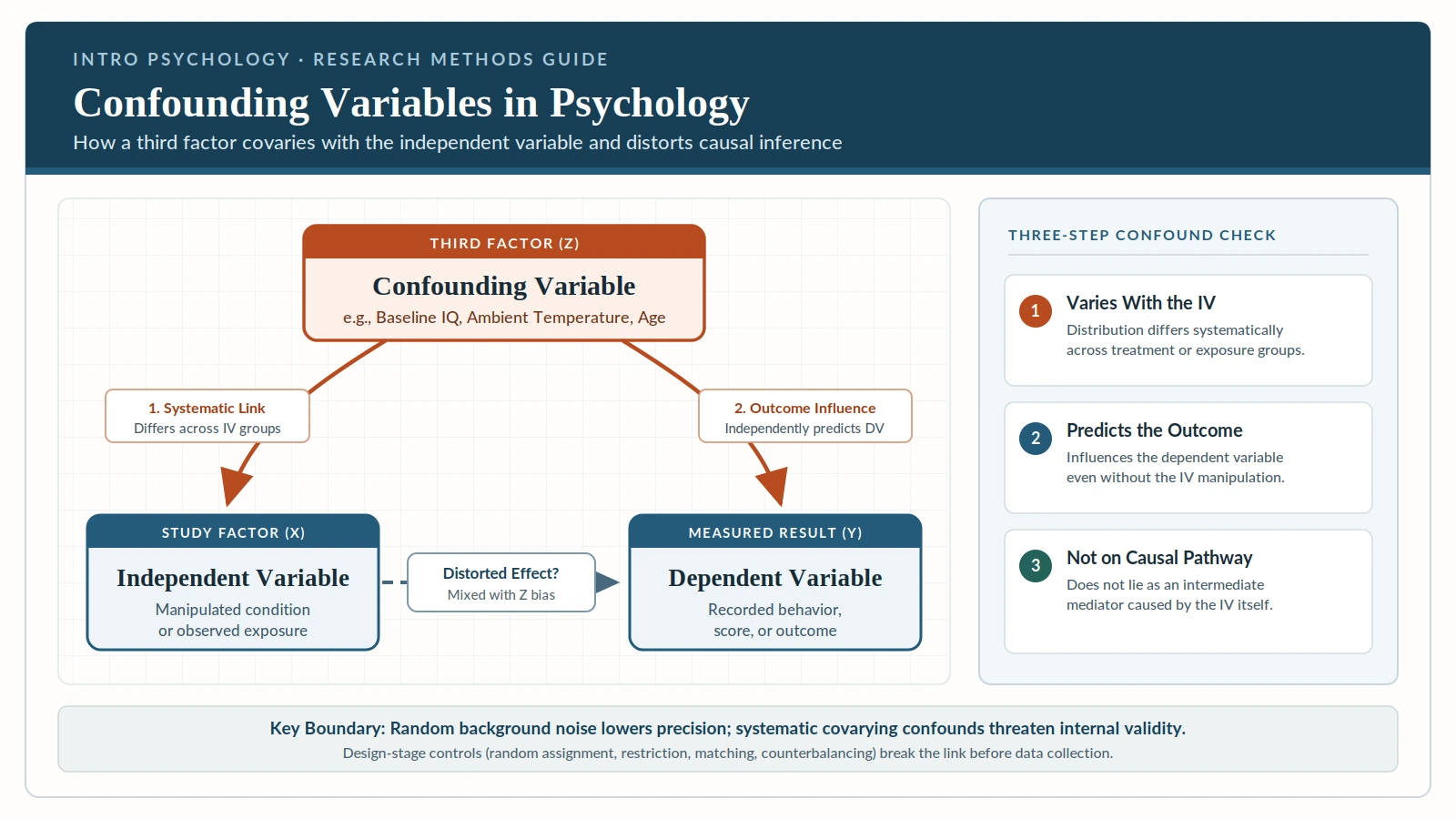
A confounding variable in psychology is an extraneous factor that varies systematically alongside the independent variable while also affecting the dependent variable, creating a competing explanation for the study’s outcome. Because its influence mixes with the intended manipulation, researchers cannot separate whether the independent variable or the confounding factor produced the observed group difference.
Across our Research Methods guides, distinguishing true confounding from ordinary background variation is essential before trusting any causal claim. Every experiment involves outside influences, from participant intelligence and fatigue to room lighting and task instructions. Treating every uncontrolled background factor as a confounding variable misses the critical diagnostic threshold: an extraneous factor becomes a confounder only when it aligns unequally with the conditions being compared and independently predicts the outcome, without sitting on the causal pathway between them.
| Variable Role | Relationship to Independent Variable (IV) | Relationship to Dependent Variable (DV) | Effect on Study Conclusions |
|---|---|---|---|
| Extraneous variable (balanced) | Varies independently of condition assignment across groups | Can influence participant scores or responses | Adds random variability (“noise”) that lowers sensitivity without systematically biasing group averages |
| Confounding variable | Differs systematically on average across levels of the IV | Independently predicts or affects the DV | Mixes effects with the IV, creating an alternative explanation and threatening internal validity |
| Intermediate variable (mediator) | Caused directly by the IV or exposure | Transmits part of the IV’s effect to the DV | Explains how the IV works along the causal pathway; controlling it removes part of the true causal effect |
| Collider (common effect) | Influenced as an effect of the IV | Also influenced as an effect of the DV | Not a confounder; statistically adjusting for it introduces collider bias (Berkson’s paradox) |
What Do Confounding Variables Affect in a Psychology Study?
Confounding variables directly undermine internal validity, which is the extent to which a study’s design supports concluding that the manipulated independent variable caused observed changes in the dependent variable. Uncontrolled confounders distort the true exposure–outcome relationship by creating false-positive Type I errors, masking genuine effects, or even reversing an association’s apparent direction.
In How to control confounding effects by statistical analysis, biostatisticians Mohamad Amin Pourhoseingholi, Ahmad Reza Baghestani, and Mohsen Vahedi explain that confounding is a major threat to the validity of cause-and-effect inferences because failing to account for a confounder leads to false-positive conclusions that the dependent variable stands in a causal relationship with the independent variable. Similarly, Andrea C. Skelly, Joseph R. Dettori, and Erika D. Brodt describe confounding in Assessing bias: the importance of considering confounding as a mixing of effects that may mask a real relationship or falsely demonstrate an apparent association where none exists.
Confounding affects internal validity rather than simply reducing precision, and that distinction sits alongside the measurement accuracy standards covered in our guide to reliability vs. validity in psychology measures. As Washington State University’s open textbook chapter on Experimentation and Validity notes, well-controlled experiments achieve high internal validity by manipulating the independent variable and controlling extraneous variables, whereas nonexperimental correlational studies remain low in internal validity precisely because alternative explanations stay open.
How Confounding Can Reverse a Result: Simpson’s Paradox
In severe cases, an unadjusted confounder flips the apparent direction of an association when separate subgroups are pooled into one table—a phenomenon known as Simpson’s paradox. Pourhoseingholi and colleagues illustrate this reversal with a cross-sectional dataset examining Helicobacter pylori infection and dyspepsia symptoms across 550 infected participants and 440 uninfected participants:
- Unadjusted (crude) table: Combining all participants yields an odds ratio of 0.60 (95% CI: 0.42–0.94), falsely implying a protective reverse association.
- Stratified by weight: Separating participants into weight strata yields an odds ratio of 0.80 (95% CI: 0.38–1.69) in the normal-weight stratum and 1.60 (95% CI: 0.79–3.27) in the overweight stratum.
- Adjusted summary estimates: Computing the Mantel-Haenszel pooled estimator yields an adjusted odds ratio of 1.16 (95% CI: 0.71–1.90), closely matched by logistic regression controlling for weight at an odds ratio of 1.15 (95% CI: 0.71–1.89).
Without recognizing and stratifying by the confounding factor, the crude numbers point researchers in the opposite direction of the adjusted relationship.
How Is an Extraneous Variable Different From a Confounding Variable?
An extraneous variable is any factor other than the independent and dependent variables that could affect the outcome, whereas a confounding variable is the subset of extraneous variables that varies systematically across levels of the independent variable. Balanced extraneous variables add random noise; systematically skewed extraneous variables create rival causal explanations.
In the APA Dictionary of Psychology, an extraneous variable is defined as a measure not under investigation in an experiment that may potentially affect the dependent variable and influence results. By contrast, the APA Dictionary of Psychology defines a confound (confounding variable) as an independent factor that is conceptually distinct yet empirically inseparable from one or more other independent variables, making it impossible to differentiate its isolated effect.
Washington State University’s Experiment Basics chapter draws this operational line through two contrasting roles:
- Extraneous variables as random noise: Suppose a study tests whether happy versus sad mood changes how many happy childhood memories participants recall. In idealized noiseless data, every happy-mood participant might recall 4 memories and every sad-mood participant 3 memories. In realistic data, differences in recall strategy, memory availability, and motivation create scatter around those same group means of 4 and 3. Because that variation appears similarly across both conditions, it makes the mean difference harder to detect statistically without biasing the comparison toward one group.
- Extraneous variables as confounding variables: Participant intelligence quotient (IQ) is an extraneous variable in nearly every cognitive experiment. When higher-IQ and lower-IQ participants appear at roughly equal average levels in both mood conditions, IQ remains ordinary background variation. However, if participants in the positive-mood condition have substantially higher average IQs than those in the negative-mood condition, IQ covaries systematically with mood and becomes a confounding variable—making it impossible to know whether mood or IQ drove the higher memory scores.
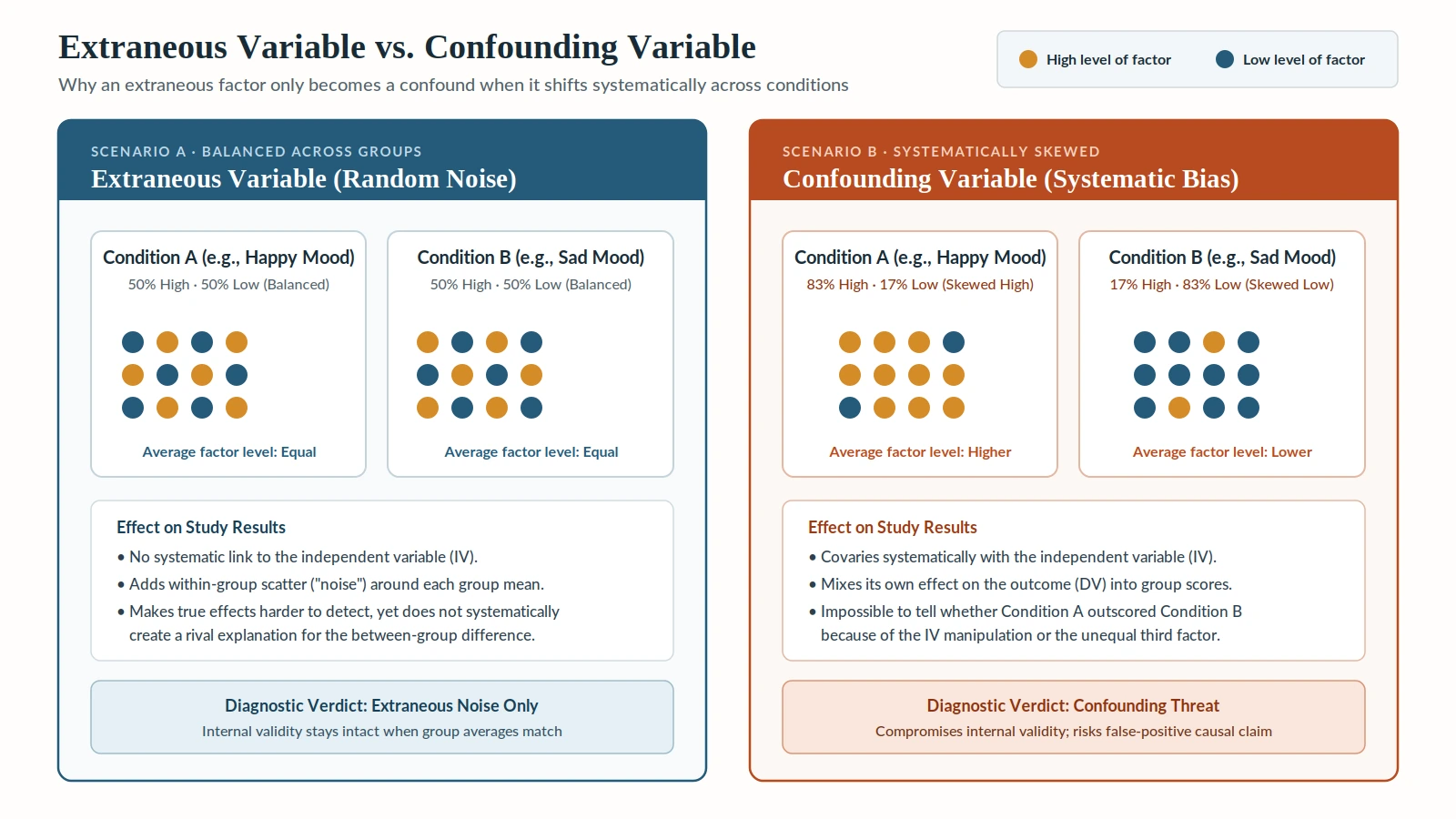 An extraneous variable distributed evenly across conditions adds within-group noise around stable averages, whereas an extraneous variable concentrated unevenly across conditions becomes a confounding threat to internal validity.
A third formal rule separates confounders from causal mechanisms. As Skelly and colleagues emphasize in Assessing bias: the importance of considering confounding, a true confounder must independently predict the outcome without being caused by the exposure, must associate with the exposure without serving as a proxy for it, and cannot act as an intermediate variable on the causal pathway—just as serum cholesterol lies along the causal chain between diet and coronary heart disease rather than confounding it.
What Are Examples of Confounding Variables in Psychology?
Examples of confounding variables in psychology span situational factors such as ambient temperature or fixed task order, participant traits such as baseline IQ or prior schooling, and expectation effects such as placebo responses. Each example shares the same structure: an unseparated third variable moves alongside the study’s focal variable and independently shapes the measured behavior.
Standard methodological classifications organize these threats by source into procedural confounds, person confounds, and operational confounds. Before mapping any of them, students should verify that the independent and dependent variables themselves are clearly specified using our psychology variables and operational definitions worksheet.
Situational and Procedural Confounds
Procedural confounds occur when another variable shifts systematically alongside the manipulated independent variable during study execution:
- Condition order and carryover effects: In Experimental Design, Washington State University researchers show how testing every participant in one fixed order—for example, judging an attractive defendant first and an unattractive defendant second—turns condition order into a confounding variable. Harsher ratings for the second defendant could stem from fatigue, boredom, practice, or a contrast effect rather than physical attractiveness.
- Experimenter bias and participant expectations: OpenStax Psychology 2e (in Analyzing Findings) highlights how knowing group assignments invites biased scoring by researchers and expectancy-driven shifts by participants. Under the placebo effect, people’s beliefs or expectations shape their reported experience independently of an active treatment, confounding treatment comparisons unless expectations are matched across groups.
- Ambient temperature in correlational data: In OpenStax Psychology 2e, ice cream sales and crime rates rise together, yet ambient temperature is a confounding variable causing systematic movement in both variables—a textbook illustration reinforced in our correlation vs. causation headline rewrite activity.
Participant and Person Confounds
Person confounds emerge whenever compared groups differ systematically on preexisting traits or background experiences:
- Baseline intelligence across conditions: As illustrated in WSU’s Experiment Basics, an unplanned difference in average IQ between positive-mood and negative-mood groups confounds memory performance with cognitive baseline.
- Prior schooling and achievement: The APA Dictionary of Psychology cites high-school achievement comparisons where the type of school previously attended (private versus public) and prior academic achievement act as confounds whose effects cannot be isolated from the high-school variable under study.
- Physical health behind lifestyle correlations: WSU’s Experimentation and Validity notes that a correlation between regular exercise and higher happiness does not prove exercise causes happiness, because better physical health can act as a third factor driving both exercise habits and mood.
Operational and Observational Confounds
Operational and clinical-observational confounds arise when measurement instruments or real-world treatment choices bundle extra factors into the variable of interest:
- Operational confounding in measurement: When a scale or task intended to measure one psychological construct inadvertently captures a second construct, the measurement itself introduces an operational confound that subgroup checks alone may fail to uncover.
- Unmeasured correlated behaviors: Pourhoseingholi and colleagues cite a classic observational example linking coffee drinking and lung cancer: when coffee drinkers are also more likely to smoke cigarettes and smoking goes unmeasured, smoking confounds the coffee–cancer association.
- Confounding by indication: Skelly and colleagues describe studies where patients assigned to one treatment start with more severe baseline illness than patients given a comparison treatment. Because baseline severity drives both treatment selection and recovery outcomes, treatment effectiveness cannot be separated from initial severity without balancing severity across groups.
When Is Participant Age a Confounding Variable?
Participant age is a confounding variable only when age differs systematically between the groups being compared and independently predicts the measured outcome. Simply recruiting participants of varying ages does not make age a confounder; if age distributions match across conditions, age behaves solely as an extraneous variable adding within-group variability.
Because age correlates with many developmental, cognitive, and health outcomes, it frequently crosses from background noise into systematic confounding in three recognizable situations:
- Natural covariation with an observational predictor: In developmental and epidemiological research, maternal age confounds the apparent relationship between birth order and Down syndrome. Higher maternal age independently predicts Down syndrome regardless of birth order, associates directly with later birth order (except in twins), and is not caused by birth order itself—satisfying every criterion of a true confounder.
- Chance imbalance during small-sample assignment: Even inside a randomized psychology experiment, WSU’s Experimental Design warns that random assignment is not infallible: by chance alone, participants assigned to one condition can turn out substantially older on average than participants in another condition, creating an accidental age confound if age influences task performance.
- Coarse categorization during statistical adjustment: As Pourhoseingholi and colleagues caution in How to control confounding effects by statistical analysis, confounding by age can persist even after statistical control if researchers group age into overly broad or poorly defined categories that fail to capture how age varies across comparison groups.
When researchers anticipate that age will strongly affect the dependent variable, they can address it before data collection through age restriction (enrolling one narrow age bracket, as noted by Skelly and colleagues) or age matching (such as pairing a 45-year-old male case with a 45-year-old male control, cited in Pourhoseingholi and colleagues). However, restricting an entire study to a single narrow age group reduces external validity—WSU’s Experiment Basics notes that limiting a sample to 20-year-old, heterosexual, female, right-handed psychology majors eliminates participant variation at the cost of generalizing findings beyond that narrow demographic.
How Do Researchers Control Confounding Variables in an Experiment?
Researchers control confounding variables most effectively before data collection using design-stage methods—random assignment, restriction or holding constant, matched groups, counterbalancing, and double-blinding—because these techniques break the link between third factors and the independent variable. When experimental manipulation is unethical or impractical, analysts adjust for measured confounders afterward using stratification, regression, or ANCOVA.
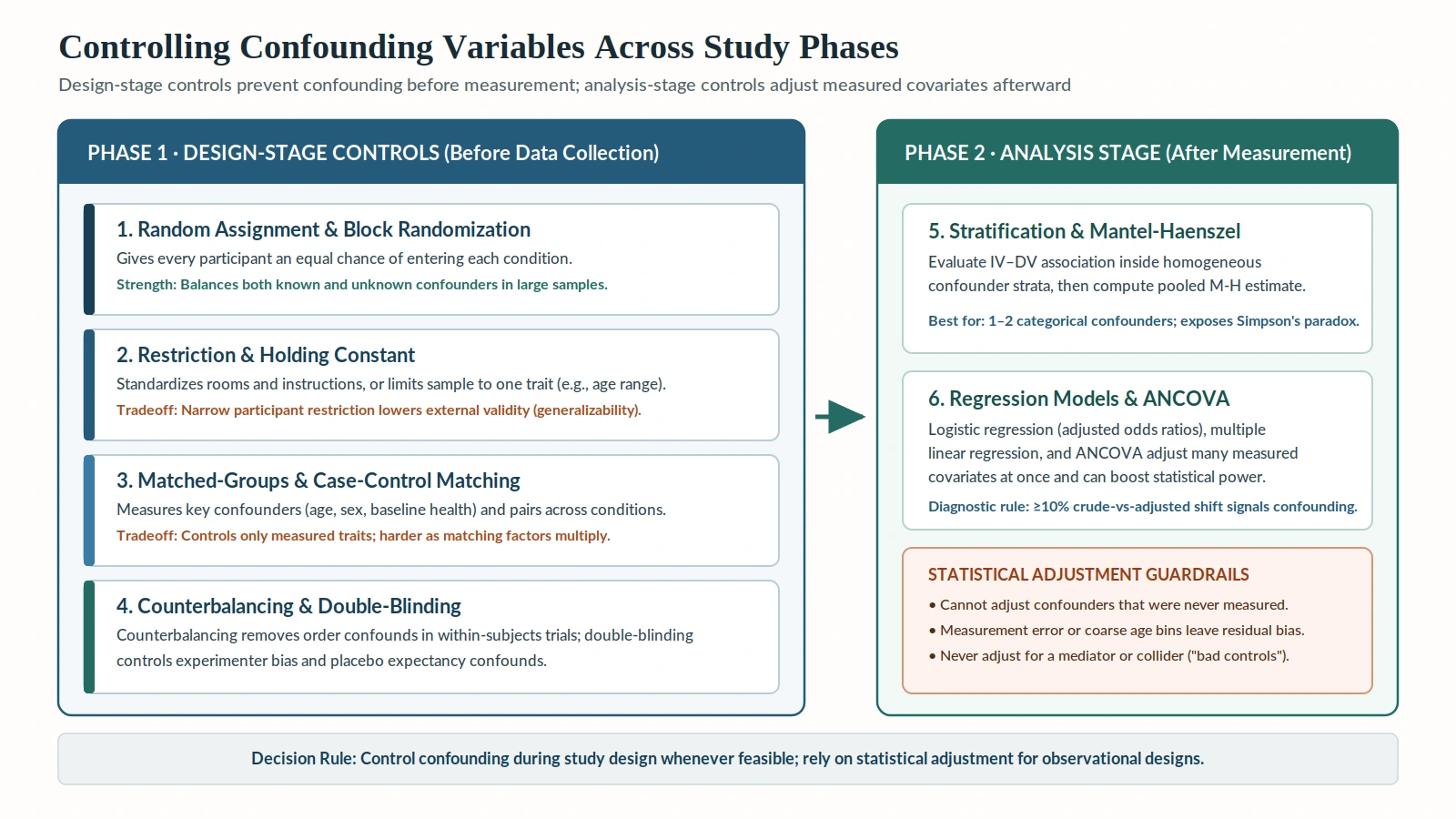 Design-stage controls prevent confounding before measurement begins, whereas analysis-stage adjustment can control only confounders that were accurately measured during the study.
Design-Stage Controls Before Data Collection
Preventing confounding during study design is generally stronger than post-hoc adjustment because it protects against both recognized and unrecognized factors:
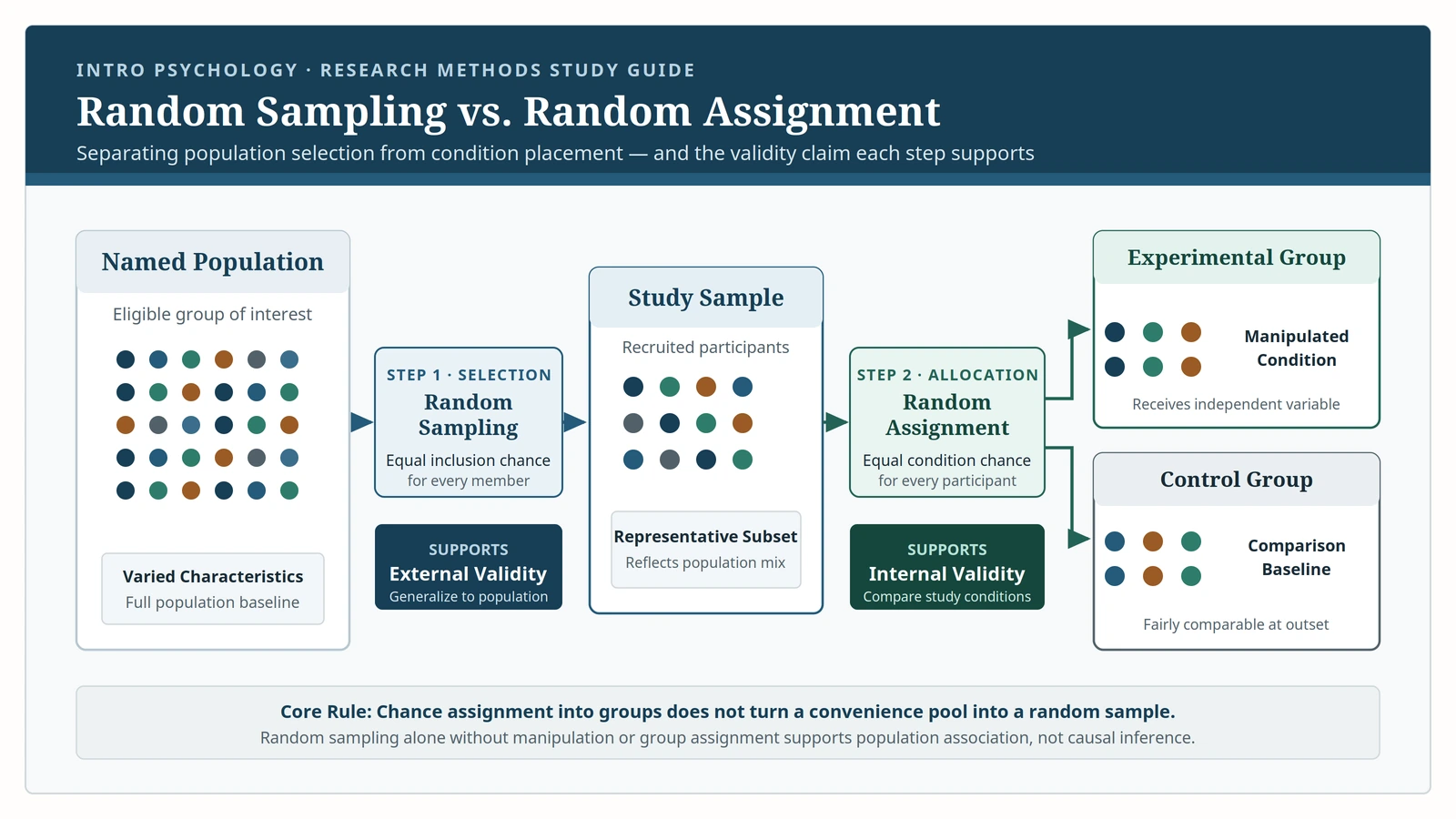
- Random assignment and block randomization: Assigning every participant independently with an equal probability of entering each condition (such as 50% in a two-group design) breaks systematic links between participant characteristics and the independent variable. As detailed in our comparison of random sampling vs. random assignment, random assignment in sufficiently large samples makes systematic baseline differences—such as one group composed entirely of males, one ethnic identity, or one religious ideology—unlikely, generating groups fairly comparable on both known and unknown confounders (OpenStax Psychology 2e; Pourhoseingholi et al.). When equal group sizes matter, WSU’s Experimental Design recommends block randomization, cycling through every condition once in random order per block before repeating.
- Restriction and holding constant: Standardizing the testing room, timing, and verbal instructions holds situational extraneous variables constant. Restricting participant eligibility—for instance, enrolling only right-handed participants in language lateralization research or selecting subjects of the same age or sex—eliminates variation in that specific confounder, though over-restriction narrows generalizability (WSU Experiment Basics; Pourhoseingholi et al.).
- Matched-groups designs: When one or two extraneous variables strongly affect the outcome, researchers can measure that trait beforehand (such as baseline health), rank-order participants, and randomly assign each matched pair to opposing conditions so the matched variable cannot confound group averages (WSU Experimental Design). In observational case-control studies, matching pairs cases with controls sharing the same confounder values (such as age and sex), though matching becomes difficult when many variables must match simultaneously.
- Within-subjects designs and counterbalancing: Testing the same individuals under every condition eliminates between-group differences on stable participant traits like IQ and socioeconomic status. To stop condition order from acting as a procedural confound, researchers counterbalance condition sequences—using complete counterbalancing (6 orders for 3 conditions, 24 for 4, or 120 for 5), Latin square schedules (4 orders for 4 treatments or 6 orders for 6 treatments rather than 720), or random counterbalancing (WSU Experimental Design). For a worked position and adjacent-pair audit, see our three-condition counterbalancing guide.
- Single-blind and double-blind procedures: Concealing group assignment from participants (single-blind) controls placebo expectancy confounds, while concealing assignments from both participants and researchers (double-blind) controls both participant expectations and experimenter scoring bias (OpenStax Psychology 2e).
Analysis-Stage Controls and Their Boundaries
When randomization is impossible—such as studying smoking, early adversity, or clinical exposures—confounding differs from selection or information bias because researchers can adjust for it statistically after data collection, provided the confounders were measured accurately (Pourhoseingholi et al.):
- Stratification and Mantel-Haenszel pooling: Investigators fix the confounder within homogeneous strata, inspect the exposure–outcome association inside each stratum, and compute a Mantel-Haenszel adjusted estimate. Stratification works best when controlling only 1 or 2 confounders with a modest number of strata, and readily reveals reversals such as Simpson’s paradox.
- Multivariable regression and ANCOVA: When many confounders or grouping levels exist simultaneously, logistic regression produces adjusted odds ratios for binary outcomes, multiple linear regression isolates numeric outcomes across multiple covariates, and Analysis of Covariance (ANCOVA)—combining ANOVA with linear regression—removes variance explained by continuous covariates while potentially increasing statistical power (Pourhoseingholi et al.).
- The 10% diagnostic check and residual confounding: Skelly and colleagues note that when an adjusted estimate differs from the crude estimate by approximately 10% or more, the factor should be treated as a confounder and the adjusted estimate reported (Skelly et al.). Still, residual confounding persists whenever confounders went unmeasured, contained measurement error, or were grouped into overly coarse categories.
- Avoiding bad controls (mediators and colliders): Adding every available variable into a regression model can backfire. Controlling an intermediate mediator blocks part of the true causal effect, while conditioning on a collider—a common effect of both the exposure and outcome—creates collider bias, also called Berkson’s paradox (Confounding overview). Selecting valid adjustment variables therefore requires domain knowledge and a clear causal model rather than automated statistical screening alone.
| Control Method | Study Phase | Confounders Addressed | Primary Tradeoff or Limit |
|---|---|---|---|
| Random assignment & block randomization | Design stage | Known and unknown baseline participant confounders | Chance imbalance remains possible in small samples; requires ethical ability to manipulate IV |
| Restriction / holding constant | Design stage | Specific known situational or demographic confounders | Narrow participant eligibility lowers external validity and limits sample size |
| Matched-groups / case-control matching | Design stage | Pre-measured key confounders (e.g., age, sex, baseline health) | Does not balance unmeasured factors; finding exact matches grows difficult across multiple traits |
| Counterbalancing (complete or Latin square) | Design stage (within-subjects) | Condition order, practice, fatigue, and contrast carryover | Unsuitable when an earlier condition creates permanent learning or lasting behavioral change |
| Double-blinding & placebo control | Design stage | Experimenter scoring bias and participant placebo expectations | Not feasible when participants or researchers can directly perceive the intervention |
| Stratification & Mantel-Haenszel | Analysis stage | One or two measured categorical confounders | Sparse cells limit reliability when stratifying across many variables at once |
| Multivariable regression & ANCOVA | Analysis stage | Multiple measured categorical or continuous covariates simultaneously | Cannot adjust unmeasured confounders; vulnerable to measurement error, wrong model form, or collider bias |
How Can You Check Whether an Extraneous Variable Is a Confounder?
To audit whether a suspected extraneous variable actually confounds a psychology study, apply a three-step diagnostic test before revising the design or running statistical adjustments. A factor qualifies as a true confounding variable only when it passes all three checks simultaneously rather than merely adding background variability.
| Audit Step | Diagnostic Question to Ask | Result Confirming a Confounder | Result Ruling Out a Confounder |
|---|---|---|---|
| Step 1: Covariation with IV | Does the variable differ systematically across experimental conditions or exposure groups? | Group averages or proportions shift unevenly across levels of the IV | Factor is distributed evenly across groups (acts only as extraneous noise) |
| Step 2: Independent effect on DV | Does the variable predict or affect the dependent variable even without the IV manipulation? | Factor independently alters scores or risk on the outcome measure | Factor has no independent relationship with the outcome |
| Step 3: Causal pathway check | Is the variable free from being caused by the IV (mediator) or caused by both IV and DV (collider)? | Factor precedes or stands outside the IV–DV causal chain as a rival cause | Factor lies on the causal pathway (mediator) or is a common effect (collider / bad control) |
Working through these three checks prevents the two most common methodological errors in introductory psychology: mislabeling harmless balanced noise as a confounding variable, and statistically adjusting for a mediator or collider that distorts the very causal relationship the study set out to test.
Sources
- How to control confounding effects by statistical analysis — Mohamad Amin Pourhoseingholi, Ahmad Reza Baghestani, and Mohsen Vahedi, Gastroenterology and Hepatology From Bed to Bench (National Library of Medicine / PMC).
- Assessing bias: the importance of considering confounding — Andrea C. Skelly, Joseph R. Dettori, and Erika D. Brodt, Evidence-Based Spine-Care Journal (National Library of Medicine / PMC).
- Experiment Basics — Research Methods in Psychology — Washington State University Open Text (Price, Jhangiani, Chiang, Leighton, and Cuttler), distinguishing extraneous noise from confounding variables and explaining holding-constant tradeoffs.
- Experimental Design — Research Methods in Psychology — Washington State University Open Text chapter detailing random assignment, block randomization, matched-groups designs, and counterbalancing.
- Experimentation and Validity — Research Methods in Psychology — Washington State University Open Text overview of internal validity, external validity, and third-variable explanations in psychology.
- Confounding — Wikipedia — Reference overview of maternal age confounding, operational/procedural/person confounds, and collider bias (Berkson’s paradox).
- Rose M. Spielman, William J. Jenkins, and Marilyn D. Lovett, Psychology 2e, “Analyzing Findings,” OpenStax, Houston, Texas.
- American Psychological Association, APA Dictionary of Psychology — Entries on confound and extraneous variable.