
A variable label without a procedure leaves a psychology question too vague to check. Revise the sentence into an explicit manipulation or observation and state exactly how its outcome would be recorded.
An operational definition specifies how a variable is manipulated or measured in a particular study. This psychology variables worksheet turns vague labels into checkable instructions while retaining missing information. It also includes an observational counterexample: grouping people by an existing characteristic does not mean the researcher manipulated it. The proposed tasks are original paper examples, not validated measures or reported classroom findings.
- Preserve the original vague sentence so the revision can be inspected.
- Say whether anything is assigned or manipulated.
- Specify material, instruction, response and scoring.
- Name the narrower conclusion the operation could support.
The Research Methods guide places operationalization within study design. For broader design practice, the existing research-methods questions have a different purpose; this page focuses on revising the wording of variables.
Replace labels with observable instructions
Move from the construct name to a procedure that another reader can identify. OpenStax’s analyzing-findings section defines operationalization as a precise account of a variable. A procedure clarifies what is recorded; it does not automatically show that the record represents every aspect of the intended construct.
For an experimental proposal, identify the independent variable that would be changed and the dependent variable that would be measured. For an observation, name the recorded variables without pretending a manipulation occurred. The grammar of “X affects Y” cannot decide the design on its own.
The proposed operation narrows the claim rather than proving that the construct has been fully measured.
Useful fields are: what material is used, what instruction is given, what response is allowed, when the record is taken, and how it is scored. If “attention” becomes correct classifications on one short card, name that task accuracy in the result sentence. The headline rewrite activity helps keep that narrower measure in the final claim.
Takeaway: A checkable operation includes a procedure and the scope of the record it produces.
Revise original vague statements without inventing results
The examples below are proposed editorial revisions, not experiments we have run. They show how a broad sentence becomes a task-specific question and how a remaining uncertainty stays in the worksheet.
Original material for the layout proposal: robin, trout, heron, carp, gull, salmon. The proposed instruction is “Mark each word as bird or fish.” The key treats robin, heron and gull as birds, and trout, carp and salmon as fish. These six words and their scoring key are original educational choices, not a standardized psychological instrument.
| Original vague sentence | Proposed manipulation or observation | Revised operational definition | Still missing |
|---|---|---|---|
| “Clutter hurts attention.” | A proposed comparison of single-column and two-column presentation | Present the same animal names in the same reading order, with the same font and instructions; record the count of correct bird/fish classifications | Layout dimensions, viewing procedure, response interval, assignment and evidence that the task captures the intended construct |
| “Practice makes learners confident.” | Record a practice history and a self-report, if merely observed | Define the exact practice task and period; specify the exact confidence question and response options | Wording and scale anchors; whether practice was assigned; whether confidence relates to accuracy |
| “Clear examples improve understanding.” | A proposed comparison of an explanation with versus without one specified example | Use the same explanation text apart from the example; record how the learner classifies a new case using a prewritten rubric | Full texts, matching exposure, assignment, novel case and rubric |
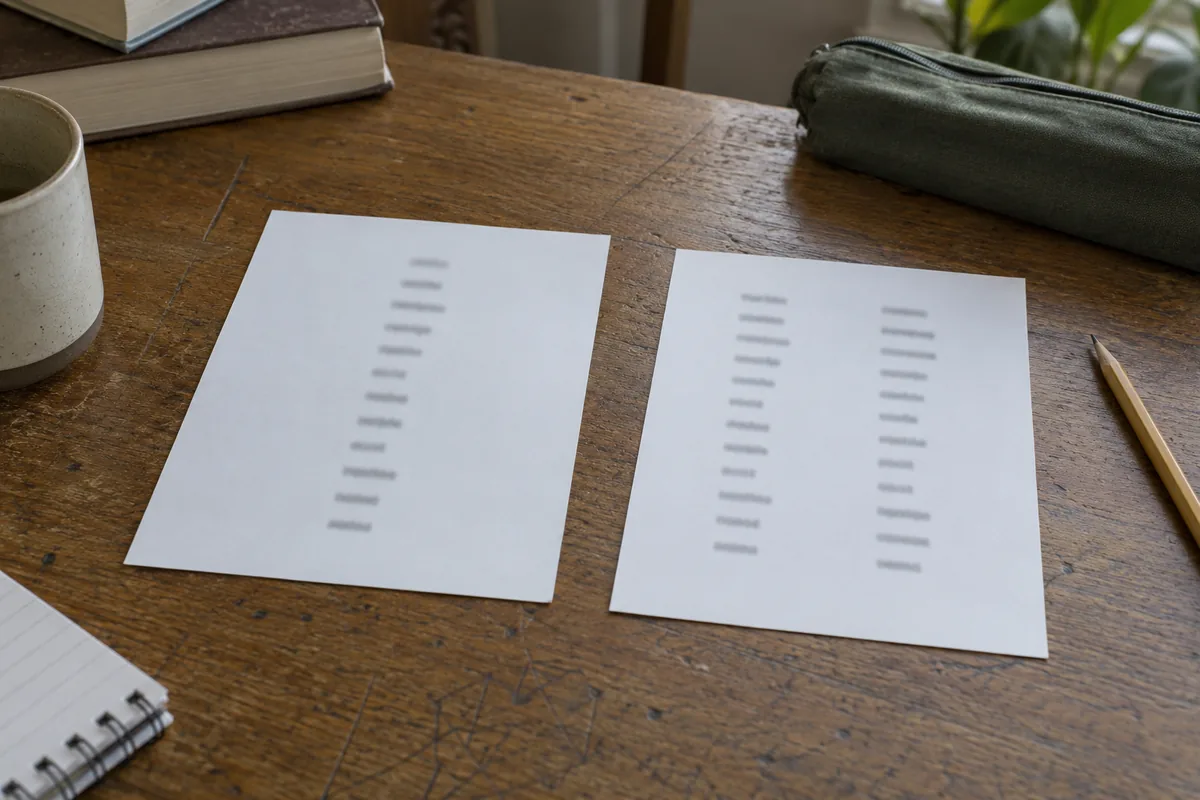
Illustrative photo — generated editorial image, not a real classroom study, participant or result.
This original proposal makes the measurement narrower and leaves design choices visible. At a glance: Narrow the question · Clutter and attention · Presentation layout · Classification accuracy.
The layout revision deliberately changes the broad construct wording. One versus two columns is a presentation manipulation; it is not a comprehensive manipulation of “clutter.” Correct animal classification is a task outcome; it is not a direct measure of all attention. Do not rename the measured result “attention improved” after carefully narrowing the operation.
The conditioning comparison uses a similar discipline when it separates the response being explained from a setting’s broad label. The personality traits and types comparison distinguishes a model from the instrument that gives its scores.
Takeaway: Revise the question as well as the measurement when the procedure captures a narrower task.
Check the unmanipulated counterexample
If a researcher records existing behavior, the grouping does not become a manipulation because the results are arranged into columns. OpenStax’s approaches-to-research section explains the difference between observing relationships and conducting experiments.
Fictional proposal: Learners voluntarily report whether they usually reread notes or generate their own questions. A researcher then records their answers to the same original concept prompts. The study has not assigned either study habit, even if it compares the two self-reported groups.
| Wording to inspect | Defensible revision |
|---|---|
| “The independent variable was randomly assigned study habit.” | “Habit was self-reported; no random assignment of habit is described.” |
| “Question generation caused better learning.” | “The proposal can examine an association between reported habit and this prompt outcome.” |
| “Learning was measured.” | “Responses were scored with a specified concept rubric; the materials and rubric still need to be supplied.” |
| “Groups were equal.” | “Preexisting knowledge and other group differences have not been established.” |

Illustrative photo — generated editorial image, not a real classroom study, participant or result.
Grouping a recorded characteristic does not change its source into a manipulation. At a glance: Where did groups come from? · Self-reported habit · Reread notes · Generate their own questions · Observed groups · No assigned habit.
Course conventions sometimes use predictor/outcome or independent/dependent labels in nonexperimental work. Report the actual procedure alongside any label so the reader does not infer assignment from the term alone. The claim-and-evidence reading sheet makes room for that distinction in a real paper.
Common mistake: Treating a measured characteristic as manipulated because one table column is called “independent variable.”
Takeaway: State where the variable came from before deciding what the comparison can establish.
Complete the blank operational-definition revision worksheet
Copy this sheet for one vague statement. The final row should use the name of the actual task or measure, not quietly return to an unrestricted construct. It is acceptable for the sheet to end with a missing-information question when the proposed operation is still incomplete.
| Revision field | Your entry |
|---|---|
| Original sentence and broad constructs | _____ |
| Revised task-specific question | _____ |
| Manipulated or recorded? Evidence for that choice | _____ |
| Material and presentation | _____ |
| Instruction and allowed response | _____ |
| Observation period or response window | _____ |
| Scoring rule and unit | _____ |
| Handling missing, repeated or ambiguous responses | _____ |
| What is held constant, and what else changes? | _____ |
| What the measure supports and leaves unresolved | _____ |
Use the table to supply actual details; no standard duration or score threshold is implied. At a glance: Leave missing details visible · Original label · Operation · Scoring · Remaining limit.
For the layout proposal, the first revised question is: “Does the specified single-column versus two-column presentation change accuracy on this animal-classification card under the planned procedure?” That wording is more modest than the original and easier to inspect. It remains a proposal until all materials and design details are specified and appropriate evidence is obtained.
Use the retrieval correction record to practice explaining why a revision is narrower. For a demonstration where conditions, sequence and errors must all be specified, the Stroop planning sheet illustrates a different application of the same measurement discipline.
Takeaway: End with an explicit task-specific question and a list of details still needed.
When this worksheet does not establish validity or causation
Precise wording is necessary for understanding an operation, but it does not validate an instrument or eliminate confounds. A well-specified score can still capture only part of a construct. Changing multiple features together also limits which feature a result could be attributed to.
The proposed examples are for paper discussion; no sensitive learner data or live comparison is needed. This sheet supplies no clinical measure, validated attention assessment, timing prescription or performance norm. Use the Research Methods guide to choose further design reading rather than treating a completed worksheet as an approved research protocol.
Takeaway: Operational precision tells the reader what was done, not whether every intended inference is justified.
Method and sources
Definitions and design boundaries were checked against OpenStax Psychology 2e, sections 2.2 and 2.3, accessed October 8, 2026. The statements, animal-name material, scoring illustration, habit proposal and blank worksheet are original editorial examples. No experimental result, validated scale, effect size or teaching benefit is reported.
Takeaway: Preserve the difference between a proposed operation and evidence obtained using it.