
Choosing “automatic” or “voluntary” from a scene can miss the learning relationship being described. Trace the stimulus pairing for a classical account and the behavior–consequence relationship for an operant account.
Classical conditioning concerns learning an association between stimuli, so a previously neutral cue comes to elicit a conditioned response. Operant conditioning concerns learning a relationship between an action and its consequence. Both relationships can occur in one setting. This public-source comparison uses an original fictional scene to separate the analysis units, rather than assign the whole scene a single label or prescribe a classroom experiment.
| Question | Definition or source | Why it matters |
|---|---|---|
| What predicts what? | Stimulus pairing; OpenStax 6.2 | Identifies the classical relationship |
| Which response is elicited by the learned cue? | Conditioned responding; OpenStax 6.2 | Separates the cue’s history from its mere appearance |
| What follows a specified action? | Behavior and consequence; OpenStax 6.3 | Identifies the operant relationship |
| Does the action change across opportunities? | Stated later pattern | Avoids equating an intended reward with learning |
| Are both relationships described? | Separate chains for one setting | Prevents an unnecessary either/or answer |
The Learning & Memory guide locates both ideas within learning. Once an operant consequence has been identified, the reinforcement classification record handles the separate task of reading its sign and effect.
Choose the relationship being analyzed
Specify the link, not just the visible action. OpenStax’s classical-conditioning section describes a neutral stimulus becoming a conditioned stimulus through a learning history. Its operant-conditioning section describes behavior in relation to consequences.
In a classical account, distinguish an unconditioned stimulus, which elicits an unlearned response in the account, from the cue that acquires a learned relation. A conditioned response is the learned response to that cue. In an operant account, specify the target action, the consequence following it, and the change in its future occurrence.
These chains describe relationships, not an automatic label for every event in a setting. At a glance: Two analysis units · Stimulus pairing · Stimulus predicts stimulus · Conditioned response · Behavior and consequence · Action produces consequence · Later behavior pattern.
Terms such as “automatic” can help summarize familiar examples, but they do not substitute for learning history. An action that looks deliberate may take place around conditioned cues. An operant behavior can also be prompted by an antecedent cue. The Research Methods guide helps separate a description of events from evidence about a learned relationship.
Takeaway: Identify the association or contingency you are explaining before selecting a label.
Trace both chains in one fictional tasting-stand scene
The following is an invented paper case, with its learning history and outcomes stipulated for analysis. It is not a reported observation, a replication of a named study, or a suggestion to condition students with food or discomfort.
Scene: At a fictional festival stand, a soft chime regularly precedes a small taste of sour fruit. The account stipulates that the fruit taste elicits salivation before this learning history, while the chime initially does not. After the pairings, the chime alone elicits salivation. Separately, returning a used cup to the collection tray produces a recipe card, and returning cups becomes more frequent across comparable visits.
| Analysis unit | Before the stipulated history | Learning relationship supplied | Later pattern supplied |
|---|---|---|---|
| Chime and salivation | Fruit taste elicits salivation; chime does not | Chime precedes fruit taste | Chime alone elicits salivation |
| Cup return | Returning cups is infrequent | Returning a cup produces a recipe card | Returning becomes more frequent |
For the first chain, the fruit taste is the unconditioned stimulus in the story, and its initial salivation is the unconditioned response. The chime becomes the conditioned stimulus; salivation to the chime is the conditioned response. For the second chain, cup return is the action, the card is its consequence, and the later increase supports an operant reinforcement account within the fiction.
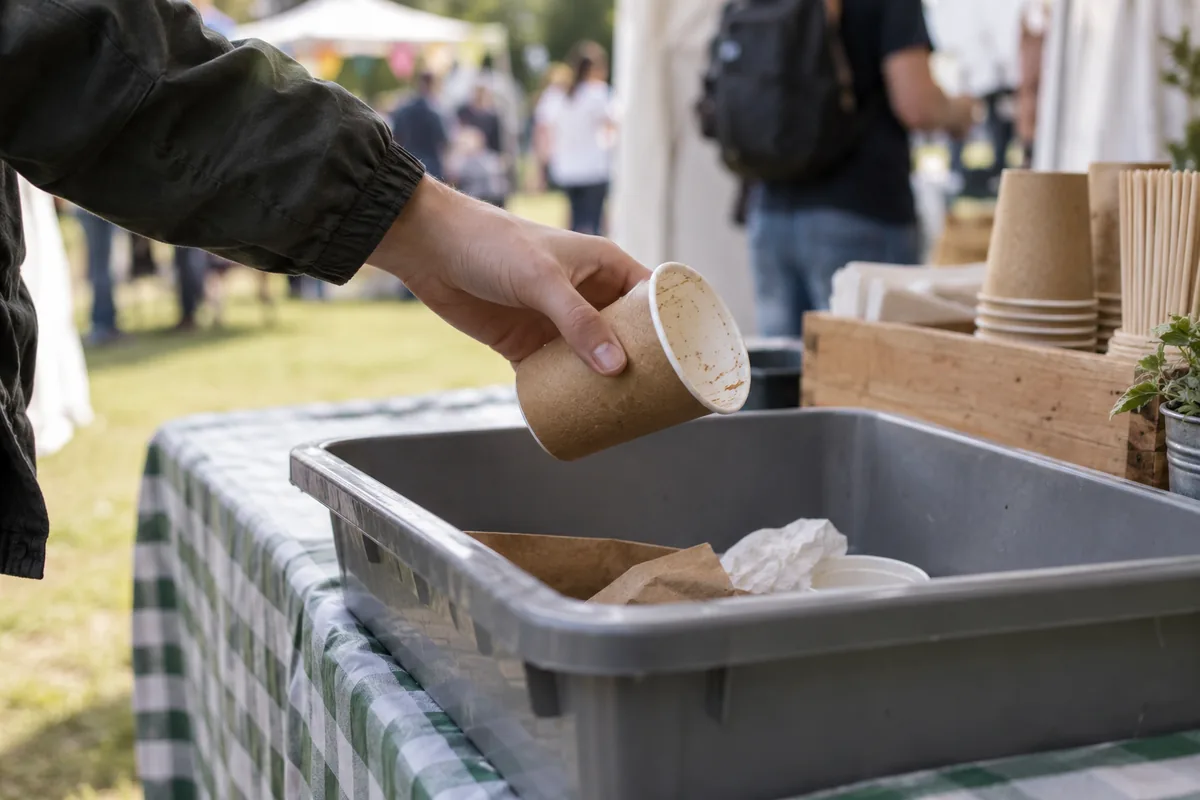
Illustrative photo — generated editorial image, not a real classroom study, participant or result.
The salivation and cup-return accounts use different responses and evidence. At a glance: One scene, two chains · Stimulus pairing · Chime then fruit taste · Salivation to chime · Behavior and consequence · Cup return then recipe card · Returning increases.
The scene does not say that salivation causes cup returning, or that recipe cards produce salivation. Keeping the response separate prevents the two chains from being merged just because they occur at the same stand. Use the operational-definition worksheet when a description such as “participation improves” hides which response changed.
Takeaway: A mixed setting can contain both mechanisms when each relationship is specified separately.
Recognize the boundary cases before guessing
A cue before an action is not sufficient evidence of classical conditioning. Likewise, a consequence after an action is not enough to establish that it changed later behavior. The boundary cases below remove a crucial piece from the scene so that the missing evidence stays visible.
| Altered fictional case | What is supplied | What is missing | Defensible reading |
|---|---|---|---|
| Chime happens once before fruit | An event sequence | Learned response to chime alone | Pairing opportunity described; conditioning not established |
| A sign says “return cups here” | Cue and action instruction | Stimulus pairing and conditioned response | An antecedent instruction, not sufficient for a classical account |
| Recipe card follows a cup return | Action and consequence | Later pattern of returning | A possible consequence; reinforcement remains unestablished |
| Card is handed out at fixed times, regardless of cup returns | Card delivery | A return-dependent consequence relationship | Do not assume the card reinforces cup return from the schedule alone |
Each gap blocks a different inference; an unknown is an acceptable analysis result. At a glance: What evidence is missing? · Cue history? · Conditioned response? · Later action pattern?
Common mistake: Seeing a chime, calling the scene classical conditioning, and ignoring the separate action-dependent consequence.
For questions about whether one event caused another, the headline rewrite activity checks claim strength against design. For a real paper about learning, the claim-and-evidence reading sheet keeps methods and results attached to their source.
Takeaway: Find the missing relationship rather than filling it with a familiar textbook label.
Use the two-chain analysis sheet
Copy the fields and analyze a supplied scene one response at a time. You do not need to run an activity to use the tool. Begin by writing what the scene actually says, then write which inference that description supports.
| Field | Stimulus-pairing account | Behavior–consequence account |
|---|---|---|
| Response being explained | _____ | _____ |
| Relevant cue or antecedent | _____ | _____ |
| Earlier learning history | _____ | _____ |
| Paired stimulus or action-dependent consequence | _____ | _____ |
| Later response pattern supplied | _____ | _____ |
| Missing information | _____ | _____ |
| Conditional conclusion | _____ | _____ |

Illustrative photo — generated editorial image, not a real classroom study, participant or result.
Use separate columns for the two possible accounts instead of choosing one label for the setting.
A complete answer for the festival case is: “The stated chime–fruit history and later salivation to the chime support a classical account of salivation; the stated return-dependent card and increased cup returns support an operant account of returning.” It names the evidence rather than relying on whether the learner seems conscious of the action.
The explain-and-check routine lets you rehearse that distinction with a fresh scene and record a correction. For practice identifying assignment and observation more broadly, the existing research-methods questions have a different focus from this two-chain sheet.
Takeaway: State the response, supplied relationship and conclusion together.
When this comparison is not enough
The chains simplify a mixed situation for introductory study. They do not enumerate all learning processes, prove a mechanism from an anecdote, or establish that one approach is universally better. Words such as habit, expectation and reward do not identify a mechanism without the relevant history and behavior information.
This comparison does not provide clinical treatment or animal-training instructions. Its chains describe stipulated relationships in a fictional case, not measured causal effects. Return to the Learning & Memory guide to select another topic without turning a conceptual illustration into an intervention.
Takeaway: Keep the mechanism claim as narrow as the relationship described.
Method and sources
Definitions were checked against OpenStax Psychology 2e, sections 6.2 and 6.3, accessed October 8, 2026. The festival setting, learning history, altered cases and sheet are original educational materials; the photos are generated illustrations. No event counts, timing requirements, effect estimates or successful classroom outcomes are asserted.
Takeaway: Use the original scene to practice relationships, not as evidence that a procedure has been tested.