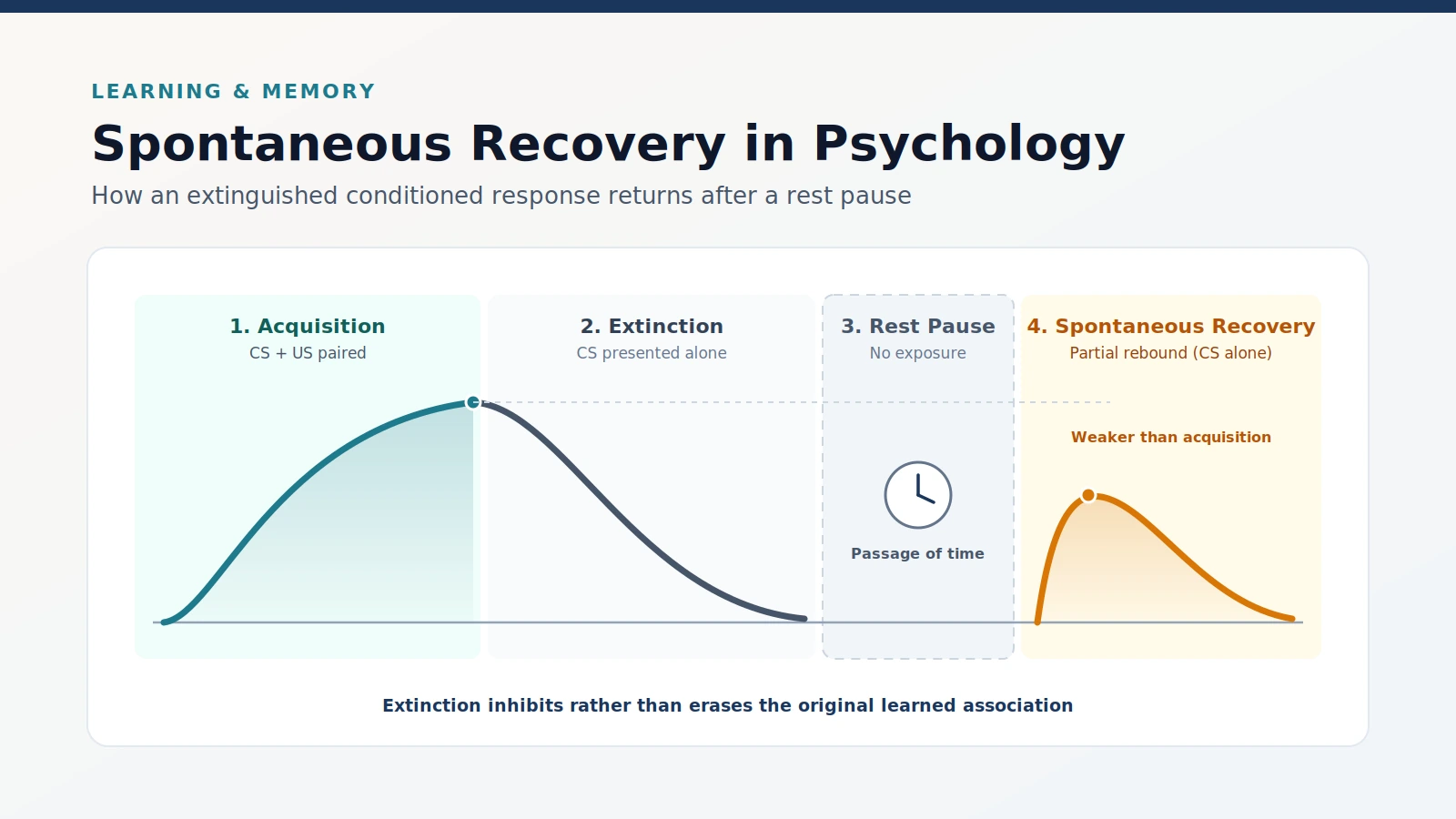
Spontaneous recovery in psychology is the temporary reappearance of a previously extinguished conditioned response following a rest period or lapse in exposure, occurring without any renewed pairing with an unconditioned stimulus or reinforcer. First described by Ivan Pavlov, the phenomenon shows that extinction in psychology inhibits rather than erases original learning.
Across our Learning and Memory study guides, spontaneous recovery serves as a key diagnostic checkpoint for understanding how conditioning changes over time. On the classic learning curve, response strength rises during acquisition, declines during extinction, pauses across a no-exposure interval, and partially rebounds when the cue or opportunity returns. The recovered response is typically weaker than during original acquisition and grows smaller across repeated recovery and extinction cycles.
| Conditioning Phase | Procedure or Condition | Observed Response Pattern | Underlying Learning Status |
|---|---|---|---|
| Acquisition | Repeated CS–US pairings (classical) or consistent reinforcement (operant) | Response strength rises quickly to its peak | Original learned association is formed |
| Extinction | CS presented without US, or reinforcer withheld when behavior occurs | Gradual weakening toward elimination or pre-learning operant level | New inhibitory learning suppresses original memory |
| Rest Pause | Passage of time with no CS exposure or training sessions | No response elicited during the break | Temporal context shifts away from extinction session |
| Spontaneous Recovery | CS presented alone or behavior emitted without reinforcement after the pause | Temporary, weaker partial return of the extinguished response | Original memory trace re-emerges outside extinction context |
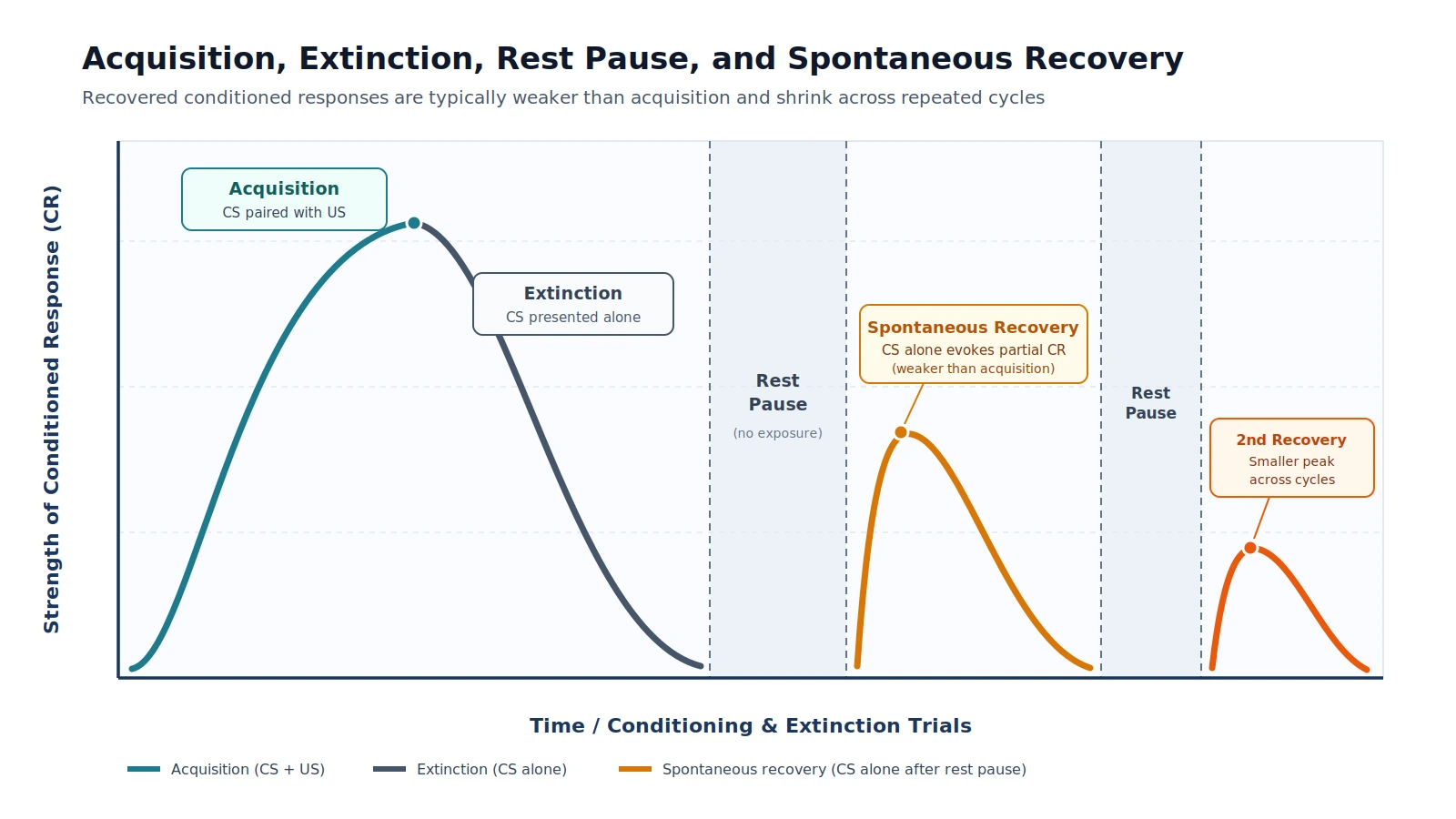 Classic conditioning curve: response strength climbs during acquisition, falls during extinction, and partially rebounds after a rest pause—with smaller peaks across repeated cycles.
What Is Spontaneous Recovery in Classical Conditioning?
In classical conditioning, spontaneous recovery is the partial re-emergence of a previously extinguished conditioned response when the conditioned stimulus is presented alone after a delay, with zero new unconditioned stimulus pairings. Pavlov coined the term after observing dogs salivate to a bell again following a rest period from extinction training.
To see how spontaneous recovery unfolds, start with extinction in classical conditioning. When the conditioned stimulus (CS) is repeatedly presented without the unconditioned stimulus (US), the conditioned response (CR) gradually weakens and eventually disappears. In OpenStax Psychology 2e (Section 6.2, Classical Conditioning), Pavlov repeatedly presented a bell without meat powder until the dogs stopped salivating to the bell. However, after a couple of hours of resting from extinction training, ringing the bell alone caused the dogs to salivate again without any further presentation of meat powder.
Although the chance of spontaneous recovery increases as time passes after extinction, the recovered response generally does not return to full acquisition strength, as summarized in Wikipedia’s overview of spontaneous recovery. With repeated cycles of recovery and additional extinction trials, the conditioned response tends to become less intense during each recovery period. For a full breakdown of how neutral cues become conditioned stimuli before extinction begins, see our classical conditioning stimulus and response examples.
What Is Spontaneous Recovery in Operant Conditioning?
In operant conditioning, spontaneous recovery is the temporary reappearance of an extinguished behavior after a break in time, even though reinforcement remains withheld. During operant extinction, stopping reinforcement causes the previously reinforced behavior to decline gradually toward its pre-learning baseline, known as the operant level, which may or may not be zero.
Just as in Pavlovian conditioning, extinction in psychology refers both to the procedure of withholding the US or reinforcer and to the resulting decline in learned responding across both paradigms. A peer-reviewed study in the Journal of Applied Behavior Analysis (PMC1284178) notes that extinction of operant behavior is associated with undesirable side effects including spontaneous recovery—the temporary reappearance of behavior after responding appears to be completely extinguished—and examines both its occurrence during disruption treatment and methods to attenuate it with large amounts of reinforcement.
Operant extinction is also distinct from forgetting, as outlined in Wikipedia’s summary of extinction in psychology. Forgetting refers to a decrease in the strength of a behavior over time when that behavior has not been emitted, whereas operant extinction requires the organism to emit the behavior without receiving reinforcement. To review how stimulus–stimulus learning compares with behavior–consequence learning and how reward timing shapes response persistence, compare our guides to classical vs. operant conditioning and schedules of reinforcement.
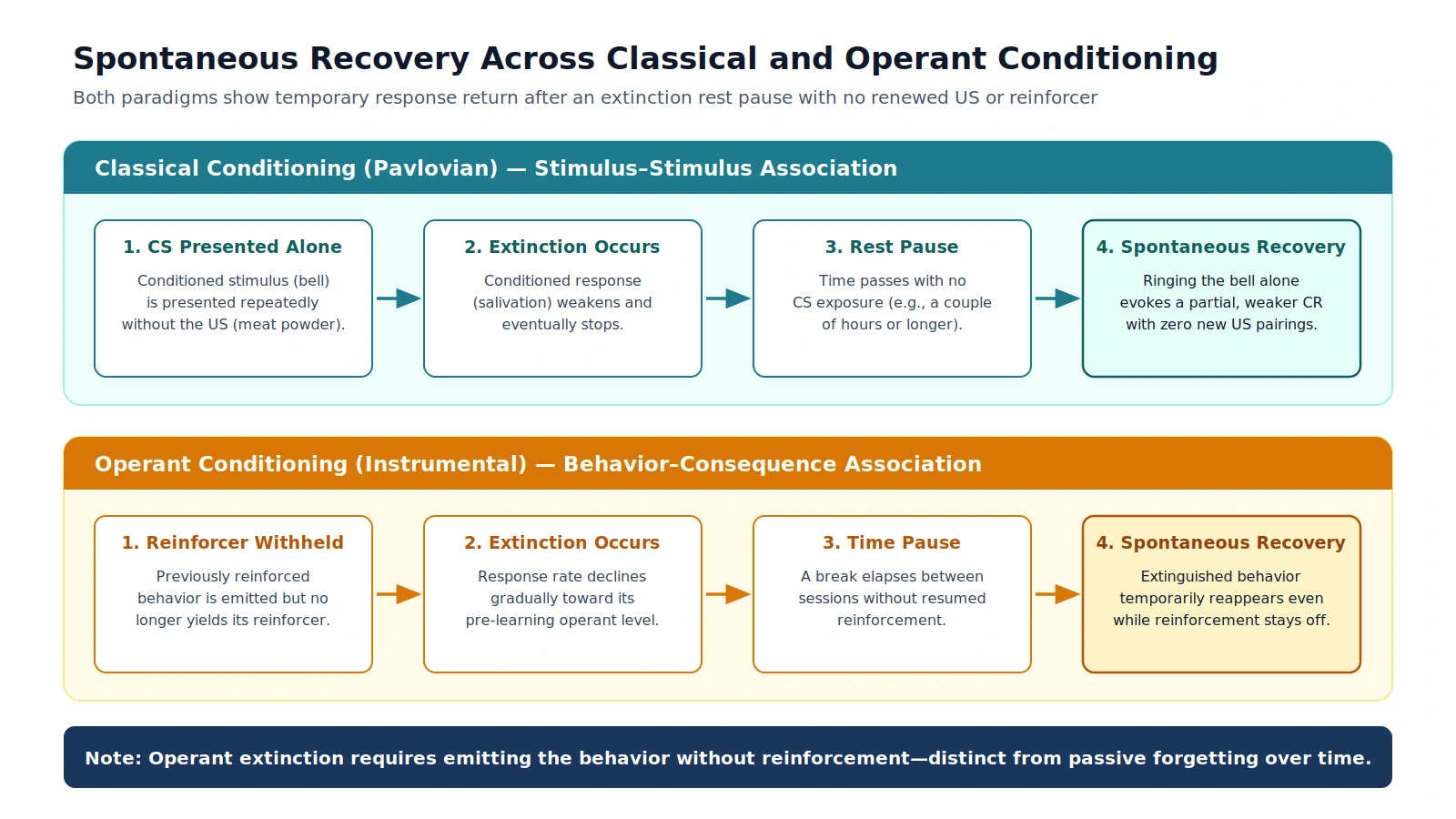 Side-by-side pathways: both classical and operant conditioning produce temporary spontaneous recovery after a pause with no renewed unconditioned stimulus or reinforcer.
Why Does an Extinguished Response Return After a Rest Pause?
An extinguished response returns after a rest pause because extinction does not erase or destroy the original learned association. Instead, conditioning leaves a lasting memory trace, and extinction builds new inhibitory learning that suppresses the original behavior—inhibition that is expressed primarily within the context where extinction occurred.
Learning theorist Mark E. Bouton emphasizes in the Noba Project module Conditioning and Learning (citing Bouton, 2004) that psychologists must recognize extinction does not necessarily destroy original learning. During adolescence and adulthood, extinction is widely interpreted as new learning of a CS–no US association that coexists in tandem with and opposes the original CS–US memory rather than overwriting it.
Context plays the decisive role in whether the inhibitory memory stays active. In learning research, context includes physical locations, internal states such as mood or the sensory effects of drugs like alcohol, and specific periods in time. Because time itself provides a contextual cue, testing the conditioned stimulus after a rest pause moves the organism outside the temporal context of extinction. Viewed theoretically, spontaneous recovery is a temporal form of the renewal effect that emerges when the CS is encountered outside the time context in which extinction was learned.
What Are Real-Life Examples of Spontaneous Recovery in Psychology?
Real-life examples of spontaneous recovery appear whenever a cue or habit that seemed extinguished re-emerges after a lapse in exposure without renewed pairing or reward. Textbook and academic illustrations span household pets responding to food cues, sensory reminders of school memories, and attention-maintained behaviors resurfacing between sessions.
- Household pet cue (classical conditioning): In OpenStax Psychology 2e (Section 6.2), a cat named Tiger associates the sound of an electric can opener with food. If the can opener breaks and goes unused for several months, fixing and running it again can still trigger excitement and send Tiger running to the kitchen because the underlying association persisted across the lapse.
- Sensory memory cue (classical conditioning): In Mark E. Bouton’s Noba Project module Conditioning and Learning, after a lapse in exposure to an extinguished CS, re-exposure to a distinctive sensory cue—such as the smell of chalkboards—can suddenly evoke the conditioned emotional response associated with middle school detention.
- Attention-maintained behavior (operant conditioning): In an everyday operant example, when a child misbehaves to gain attention and attention is consistently withheld, the misbehavior decreases or ceases during extinction. After a pause between sessions, that extinguished behavior can temporarily reappear even while attention remains withheld, as documented in applied behavior research on disruptive behavior (PMC1284178).
How Does Spontaneous Recovery Differ from an Extinction Burst, Renewal, Reacquisition, and Reinstatement?
Separating spontaneous recovery from related post-extinction phenomena requires checking three diagnostic details: when the response appears relative to extinction, what triggered it, and whether the unconditioned stimulus or reinforcer returned. Spontaneous recovery requires prior extinction, a rest pause, and zero renewed US or reinforcement.
Spontaneous Recovery vs. Extinction Burst
An extinction burst happens immediately when the extinction procedure has just begun, whereas spontaneous recovery occurs only after extinction has already weakened or eliminated responding and a rest period has passed. At the onset of extinction, an extinction burst produces a sudden, temporary increase in response frequency—often accompanied by novel, emotional, or aggressive behavior—before the response declines. Learners may also display variations in response topography, such as trying different movements when a familiar action stops working. By contrast, spontaneous recovery is a weaker partial return after a pause rather than an immediate surge at the start of extinction.
Spontaneous Recovery vs. the Renewal Effect
Both spontaneous recovery and the renewal effect show that extinction inhibits rather than erases learned behavior, and both occur in either classical or instrumental conditioning. The difference is the trigger: the renewal effect occurs when an extinguished CS is tested in a different context, such as a new room or location, whereas spontaneous recovery is triggered by the passage of time. Renewal is especially strong when returning to the original conditioning context. Researchers distinguish three renewal designs:
- ABA renewal: Conditioning occurs in context A, extinction occurs in context B, and returning the CS to context A restores conditioned responding.
- ABC renewal: Conditioning occurs in context A, extinction occurs in context B, and testing in a third neutral context C still renews responding.
- AAB renewal: Conditioning and extinction both occur in context A and testing takes place in a second context B, a pattern that currently has weaker evidence of returned responding than ABA or ABC renewal.
Spontaneous Recovery vs. Reacquisition and Reinstatement
Spontaneous recovery occurs without any presentation of the unconditioned stimulus or reinforcer. Reacquisition (also called reconditioning) occurs when the original CS and US are paired again after extinction; it usually proceeds much faster than initial acquisition, demonstrating that the original learning was saved rather than destroyed. Reinstatement also restores conditioned behavior after extinction, but it is triggered by re-exposure to the unconditioned stimulus alone rather than by a rest pause alone.
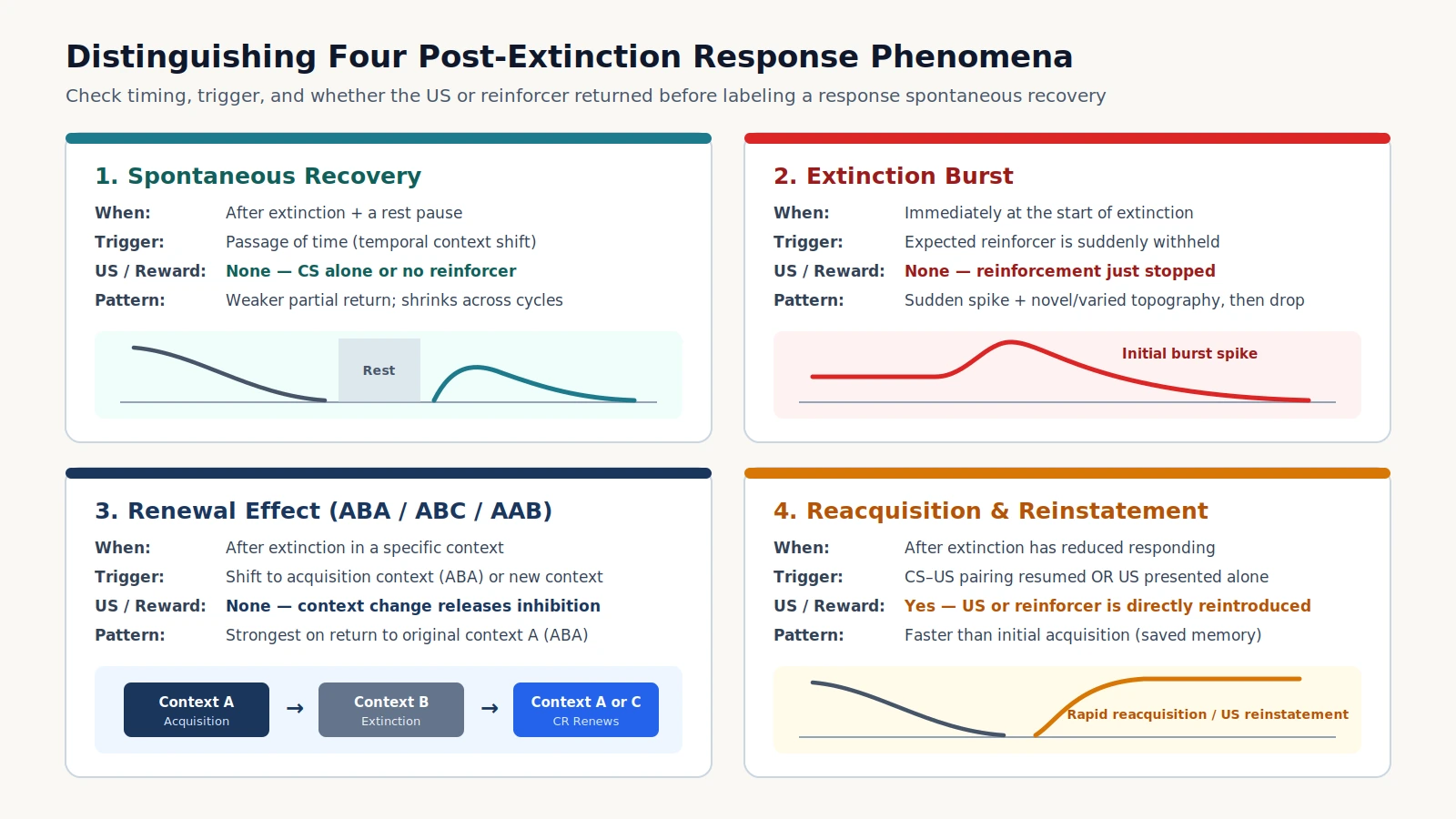 Diagnostic comparison: verify timing, trigger, and whether the US or reinforcer returned before classifying a post-extinction response.
| Phenomenon | Timing Relative to Extinction | Primary Trigger | US or Reinforcer Reintroduced? | Typical Response Pattern |
|---|---|---|---|---|
| Spontaneous recovery | After extinction + rest pause | Passage of time (temporal context shift) | No (CS alone or no reinforcer) | Temporary, weaker than acquisition; shrinks across cycles |
| Extinction burst | Immediately at start of extinction | Expected reinforcer suddenly withheld | No (reinforcement just stopped) | Sudden spike in frequency + novel or varied topography, then decline |
| Renewal effect | After extinction in one context | Context change (ABA, ABC, or AAB) | No (context shift releases inhibition) | Return of CR; strongest when returning to original context A |
| Reacquisition (reconditioning) | After extinction | Resumed CS–US pairings or reinforcement | Yes (contingent pairing resumed) | Faster restoration than original acquisition (saved learning) |
| Reinstatement | After extinction | Re-exposure to the US alone | Yes (US presented alone) | Recovery of conditioned responding triggered by US exposure |
Sources
- Effects of reinforcement magnitude on spontaneous recovery (PMCID: PMC1284178) — Applied behavior analysis study of spontaneous recovery during extinction of operant behavior and attenuation methods.
- Spontaneous recovery — Wikipedia — Overview of Pavlov’s discovery, diminishing recovery across cycles, ABA/ABC/AAB renewal designs, reacquisition, and reinstatement.
- Extinction (psychology) — Wikipedia — Classical and operant extinction definitions, operant level, extinction bursts, response-topography variability, forgetting contrast, and CS–no US inhibitory learning.
- OpenStax Psychology 2e, Section 6.2 Classical Conditioning — Definitions of extinction and spontaneous recovery, Pavlov’s dogs resting a couple of hours, and Tiger the cat.
- Mark E. Bouton, Conditioning and Learning, Noba Project (referencing Bouton, 2004).