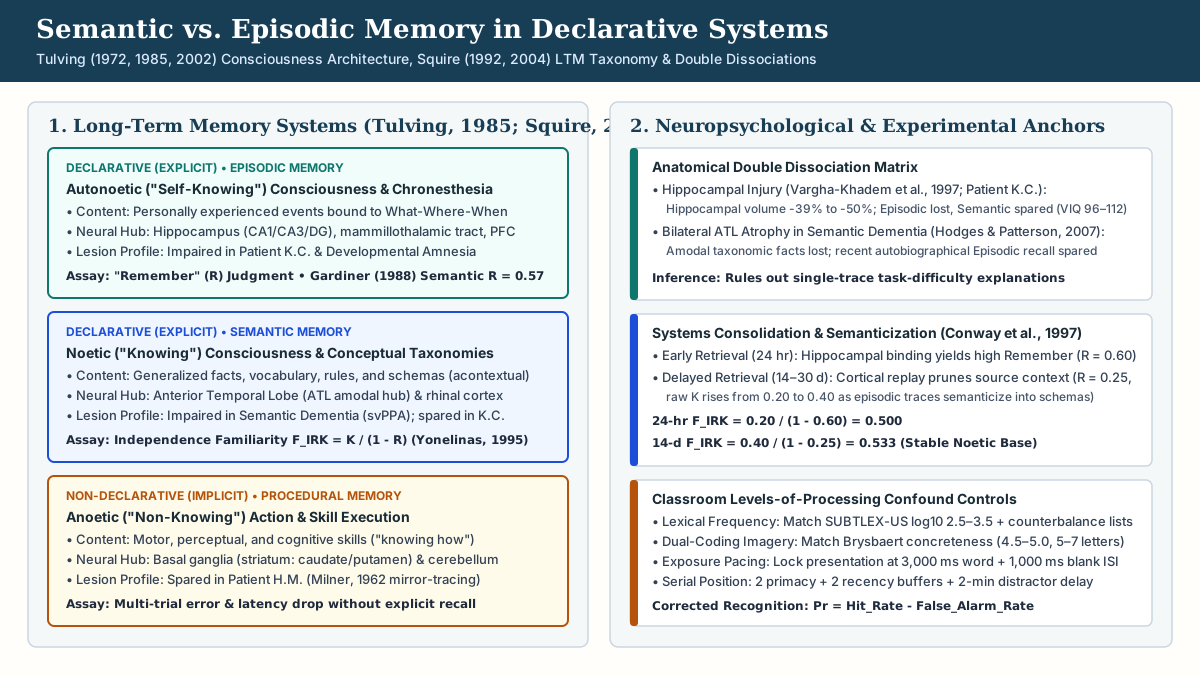
Treating semantic vs episodic memory as a single undifferentiated store causes students to misclassify clinical amnesia profiles and fail experimental retrieval analyses when uncalibrated word lists introduce a confounding variable in psychology labs. Within declarative long-term memory, episodic memory binds personally experienced events to a specific spatiotemporal context through autonoetic recollection, whereas semantic memory stores decontextualized conceptual facts, vocabulary, and taxonomic rules retrieved through noetic awareness.
Across the Learning & Memory study hub and our companion guide to memory psychology classroom experiments, accurate analysis of human memory requires separating three architectural questions before interpreting any recall or recognition score:
- System Boundary (
Procedural vs Declarative Memory): Does the task measure conscious, truth-evaluable recollection mediated by the medial temporal lobe and diencephalon (declarative/explicit), or dispositional motor and perceptual tuning expressed through task performance via the basal ganglia, cerebellum, and neocortex (non-declarative/implicit)? - Declarative Subsystem (
Semantic vs Episodic Memory): Does retrieval require autonoetic mental time travel back to the encoding episode (Remember[R]judgment anchored in the hippocampus), or noetic access to acontextual world knowledge and familiarity (Know[K]judgment and conceptual verification anchored in the anterior and lateral temporal cortices)? - Experimental Internal Validity (
Confounding Variable PsychologyControls): In classroom memory experiments comparing deep semantic encoding against shallow structural or phonemic encoding, are lexical frequency, noun concreteness, exposure duration, and serial position held constant so they do not masquerade as an encoding-depth effect?
| Memory System | Taxonomic Branch (Squire, 1992, 2004) | Encoding Context & Information Stored | Tulving (1985) Consciousness Mode | Primary Neural Substrate | Clinical Lesion Dissociation | Behavioral Retrieval Assay & Metric | Dominant Classroom Failure Mode |
|---|---|---|---|---|---|---|---|
| Episodic Memory | Declarative (Explicit) (“Knowing that”) | Personally experienced events bound in a specific spatiotemporal matrix (what-where-when) | Autonoetic (“Self-knowing”): first-person re-experiencing & chronesthesia (mental time travel) | Hippocampus (CA1/CA3/dentate gyrus), mammillothalamic tract, retrosplenial & prefrontal cortex |
Impaired in Patient K.C. & Developmental Amnesia (Vargha-Khadem et al., 1997); Spared early in Semantic Dementia | Free/cued event recall; Recognition Remember (R) proportion (Gardiner, 1988: Semantic R = 0.57 vs. Phonemic R = 0.27) |
Treating any recognized word on an old/new test as episodic recall without separating R from K |
| Semantic Memory | Declarative (Explicit) (“Knowing that”) | Generalized facts, concepts, vocabulary, mathematical rules, and schemas detached from source context (what) | Noetic (“Knowing”): symbolic awareness of truth-evaluable facts without reliving the study episode | Anterior Temporal Lobe (ATL) amodal hub, perirhinal/entorhinal cortices, lateral temporal & inferior frontal cortex | Impaired in Semantic Dementia / svPPA (Hodges & Patterson, 2007); Spared in Patient K.C. & Developmental Amnesia (VIQ 96–112) |
Taxonomic verification (Pyramids & Palm Trees); Independence Familiarity F_IRK = K / (1 - R) (Yonelinas & Jacoby, 1995) |
Using raw Know (K) proportions without correcting for the (1 - R) opportunity ceiling |
| Procedural Memory | Non-Declarative (Implicit) (“Knowing how”) | Motor, perceptual, and cognitive skills/habits tied to stimulus-response execution; neither true nor false | Anoetic (“Non-knowing”): stimulus-bound action tuning without conscious recollection of prior training | Striatum / Basal Ganglia (caudate nucleus & putamen), motor cortex, and Cerebellum | Spared in Patient H.M. (Milner, 1962 mirror-tracing across 3 days / 30 trials); Impaired in Huntington’s & Parkinson’s disease | Multi-trial error reduction & completion latency slopes across motor or probabilistic habit trials | Confusing knowing the verbal rules of a skill (semantic) with striatal-cerebellar motor execution (procedural) |
How Does Procedural vs Declarative Memory Divide Long-Term Storage?
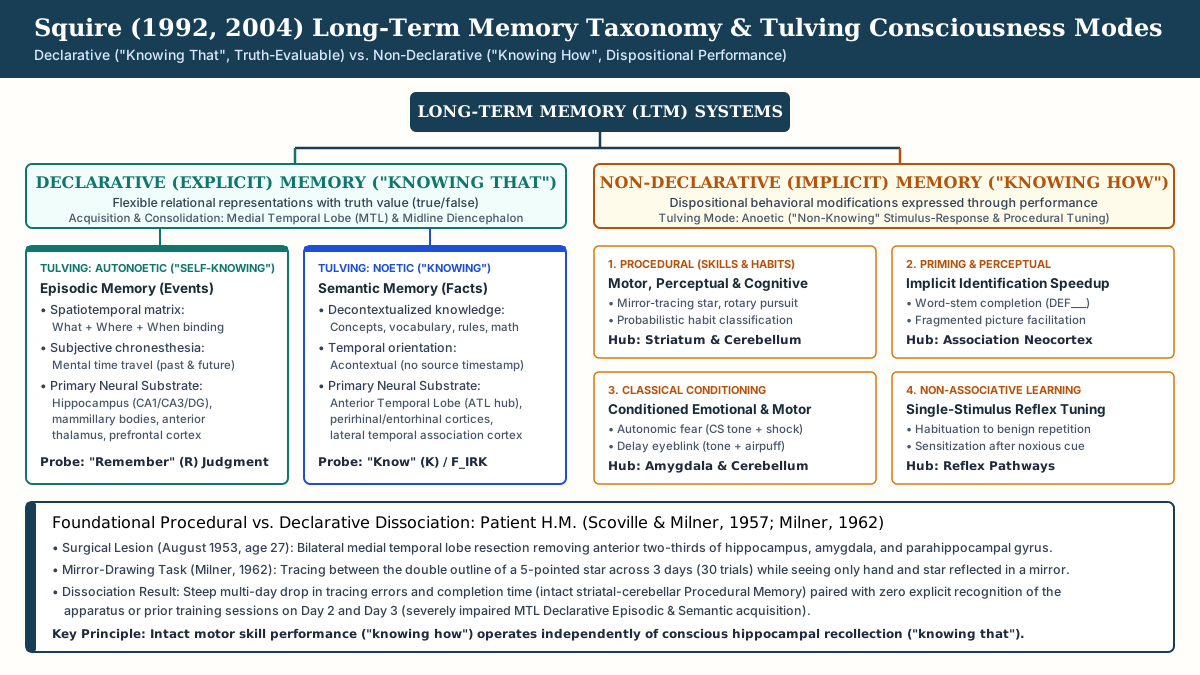
In Larry R. Squire’s (1992, 2004) biological taxonomy of long-term memory (summarized alongside OpenStax Psychology 2e sections 8.1 and 8.2), long-term storage is not a unitary faculty. Instead, it divides into two anatomically and functionally distinct major branches based on whether information is accessible to conscious awareness and how it is expressed behaviorally.
1. Declarative (Explicit) Memory: Relational Representations With Truth Value
Declarative memory (also termed explicit memory) encompasses the conscious, intentional recollection of factual world knowledge and personal autobiographical events (“knowing that”). Declarative representations share three defining computational properties:
- Truth Value: A declarative memory statement (such as “Pavlov published his conditioned reflex lectures in 1927” or “I sat in the third row during Tuesday’s psychology lab”) can be evaluated as objectively true or false.
- Relational Flexibility: Because the medial temporal lobe (MTL) binds multiple cortical inputs into a relational network, declarative memories can be accessed flexibly across novel contexts, verbal prompts, or inferential questions that differ completely from the original study environment.
- Two-Stage Anatomical Dependency: Acquisition and systems consolidation depend on the medial temporal lobe (the hippocampus proper, plus the subhippocampal entorhinal, perirhinal, and parahippocampal cortices) and the midline diencephalon (mammillary bodies and anterior/mediodorsal thalamic nuclei). Over time, systems consolidation stabilizes long-term representations across distributed association neocortex.
2. Non-Declarative (Implicit) Memory: Dispositional Performance Subtypes
By contrast, non-declarative memory (also termed implicit memory) is an umbrella category for four heterogeneous learning systems that modify behavior through direct task performance (“knowing how”) without requiring any conscious recollection of the prior learning episodes. Non-declarative representations are rigid, bound closely to original stimulus-response parameters, and possess no truth value (a bicycle-balancing adjustment or a conditioned eyeblink is neither true nor false):
- Procedural Memory (Skills and Habits): Gradual acquisition of motor skills (mirror-tracing a star, rotary pursuit tracking, riding a bicycle), perceptual skills (reading mirror-reversed text), and cognitive habits (probabilistic weather-prediction classification). Mediated by the striatum / basal ganglia (caudate nucleus and putamen), motor cortex, and cerebellum.
- Priming and Perceptual Learning: Enhanced speed or accuracy in identifying or completing a stimulus following recent prior exposure (such as completing the word stem
DEF___asDEFENDrather thanDEFEATafter seeingDEFENDon an earlier list, even when the participant cannot consciously recall the study list). Mediated by structural representation systems in unimodal and multimodal association neocortex (such as extrastriate visual cortex). - Simple Classical Conditioning: Associative pairing of a neutral conditioned stimulus (
CS) with an unconditioned stimulus (US), which we examine step by step in our classical vs. operant conditioning guide. Autonomic emotional fear conditioning (tone + footshock) depends on the amygdala, whereas skeletal motor delay eyeblink conditioning (tone + corneal airpuff) depends on the cerebellum and interpositus nucleus. - Non-Associative Learning: Single-stimulus behavioral tuning across habituation (progressive decrease in orienting response to a benign repeated stimulus) and sensitization (amplified startle response following a noxious stimulus), mediated by sensory-motor reflex pathways.
In Endel Tulving’s (1985) tripartite model of memory and consciousness, all non-declarative/implicit systems operate at the anoetic (“non-knowing”) tier: the organism registers present sensory stimuli and executes learned behavioral dispositions without conscious awareness of symbolic concepts (noetic) or personal past time (autonoetic).
3. Foundational Clinical Anchor: Patient H.M. and the Mirror-Drawing Dissociation
The anatomical boundary between procedural vs declarative memory was established through the clinical investigation of Henry Molaison (Patient H.M.), reported by William Beecher Scoville and Brenda Milner (1957), Milner (1962), and Suzanne Corkin (2002):
- Surgical Resection (August 1953): At age 27, to relieve medically intractable epilepsy, H.M. underwent bilateral medial temporal lobe resection removing the anterior two-thirds of the hippocampus, amygdala, and parahippocampal gyrus (extending roughly
8 cmposteriorly from the temporal tips). - Profound Anterograde Declarative Amnesia: Following surgery, H.M. retained normal working-memory span (recalling digits as long as he actively rehearsed them) and normal intelligence, but lost the ability to form new long-term episodic events or new semantic facts. Seconds after a conversation ended or a clinician left the room, H.M. had zero explicit memory of the person or event.
- Milner’s (1962) Mirror-Drawing Task: Milner tested H.M. across 3 consecutive days (10 trials per day, 30 trials total) on a sensorimotor procedural task requiring him to trace a line between the double border of a five-pointed star while viewing his hand and the star only as reflected in a mirror (which reverses vertical visual-motor feedback).
- Quantitative Dissociation Outcome: Across the 30 trials, H.M.’s boundary-crossing error count and trial completion time dropped steeply along a normal motor-learning curve, retention of the motor skill carried over cleanly across the 24-hour intervals between Day 1, Day 2, and Day 3, yet before starting Day 2 and Day 3 he had zero declarative recollection of ever having seen the mirror-tracing apparatus or practiced the task.
Rule of thumb: If a memory task requires the learner to verbally declare or recognize what happened or what a fact means (and fails after bilateral medial temporal lobe damage), classify it as Declarative. If learning manifests purely as faster latency, fewer motor errors, or implicit stimulus bias across trials without requiring conscious recall of the training session (and survives hippocampal resection), classify it as Non-Declarative / Procedural.
Takeaway: Squire’s taxonomy separates medial-temporal declarative memory (“knowing that”, comprising episodic and semantic stores) from striatal, cerebellar, and neocortical non-declarative memory (“knowing how”, proven by Patient H.M.’s intact 30-trial mirror-tracing curve).
How Do Semantic vs Episodic Memory Differ Across Tulving’s Eight Dimensions?
Inside the declarative branch, Endel Tulving (1972) introduced the foundational distinction between episodic memory and semantic memory, later expanding the framework in Tulving (1985) and Tulving (2002) from a difference in stored content into a multi-level neurocognitive architecture. While both systems store truth-evaluable propositions and interact constantly during everyday learning, they diverge across eight operational dimensions.
| Architectural Dimension | Episodic Memory System | Semantic Memory System | Classroom & Exam Diagnostic Cue |
|---|---|---|---|
| 1. Core Information Stored | Personally experienced events situated in a specific spatiotemporal matrix (What-Where-When) | Generalized conceptual facts, word meanings, rules, formulas, and world knowledge (What) | Remembering dropping your beaker in Tuesday’s 10 a.m. lab (Episodic) vs. knowing the molar mass of water is 18.015 g/mol (Semantic) |
| 2. Level of Consciousness (Tulving, 1985) | Autonoetic (“Self-knowing”): first-person conscious re-experiencing of the subjective personal past | Noetic (“Knowing”): conscious symbolic awareness of concepts and facts without reliving the study episode | First-person self-reference (similar to the actor perspective in actor-observer attribution) marks autonoetic retrieval |
| 3. Subjective Temporal Orientation | Chronesthesia (“Mental time travel”): projecting self backward into personal past and forward into episodic future planning | Acontextual and timeless: retrieved rapidly without a personal timestamp or spatial origin tag | You do not need to remember the kindergarten classroom where you learned that Paris is the capital of France to verify the fact |
| 4. Retrieval Experience & Operational Probe | Recollection (Remember [R] judgment): retrieves sensory-perceptual, emotional, or associative thoughts from encoding |
Familiarity / Conceptual Verification (Know [K] judgment): high recognition certainty with zero contextual source details |
On an old/new recognition test, R tracks episodic context retrieval while F_IRK = K / (1 - R) tracks noetic familiarity |
| 5. Vulnerability to Context Interference | Highly vulnerable to proactive and retroactive interference, source amnesia, and post-event misinformation | Robust against spatiotemporal context interference once integrated into taxonomic cortical networks | Studying three similar word lists in the same room disrupts episodic list tags far more than core vocabulary meanings |
| 6. Encoding & Consolidation Trajectory | Single-trial rapid binding in hippocampal subfields (CA3/CA1/dentate gyrus) paired with prefrontal control |
Incremental extraction across repeated episodes (semanticization) or fast cortical mapping into prior schemas | One distinctive event creates an episodic trace; repeated exposure strips the room context and leaves a semantic concept |
| 7. Primary Neural Hub | Hippocampus, mammillothalamic tract, retrosplenial/posterior cingulate cortex, and prefrontal cortex (HERA model) | Anterior Temporal Lobe (ATL) amodal semantic hub, perirhinal/entorhinal cortices, and inferior frontal gyrus | Selective hippocampal lesions wipe out episodic recall while ATL degeneration in semantic dementia wipes out conceptual facts |
| 8. Ontogenetic Emergence | Late-developing: emerges around ages 3 to 4 years following the offset of infantile amnesia as PFC-hippocampal circuits mature | Early-developing: rapid vocabulary and categorical knowledge acquisition during infancy and toddlerhood prior to durable episodic recall | A 2-year-old child acquires hundreds of semantic nouns and category rules long before retaining lifelong autobiographical episodes |
Chronesthesia and Autonoetic vs. Noetic Consciousness
Why did Tulving (2002) argue that episodic memory is a uniquely late-evolving neurocognitive system? In Tulving’s architecture, semantic memory is evolutionarily and developmentally older: infants and non-human animals build rich noetic representations of spatial layouts, object categories, and causal regularities without needing to mentally replay the specific afternoon those regularities were learned.
Episodic memory adds two specialized capacities on top of the semantic foundation:
- Autonoetic Awareness: When retrieving an episodic memory, the rememberer does not merely inspect an objective fact; the self is projected as the first-person protagonist inside the reconstructed scene.
- Chronesthesia (Subjective Time Awareness): Episodic memory supports mental time travel both retrospectively (re-experiencing past personal episodes) and prospectively (episodic future thinking: simulating specific personal scenarios next week or next year). As clinical lesion studies confirm, damage that destroys retrospective episodic recall simultaneously abolishes a patient’s ability to imagine specific personal future episodes.
Takeaway: Episodic memory requires autonoetic mental time travel (What-Where-When bound by the hippocampus), whereas semantic memory operates through noetic conceptual awareness (timeless What facts organized in the anterior and lateral temporal cortices).
What Neuropsychological Double Dissociations Separate Episodic and Semantic Systems?
In cognitive neuropsychology, as when applying the evaluation rules in our guide on how to read a psychology study, a single dissociation (where Brain Lesion X impairs Task A more than Task B) cannot prove that Task A and Task B rely on separate memory systems. A skeptic can always argue that Task A (recalling a complex personal event with time and place details) is simply harder or requires more general cortical resources than Task B (defining a familiar word).
To rule out a single-trace task-difficulty explanation, researchers require a crossover double dissociation:
- Group / Patient Profile 1 (Hippocampal Pathology) must exhibit severely impaired Episodic Memory alongside spared Semantic Memory.
- Group / Patient Profile 2 (Anterior Temporal Lobe Pathology) must exhibit spared Episodic Memory alongside severely impaired Semantic Memory.
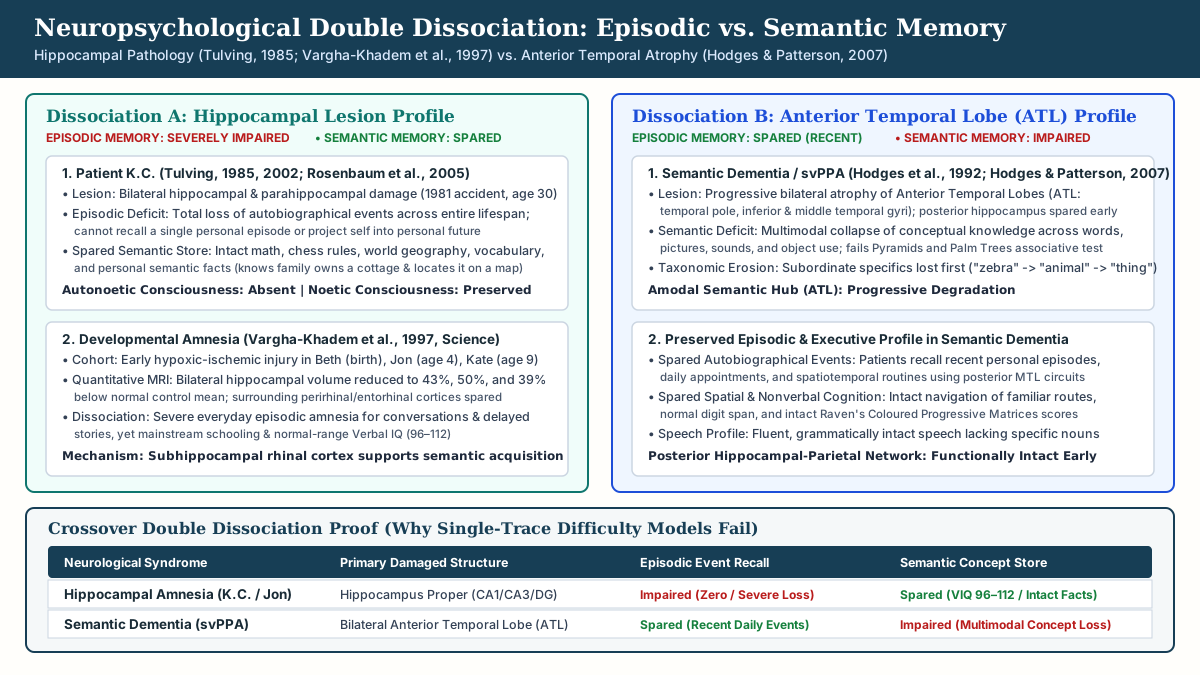
1. Dissociation A (Impaired Episodic, Spared Semantic): Patient K.C. and Developmental Amnesia
Two landmark clinical lines demonstrate that selective hippocampal damage abolishes episodic recollection while sparing semantic knowledge:
- Patient K.C. (Kent Cochrane; Tulving, 1985, 2002; Rosenbaum et al., 2005): Following a 1981 motorcycle accident at age 30, K.C. sustained severe bilateral lesions to the hippocampus and parahippocampal gyrus alongside left frontoparietal damage. K.C. suffered a total loss of autobiographical episodic memory spanning his entire life (both retrograde and anterograde): he failed to recollect a single personal episode he had ever experienced, including tragic events such as his brother’s death or a train derailment near his home, and when asked what he would be doing tomorrow or next summer, he described his mind as “blank” (loss of autonoetic chronesthesia). Yet K.C.’s semantic memory remained remarkably preserved: he retained normal intelligence, vocabulary, mathematics, historical and geographical knowledge, the rules of chess and bridge, and personal semantic facts (for example, he knew that his family owned a summer cottage, pointed to its exact location on a map of Ontario, and stated the distance from his home, even though he failed to recall a single personal visit there). Furthermore, when proactive and retroactive interference were minimized in errorless learning protocols, K.C. slowly acquired new computer vocabulary and three-word semantic definitions.
- Developmental Amnesia (Vargha-Khadem et al., 1997, Science): A critical question left open by adult-onset cases like K.C. was whether a child born with selective hippocampal damage acquires semantic school knowledge during development. Faraneh Vargha-Khadem and colleagues (1997) studied three young patients who suffered early hypoxic-ischemic episodes: Beth (injured at birth), Jon (injured at age 4), and Kate (injured at age 9). High-resolution quantitative MRI revealed selective bilateral hippocampal atrophy, with hippocampal volumes reduced to 43% (Beth), 50% (Jon), and 39% (Kate) below the normal control mean, while the underlying subhippocampal perirhinal and entorhinal cortices remained largely intact. Behaviorally, all three children exhibited profound everyday episodic amnesia, failing to remember daily conversations, television programs, where they placed personal belongings, or delayed story and complex figure recall on the Wechsler Memory Scale. Despite this severe episodic deficit, all three attended mainstream schools, acquired fluent reading, writing, and factual world knowledge, and scored squarely in the normal range on standardized Verbal IQ (
96 to 112) and vocabulary tests. Vargha-Khadem et al. (1997) proved anatomically that the subhippocampal rhinal cortices mediate semantic fact acquisition during development even when the hippocampus proper cannot bind spatiotemporal episodes.
2. Dissociation B (Impaired Semantic, Spared Episodic): Semantic Dementia (svPPA)
The opposite leg of the double dissociation is provided by semantic dementia (also classified as the semantic variant of Primary Progressive Aphasia, svPPA), characterized in detail by John R. Hodges, Karalyn Patterson, and colleagues (1992, 2007):
- Anatomical Locus: Patients with semantic dementia undergo progressive, often asymmetric bilateral atrophy of the anterior temporal lobes (ATL), specifically the temporal pole and the inferior and middle temporal gyri, while the posterior hippocampus, posterior cingulate, and parietal cortices remain relatively spared in the early-to-moderate stages.
- Catastrophic Multimodal Semantic Loss: Because the ATL functions as an amodal semantic hub that binds visual, auditory, verbal, and functional features into coherent concepts, ATL atrophy produces a progressive collapse of conceptual knowledge across all sensory modalities. Patients lose subordinate taxonomic distinctions first while temporarily retaining superordinate labels: a patient shown a picture of a zebra or giraffe calls it an “animal” or “dog” before eventually calling it a “thing”, fails the non-verbal Pyramids and Palm Trees conceptual association test (matching a pyramid to a palm tree rather than a pine tree), and loses knowledge of how everyday tools (such as a corkscrew or matches) function.
- Spared Autobiographical Episodic Memory: In stark contrast to Patient K.C. and Jon, early-to-moderate semantic dementia patients retain intact day-to-day episodic memory for recent personal events. They remember recent clinic appointments, recall where they parked or placed personal items around the house, navigate familiar neighborhood routes accurately, and achieve normal scores on visuospatial working memory and non-verbal problem-solving tasks (Raven’s Coloured Progressive Matrices).
Takeaway: Hippocampal damage (Patient K.C.; Vargha-Khadem et al., 1997 with 39%–50% hippocampal volume loss) destroys episodic recall while sparing semantic facts, whereas anterior temporal lobe atrophy in semantic dementia (Hodges & Patterson, 2007) destroys conceptual semantics while sparing recent episodic recall.
How Does Episodic Memory Transform Into Semantic Memory? (Remember/Know and IRK Math)
Although episodic and semantic memory can be doubly dissociated by focal brain lesions, in the healthy brain they form a dynamic pipeline. When a psychology student first learns a technical concept, such as negative reinforcement or signal detection sensitivity, the memory initially relies on an episodic trace bound by the hippocampus: the student recalls the instructor’s voice, the blue diagram on Slide 14, and sitting near the window on Wednesday morning.
Across repeated active retrieval, which is the core mechanism in our retrieval practice psychology study routine, and sleep-dependent hippocampal-neocortical replay, peripheral spatiotemporal source details are progressively pruned away while the core conceptual relationships stabilize inside distributed neocortical networks. Memory researchers term this episodic-to-semantic transformation semanticization (Squire & Alvarez, 1995; Winocur & Moscovitch, 2011).
Martin A. Conway, John M. Gardiner, and colleagues (1997) demonstrated this transformation directly in undergraduate introductory psychology courses: when students were tested immediately after lecture modules, recognition of course concepts was dominated by Remember (R) episodic recollection of specific lectures; when retested several months later, high-performing students exhibited a pronounced Remember-to-Know (R-to-K) shift, indicating that episodic lecture memories had consolidated into generalized, fast-access noetic semantic schemas.
1. Tulving (1985) and Gardiner (1988): The Remember/Know (R/K) Recognition Paradigm
To separate episodic recollection from semantic familiarity on a single recognition test, building on the hit and false-alarm framework covered in our signal detection theory outcome records guide, Tulving (1985) and John M. Gardiner (1988) developed the Remember/Know (R/K) procedure. Whenever a participant identifies a test word as “Old” (studied on the earlier list), they must classify their subjective state of awareness into one of two responses:
- Remember (
R, Autonoetic Episodic Recollection): The participant consciously recollects specific contextual details from the encoding episode (such as the exact semantic associate or rhyme they generated, a visual mental image, what the word looked like on screen, or an incidental thought that occurred when the word appeared). - Know (
K, Noetic Decontextualized Familiarity): The participant knows with high certainty that the word appeared on the study list, but cannot retrieve any specific spatiotemporal or associative details from the moment of encoding.
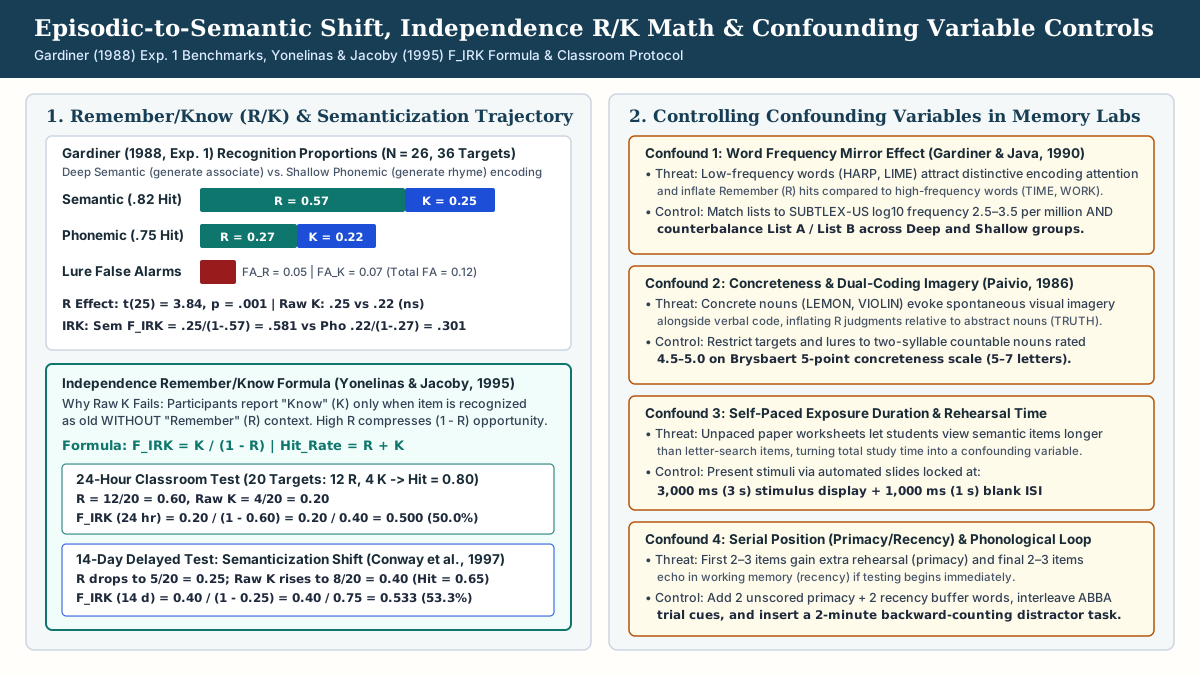
In Gardiner (1988, Experiment 1), N = 26 participants studied a 36-word target list under two levels of processing (Deep Semantic orienting task: generating a semantic associate for each word vs. Shallow Phonemic orienting task: generating a rhyme for each word), followed by an old/new recognition test containing the 36 old target words mixed with 36 unstudied lure words:
- Semantic Encoding Hit Rate:
0.82(composed ofR = 0.57andK = 0.25) - Phonemic Encoding Hit Rate:
0.75(composed ofR = 0.27andK = 0.22) - Unstudied Lure False Alarm (
FA) Rate: TotalFA = 0.12(composed ofFA_R = 0.05andFA_K = 0.07) - Published Statistical Contrast: Deep semantic processing significantly increased overall recognition hits (
0.82vs.0.75,F(1,25) = 5.54, p = .027) and more than doubled Remember (R) responses (0.57vs.0.27,t(25) = 3.84, p = .001), whereas raw Know (K) proportions appeared statistically unchanged (0.25vs.0.22,t(25) = 1.09, ns).
2. Why Raw K Underestimates Familiarity: The Independence Remember/Know (F_IRK) Formula
Why did raw K (0.25 vs. 0.22) appear flat in Gardiner’s (1988) table even though semantic processing strengthens conceptual representations? Andrew P. Yonelinas and Larry L. Jacoby (1995) proved that raw K suffers from a mathematical ceiling artifact created by standard task instructions.
Because participants are instructed to press Know (K) only when an item is recognized as old and is not recollected (not R), R and K are mutually exclusive responses that sum to the overall hit rate (Hit_Rate = R + K), even though underlying episodic recollection (R) and noetic familiarity (F) operate as independent memory processes. Under stochastic independence, the probability of making a K response is the joint probability that an item is familiar (F_IRK) and that episodic recollection fails (1 - R):
- Response Exclusivity Equation:
K = F_IRK × (1 - R) - Yonelinas & Jacoby (1995) Independence Familiarity Formula (
F_IRK):F_IRK = K / (1 - R)
Whenever an experimental manipulation (such as deep semantic encoding or immediate testing) drives R upward (for example, to 0.57 or 0.60), it shrinks the remaining non-recollected opportunity space (1 - R) down to 0.43 or 0.40. Dividing K by (1 - R) recovers the true conditional probability of noetic familiarity across non-recollected trials.
Worked Example 1: Applying Pr and F_IRK to Gardiner (1988) Experiment 1
Let us compute Corrected Recognition (Pr) and Independence Familiarity (F_IRK) on Gardiner’s (1988) Experiment 1 benchmark proportions:
-
Corrected Recognition Discrimination (
Pr = Hit_Rate - False_Alarm_Rate):Total False_Alarm_Rate = FA_R + FA_K = 0.05 + 0.07 = 0.12Pr_Semantic = 0.82 - 0.12 = 0.70Pr_Phonemic = 0.75 - 0.12 = 0.63Pr_Remember_Semantic = R_Semantic - FA_R = 0.57 - 0.05 = 0.52Pr_Remember_Phonemic = R_Phonemic - FA_R = 0.27 - 0.05 = 0.22
-
Independence Familiarity (
F_IRK = K / (1 - R)):- Deep Semantic Condition (
R = 0.57,K = 0.25):F_IRK (Semantic) = 0.25 / (1 - 0.57) = 0.25 / 0.43 = 0.5814 (58.1%) - Shallow Phonemic Condition (
R = 0.27,K = 0.22):F_IRK (Phonemic) = 0.22 / (1 - 0.27) = 0.22 / 0.73 = 0.3014 (30.1%)
- Deep Semantic Condition (
While raw K looked nearly identical (0.25 vs. 0.22), correcting for the (1 - R) opportunity space reveals that deep semantic encoding nearly doubled underlying noetic familiarity (58.1% vs. 30.1%, a +28.0 percentage-point gain) alongside its +30.0 percentage-point boost in episodic recollection (0.57 vs. 0.27).
Worked Example 2: Tracking the 24-Hour vs. 14-Day Classroom Semanticization Shift
Suppose a student completes a 20-target recognition test at 24 hours post-study and a matched 20-target delayed recognition test at 14 days post-study (modeling the Conway et al., 1997 consolidation trajectory):
-
At 24 Hours Post-Encoding (
20Old Targets):- Total Old Hits =
16 / 20(Hit_Rate = 0.80) Remember (R)=12 / 20 = 0.60- Raw
Know (K)=4 / 20 = 0.20 - Independence Familiarity:
F_IRK (24 hr) = 0.20 / (1 - 0.60) = 0.20 / 0.40 = 0.500 (50.0%)
- Total Old Hits =
-
At 14 Days Post-Encoding (
20Old Targets):- Total Old Hits =
13 / 20(Hit_Rate = 0.65) Remember (R)drops to5 / 20 = 0.25(as specific room and slide context fades)- Raw
Know (K)doubles to8 / 20 = 0.40(items formerly inRshift intoKas they semanticize) - Independence Familiarity:
F_IRK (14 d) = 0.40 / (1 - 0.25) = 0.40 / 0.75 = 0.533 (53.3%)
- Total Old Hits =
Diagnostic Interpretation: Between Day 1 and Day 14, episodic recollection (R) declined sharply from 0.60 to 0.25 (Delta_R = -0.35), causing raw K to jump from 0.20 to 0.40 (Delta_K = +0.20) as formerly recollected items lost their spatiotemporal tags. Computing F_IRK (0.500 at 24 hours vs. 0.533 at 14 days) proves that the underlying noetic semantic representation remained completely stable across the two-week consolidation window.
Takeaway: Always compute F_IRK = K / (1 - R) alongside Pr = Hit_Rate - False_Alarm_Rate; raw K is compressed whenever R is high and rises mechanically during delayed testing as episodic memories shed their source context.
How to Control Confounding Variables in a Classroom Memory Experiment
In introductory psychology courses, replicating Craik and Tulving’s (1975) Levels of Processing effect with Gardiner’s (1988) Remember/Know recognition probes is one of the clearest ways to teach both declarative memory systems and confounding variable psychology controls. When students design a rough classroom demonstration without tightening stimulus and timing parameters, at least four extraneous variables routinely covary with the encoding manipulation and invalidate the causal claim.
Before running the 20-minute protocol, have students record the independent variable, dependent variables, and operational definitions using our psychology variables and operational definitions worksheet:
- Independent Variable (
IV, Encoding Orientation): Deep Semantic Encoding (“Does this word refer to a living or non-living object?” or “Rate word pleasantness from 1 to 5”) versus Shallow Structural/Phonemic Encoding (“Does this word contain the letter E?” or “Does this word have exactly two syllables?”). - Dependent Variables (
DVs):- Old/New Corrected Recognition:
Pr = Hit_Rate - False_Alarm_Rate - Autonoetic Recollection Proportion:
R = Remember_Hits / Total_Old_Targets - Noetic Independence Familiarity:
F_IRK = K / (1 - R)
- Old/New Corrected Recognition:
Confounding Variable (Confounding Variable Psychology) |
Mechanism of Threat to Internal Validity | Direction of Distortion on R and K |
Mandatory Experimental Control Procedure |
|---|---|---|---|
| 1. Lexical Word Frequency (Gardiner & Java, 1990; Glanzer & Adams, 1985 mirror effect) | Low-frequency words (such as HARP, LIME) are orthographically and conceptually distinctive at encoding compared to high-frequency everyday words (TIME, WORK) |
Low-frequency targets artificially inflate Remember (R) hit rates and suppress lure false alarms independent of encoding depth |
Match List A and List B to SUBTLEX-US log10 word frequency of 2.5 to 3.5 per million AND counterbalance lists across Deep and Shallow groups |
| 2. Noun Concreteness & Imageability (Paivio, 1986 Dual-Coding Theory) | Concrete, high-imageability nouns (LEMON, VIOLIN) automatically evoke a visual mental image code alongside the verbal lexical code, whereas abstract nouns (TRUTH, JUSTICE) rely on verbal code alone |
Dual-coded concrete nouns generate rich sensory-perceptual retrieval cues that inflate Remember (R) judgments even under shallow instructions |
Restrict all target and lure words to two-syllable countable concrete nouns matched at 4.5 to 5.0 on Brysbaert et al.’s 5-point concreteness scale (5–7 letters) |
| 3. Self-Paced Exposure Duration & Rehearsal Time | When students complete encoding ratings on an unpaced paper handout, rating semantic pleasantness takes longer or invites extended elaborative viewing compared to scanning for the letter E |
Longer exposure duration per item increases total encoding time, turning study duration into a direct confounding variable | Present all encoding stimuli via an automated slide deck locked at 3,000 ms (3 s) stimulus display + 1,000 ms (1 s) blank ISI across every trial |
| 4. Serial Position Effect (Primacy & Recency) & Working Memory | The first 2–3 list items receive extra cumulative rehearsal (primacy), and the final 2–3 items remain active in the phonological loop (recency) if recognition testing begins immediately |
If Deep or Shallow trials cluster at list boundaries, or if testing starts without a filled delay, recency echoes inflate scores without testing long-term memory | Add 2 unscored primacy buffer words at the start and 2 unscored recency buffer words at the end, interleave prompts in an ABBA sequence, and insert a 2-minute backward-counting distractor task |
Step-by-Step 20-Minute Classroom Protocol (N = 20 to 30 Students)
- Stimulus List Construction (
20Scored Targets +4Buffers +20Matched Lures):- Select
40concrete, two-syllable countable nouns (5 to 7letters,SUBTLEX-US log10frequency2.5–3.5, Brysbaert concreteness4.5–5.0). Divide them into List A (10words), List B (10words), and Lure List C (20words), plus4extra matched nouns for the2primacy buffers (Positions 1–2) and2recency buffers (Positions 23–24).
- Select
- Counterbalanced Group Assignment (Preventing List-Difficulty Confounds):
- Divide the class into Group 1 and Group 2 using the counterbalancing audit rules in our three-condition order audit guide:
- Group 1 Packet: Encodes List A under Deep Semantic instructions (“Living or Non-Living?”) and List B under Shallow Structural instructions (“Contains the letter E?”).
- Group 2 Packet: Encodes List B under Deep Semantic instructions and List A under Shallow Structural instructions.
- Interleave trial prompts in an ABBA block structure so neither condition systematically occupies earlier or later serial positions.
- Divide the class into Group 1 and Group 2 using the counterbalancing audit rules in our three-condition order audit guide:
- Paced Encoding Phase (
96 SecondsTotal):- Run an automated slide deck displaying each of the
24words (2primacy buffers +20scored targets +2recency buffers) for3,000 ms(3.0 s) followed by a1,000 ms(1.0 s) blank screen (24 trials × 4.0 s = 96 seconds). Students circleYes / Noon their encoding sheet during each 4-second window.
- Run an automated slide deck displaying each of the
- Filled Distractor Retention Interval (
120 Seconds):- Immediately after Slide 24 disappears, have all students turn their encoding sheets face down and complete a 2-minute (
120-second) distractor task (counting backward by 7s from483in writing or completing a digit-symbol substitution grid). This clears the phonological loop and eliminates the short-term recency effect.
- Immediately after Slide 24 disappears, have all students turn their encoding sheets face down and complete a 2-minute (
- Recognition and Remember/Know (
R/K) Test Phase (5 Minutes):- Distribute the
40-wordtest sheet (20scored targets from List A and List B randomly intermixed with20unstudied lures from List C; primacy and recency buffers are omitted). - For each word, students first circle Old or New. For every word marked Old, they circle either R (
Remember: I can replay a specific encoding detail, image, or thought from when this word flashed on screen) or K (Know: I am certain this word was on the slide deck, but I recall no specific episode details).
- Distribute the
Worked Example 3: Counterbalancing Audit That Eliminates a List-Specific Confound
Suppose despite careful selection, List A happens to contain slightly more distinctive nouns than List B, creating a +0.08 (8.0 percentage-point) intrinsic list advantage on Remember (R) scores independent of the encoding instructions. Watch what happens in an uncounterbalanced design versus our 2-group counterbalanced design across N = 30 students (n = 15 per group):
-
Scenario 1 (Flawed Uncounterbalanced Design: All 30 students get List A = Deep, List B = Shallow):
- True baseline
R(Shallow):0.25; True Deep encoding boost:+0.26; Accidental List A confound:+0.08 - Observed
R_Deep (List A only)=0.25 + 0.26 + 0.08 = 0.59 - Observed
R_Shallow (List B only)=0.25 + 0.00 = 0.25 - Biased Apparent Effect =
0.59 - 0.25 = +0.34(Overestimates the true+0.26encoding effect by+0.08because list identity is 100% confounded with the independent variable).
- True baseline
-
Scenario 2 (Counterbalanced 2-Group Design:
n = 15Group 1 [A=Deep, B=Shallow];n = 15Group 2 [B=Deep, A=Shallow]):- Group 1 (
n = 15):R_Deep (List A) = 0.59,R_Shallow (List B) = 0.25 - Group 2 (
n = 15):R_Deep (List B) = 0.25 + 0.26 = 0.51,R_Shallow (List A) = 0.25 + 0.08 = 0.33 - Pooled Class Mean for Deep Semantic Encoding:
Mean_R_Deep = (0.59 + 0.51) / 2 = 1.10 / 2 = 0.55 - Pooled Class Mean for Shallow Structural Encoding:
Mean_R_Shallow = (0.25 + 0.33) / 2 = 0.58 / 2 = 0.29 - Unbiased Class Encoding Effect (
Delta_R):Delta_R = Mean_R_Deep - Mean_R_Shallow = 0.55 - 0.29 = +0.26 - Isolated List-Difficulty Check (
List_Offset):List_Offset = ((0.59 + 0.33) / 2) - ((0.51 + 0.25) / 2) = 0.46 - 0.38 = +0.08
- Group 1 (
By counterbalancing List A and List B across Group 1 and Group 2, the +0.08 stimulus-list offset contributes equally to both Deep (0.55) and Shallow (0.29) pooled means, recovering the exact +0.26 true encoding-depth effect and allowing the class to measure the +0.08 list difference separately.
Takeaway: Match stimuli on SUBTLEX-US frequency (2.5–3.5) and Brysbaert concreteness (4.5–5.0), lock presentation timing at 3,000 ms + 1,000 ms ISI, include 2 primacy and 2 recency buffers with a 2-minute distractor task, and counterbalance List A and List B across Deep and Shallow conditions so stimulus properties never become a confounding variable.