Calling every unpleasant event punishment leads to wrong answers on negative reinforcement examples vs punishment. Negative reinforcement strengthens a response through the removal or prevention of an aversive event; punishment weakens the response.
Escape ends an aversive event that has already started; avoidance prevents an expected aversive event. Both count as negative reinforcement when that consequence makes the named response more likely in comparable situations. An unpleasant sound alone does not identify punishment, and relief alone does not establish reinforcement. First name the response, then identify what it changes, then check what happens to that same response later. The examples and practice cases below make those pieces explicit.
For the broader addition/removal framework, use positive vs negative reinforcement. This page focuses on interpreting cases within the Learning & Memory guide.
Which negative reinforcement examples show escape or avoidance?
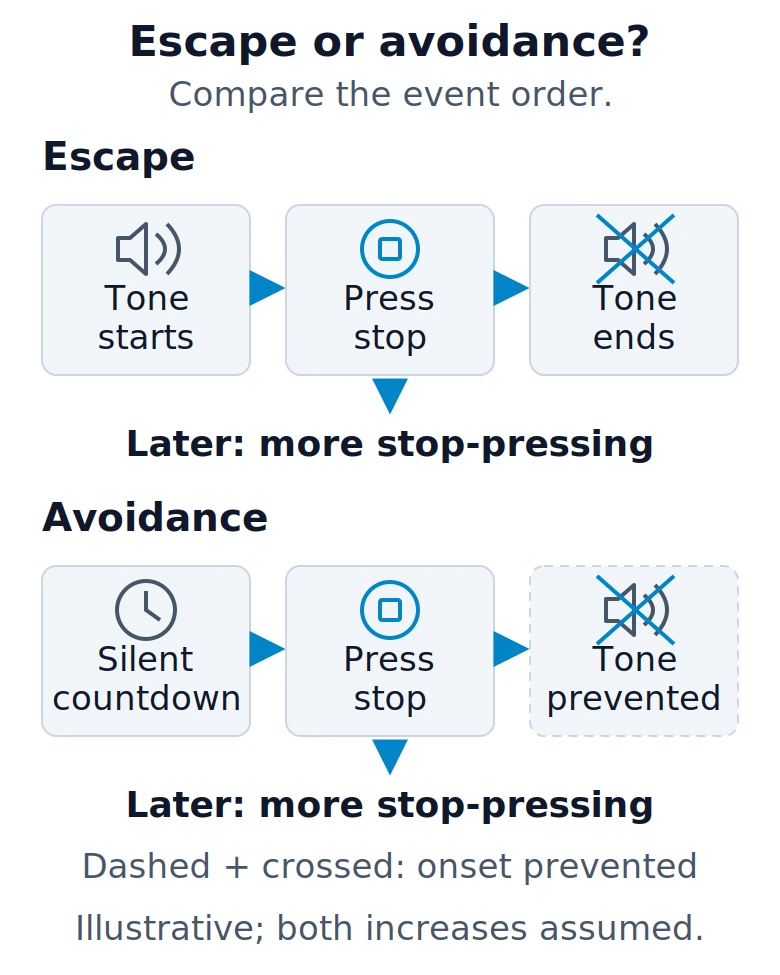
Escape examples stop something already happening; avoidance examples prevent something expected. The table uses a hypothetical desk timer to hold the action constant while changing its timing. These are written study scenarios, not activities to carry out on another person.
| Case | Named response | Event and consequence | Later responding stated in the case | Classification and reason |
|---|---|---|---|---|
| Timer already sounding | Press the stop button | An unwanted tone is sounding; pressing ends it | The person becomes more likely to press stop when it sounds | Escape: the response ends the ongoing event and increases |
| Timer about to sound | Press the stop button during a silent countdown | In this fictional timer, pressing cancels the expected unwanted tone | Cancelling during the countdown becomes more likely | Avoidance: the response prevents the event and increases |
| Timer stops, later behavior omitted | Press the stop button | The unwanted tone ends when pressed | Not reported | Escape arrangement, but its reinforcing effect is not established |
The timing distinction follows Washington State University’s Principles of Learning and Behavior, Module 6, sections 6.2.2 and 6.7.1. A cue can precede an avoidance response without being the aversive event itself: the timer’s silent countdown precedes the unwanted sound. Do not classify the case by whichever stimulus happens to appear first.
Can the same action be escape in one example and avoidance in another?
Yes. The action’s relation to the aversive event changes the classification. OpenStax’s seatbelt example describes buckling that stops an ongoing warning sound and makes later buckling more likely: an escape example. A separate, hypothetical variation would specify that earlier buckling prevents an expected warning and becomes more likely: avoidance. That variation assumes a warning arrangement; it is not a specification for every vehicle.
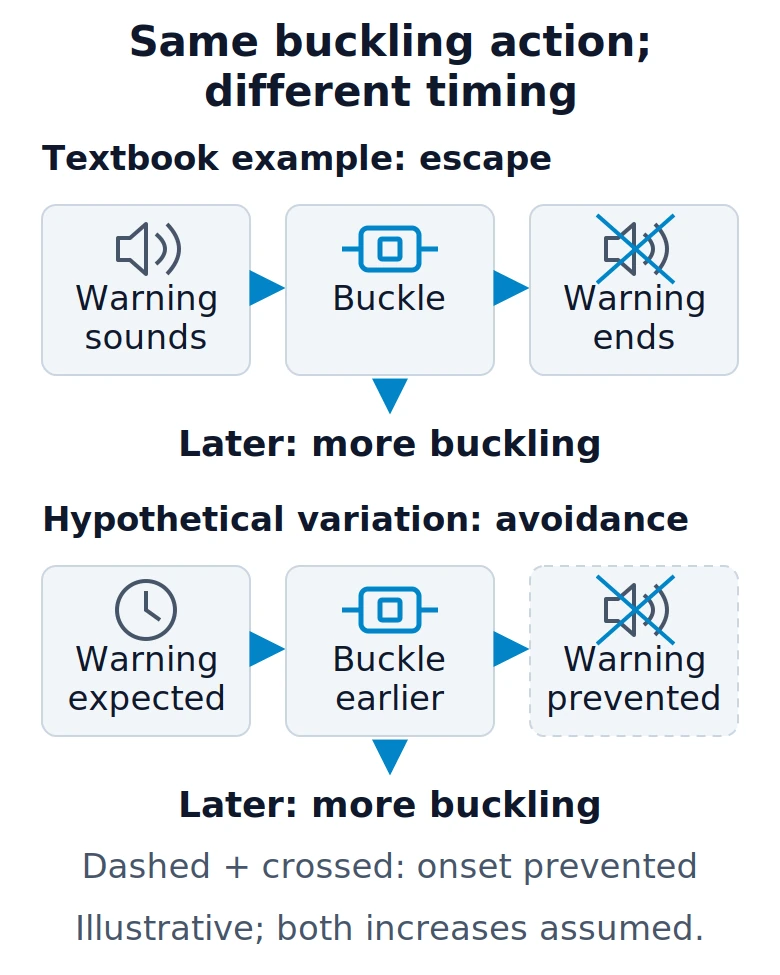
Rule of thumb: If the event is already occurring and the response ends it, classify the timing as escape. If the response prevents an expected event before it starts, classify it as avoidance. Then check that the response increases before calling the consequence reinforcing.
A simple timing formula helps with a written scenario:
d = t(response) − t(event onset)
Here, d is the response’s position relative to onset, in seconds. For avoidance, use the onset scheduled if no response occurred, since the prevented event has no actual onset. With an ongoing event, d > 0 is compatible with escape; with an event successfully prevented, d < 0 is compatible with avoidance. An exactly simultaneous or unspecified sequence needs more detail. The sign alone does not establish a contingency or learning.
Worked example, invented timing: A tone starts at 5 s and pressing stop ends it at 8 s: d = 8 s − 5 s = +3 s, so the timing is escape. Increased later pressing would still need to be stated. These numbers illustrate event order; they are not a response-time standard or research finding.
If a question confuses a cue before the response with a consequence after it, review classical vs operant conditioning.
Why are these examples different from punishment?
They strengthen the response that removes or prevents the aversive event. Punishment decreases the response that produces its consequence. Keep the same response in view throughout the explanation; switching from “making a noise” to “pressing stop” halfway through changes the question.
| Written case | Label, given the stated outcome | Dominant failure mode & prevention |
|---|---|---|
| Pressing stop removes an unwanted tone; later pressing increases | Negative reinforcement | Calling the tone punishment because it is unpleasant. Track pressing and its consequence. |
| An unwanted error tone follows an incorrect keypress; that keypress decreases | Positive punishment | Classifying the later stop-button response instead. Keep the incorrect keypress as the target response. |
| A valued game token is removed after an off-turn move; off-turn moves decrease | Negative punishment | Treating all removal as negative reinforcement. Identify what is removed and whether the target response decreases. |
| An unwanted task ends after disruption; disruption increases | Negative reinforcement | Using the intended disciplinary label. Classify the stated effect on disruption. |
These are hypothetical classification cases, not disciplinary recommendations. The task-removal contrast adapts WSU section 6.7.3’s warning that an intended punishment can reinforce the response instead. “Wanted it to stop” describes an intention; the case must also supply the relevant consequence and later behavior.
Practice: can you identify the response, consequence, and label?
Use the stated contingency and later direction to classify each written case. Answer without looking at the key, including an explanation of what is missing when a label cannot be confirmed.
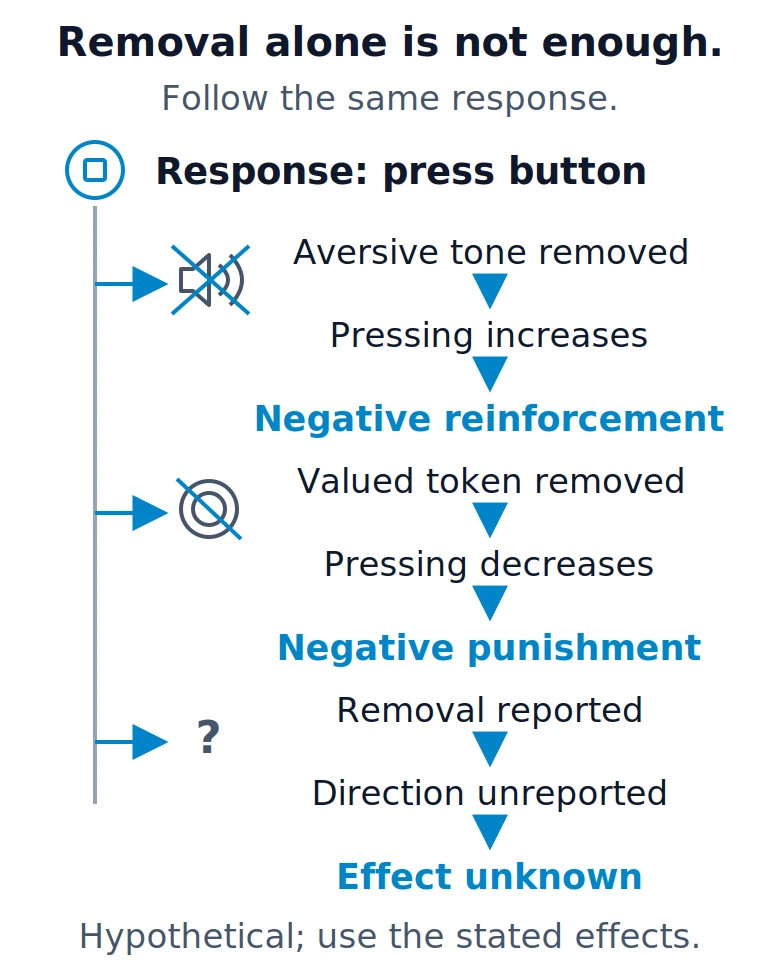
All cases below are fictional. “More likely” and “less likely” are assumptions supplied by the exercise, not observations or measured effect sizes.
- A. An unwanted timer tone is sounding. Lee presses stop, which ends it. Pressing stop when the tone sounds becomes more likely.
- B. On the same fictional timer, Lee presses stop before the tone is due, preventing it. Pressing during that countdown becomes more likely.
- C. In a fictional game, an incorrect keypress produces an unwanted error tone. That incorrect keypress becomes less likely.
- D. In another game, an off-turn move removes a valued token. Off-turn moves become less likely.
- E. An unwanted tone ends because Lee presses stop. The description gives no information about later pressing.
- F. An unwanted fictional worksheet task ends whenever the character disrupts it. Disruption becomes more likely in that situation.
Copy or fill the following table in your notes. There is no separate download.
| Case | Target response | What changes because of it? | Later direction | Label and timing, or missing information |
|---|---|---|---|---|
| A | ______ | ______ | ______ | ______ |
| B | ______ | ______ | ______ | ______ |
| C | ______ | ______ | ______ | ______ |
| D | ______ | ______ | ______ | ______ |
| E | ______ | ______ | ______ | ______ |
| F | ______ | ______ | ______ | ______ |
Show the answer key and reasoning
- A — Negative reinforcement, escape. Pressing stop ends an ongoing unwanted tone, and pressing increases.
- B — Negative reinforcement, avoidance. Pressing stop prevents the expected unwanted tone, and earlier pressing increases.
- C — Positive punishment. The target is the incorrect keypress. It produces an added unwanted tone and decreases. The later action that silences the tone is not the response being classified.
- D — Negative punishment. The target is the off-turn move. It removes a valued token and decreases.
- E — Reinforcement not established. Pressing ends an ongoing event, so this is an escape arrangement. Without the later effect, the description does not establish that pressing was reinforced.
- F — Negative reinforcement, escape. Disruption ends an ongoing unwanted task and increases. A character’s or observer’s intention does not change that stated relation.
Where does a shortcut create extra study work?
Memorizing only “negative means removal” leaves the response and its later direction unresolved. Use the table below as a study-effort ledger: it records likely repair tasks, without inventing time savings or a learning-effect percentage.
| Shortcut | Hidden study cost | Repair and next step |
|---|---|---|
| Labeling by whether an event seems bad | Reworking examples that have different target responses | Write the action first; use the operational-definitions worksheet if it remains vague |
| Memorizing one object, such as a timer | Relearning the case when event order changes | Explain both A and B with the same action and different timing |
| Looking at the answer before attempting the case | Losing the opportunity to identify your own missing step | Attempt the blank table, then use the retrieval-practice routine to revisit a missed explanation |
When an answer is wrong, repair the particular field that caused it: response, consequence, direction, or timing. You can do this entirely with written cases.
Method and sources
This guide uses OpenStax Psychology 2e, section 6.3, for the reinforcement/punishment distinction and the seatbelt example, and WSU’s Principles of Learning and Behavior, Module 6, sections 6.2.2, 6.7.1, and 6.7.3, for escape, avoidance, and the task-removal caveat. Sources were accessed on 19 October 2026. Timer and game cases, the practice table, and the timing arithmetic are original teaching constructions with their assumptions stated. They do not report an experiment, a treatment outcome, or a vehicle specification. This is a study resource for interpreting examples.
Last updated: October 19, 2026.