Swapping a cue with the response it elicits can make an entire example table wrong. In these classical conditioning examples, the UCS, UCR, CS, and CR table separates the unlearned stimulus–response relationship from the learned cue–response relationship.
The UCS elicits an unlearned response, the UCR; the CS elicits a learned response, the CR. In Pavlov’s food example, food is the UCS and salivation to food is the UCR. A tone begins as a neutral stimulus (NS) for salivation; after learning, that tone is the CS and salivation to it is the CR. Label the event and the response separately, and specify which stimulus elicited the response. The worked table and paper practice below apply that distinction, including a case where the learning history is incomplete.
Use this page within the Learning & Memory guide. If you first need to distinguish stimulus associations from behavior and consequences, read classical vs operant conditioning.
What do UCS, UCR, CS, and CR mean?
UCS and CS name stimuli; UCR and CR name responses. “Unconditioned” identifies the unlearned relationship in the example, while “conditioned” identifies the relationship acquired through learning.
| Role | Question to answer | Pavlov food-and-tone example |
|---|---|---|
| UCS: unconditioned stimulus | What elicits the unlearned response? | Food in the mouth |
| UCR: unconditioned response | What response does that UCS elicit? | Salivation to food |
| NS: neutral stimulus | Which cue initially does not elicit the target response? | Tone before learning |
| CS: conditioned stimulus | Which cue elicits the response after learning? | That tone after learning |
| CR: conditioned response | What learned response does the CS elicit? | Salivation to the tone alone |
OpenStax uses UCS/UCR; Noba uses US/UR for the same unconditioned roles. A tone can be audible while being neutral with respect to salivation: “neutral” does not mean undetectable or incapable of producing any response.
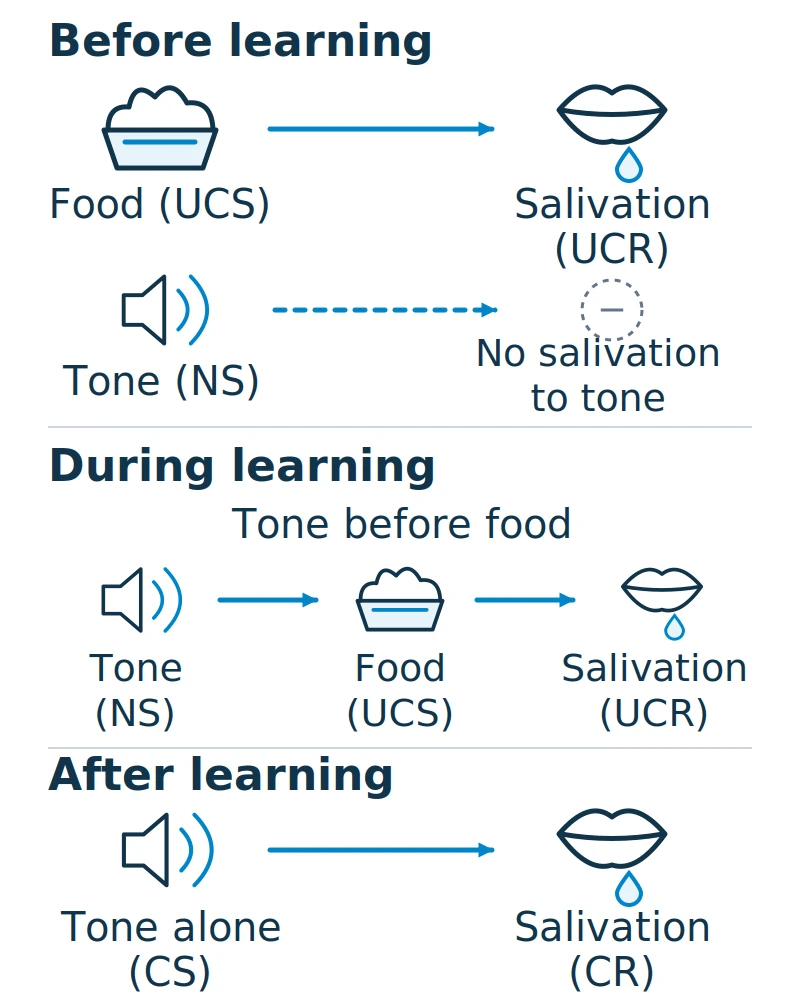
Before learning: food elicits salivation, while the tone does not elicit that target response. During learning: the tone precedes food. After learning: the tone alone elicits salivation. The same cue changes from NS to CS; food remains the UCS.
This phase map follows OpenStax section 6.2 and Figure 6.4. The arrows show relationships and order, not a formula for learning strength or a required number of trials.
Which classical conditioning examples fit the table?
Food and salivation provide the clearest reference cases; taste, emotion, and advertising examples require closer attention to the scenario’s assumptions. Read each row as a mapping for the learner and response described, rather than a universal reaction to that object. Scroll across the table to see every role and its error-prevention column.
| Scenario | UCS | UCR | NS before → CS after learning | CR | Dominant failure mode & prevention |
|---|---|---|---|---|---|
| Pavlov’s dogs | Meat powder / food | Salivation to food | Tone initially neutral for salivation → tone that predicts food | Salivation to the tone alone | Calling the tone UCS. Identify what elicited salivation before the tone–food learning. |
| Ice-cream truck music | Chocolate ice cream in the mouth | Mouth watering to the ice cream | Truck music initially neutral for mouth watering → music associated with eating ice cream | Mouth watering to the music before eating | Labeling the purchase as CR. Keep mouth watering as the target response. |
| Harry’s taste-aversion story | Eating too much cotton candy, as this textbook story labels it | Getting sick and vomiting | Sugary flavor → flavor associated with that sickness | Later nausea at the taste of sugar | Treating all candy as an illness-producing UCS. Preserve the story’s excessive intake and later taste response. |
| Textbook dog-fence case | Electrical shock | Discomfort from the shock | Yard edge → location associated with shock | Fear/anxiety at the yard edge | Labeling the yard as the painful event. Separate the location cue from the shock. |
| Advertising analogy, assuming an already positive response to an athlete | Athlete in the textbook’s simplified UCS role | Positive feelings toward the athlete | Product initially neutral for those feelings → product associated with the athlete | Positive feelings toward the product, if acquired | Assuming every viewer responds positively or buys. State the assumed feelings and distinguish an attitude from a purchase. |
The rows adapt examples in OpenStax section 6.2: the Pavlov definitions, ice-cream passage, Harry paragraph, dog-fence paragraph, and “Advertising and Associative Learning” box. These are textbook examples for analysis. Keep the aversive cases on paper; do not recreate illness or fear with classmates or animals.
Harry’s UCS cell follows that particular story’s wording. It does not establish that an ordinary sugary taste naturally causes illness. The flavor is the learned cue in the later part of the story.
The advertising row is a simplified analogy. OpenStax assigns the athlete, positive feelings, and product to UCS, UCR, and CS roles; the CR cell here applies the definition to feelings toward the product. Prior fondness for an athlete may itself have been learned, so this is a less clean example of an unlearned relationship than food eliciting salivation. Without the assumed initial response and a later change toward the product, the completed mapping is not established for an actual viewer.
Why can salivation be UCR in one case and CR in another?
The label depends on what elicits the response and how that relationship developed. In the ice-cream example, mouth watering to ice cream is UCR; mouth watering to the associated music before any bite is CR. The physical description can look similar while the eliciting stimulus differs.
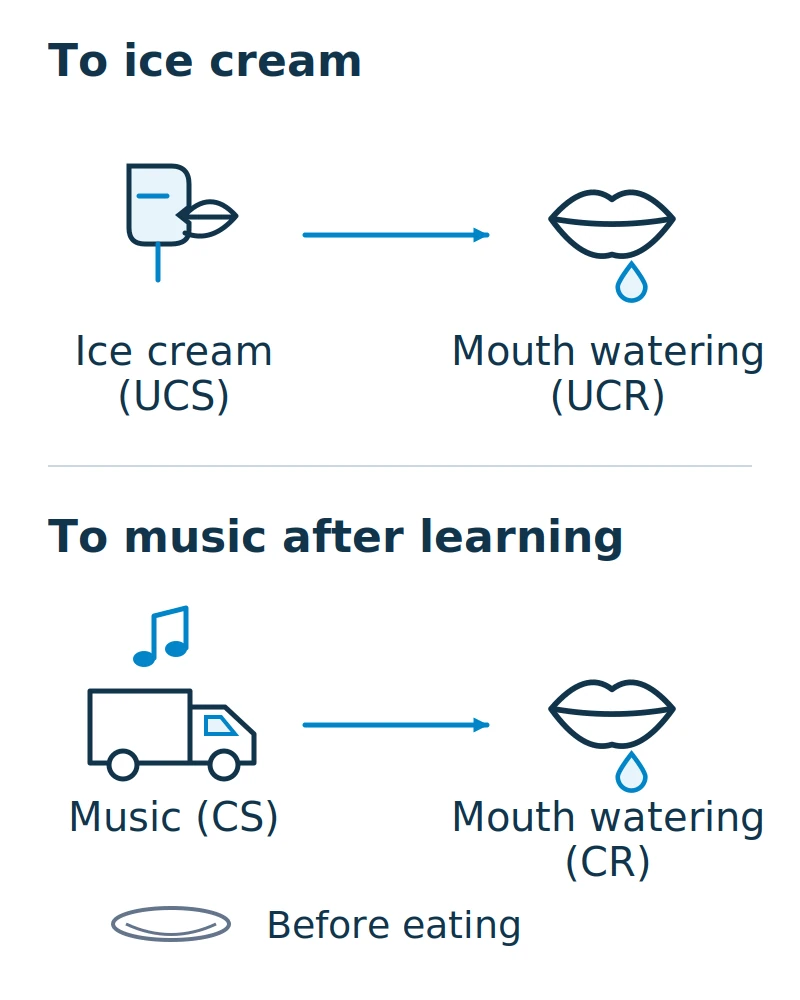
Ice cream in the mouth → mouth watering (UCR). After learning, truck music before eating → mouth watering (CR). The diagram holds the named response constant and changes its elicitor.
Do not turn this convenient example into a rule that CR must always be identical to UCR. Noba’s “Classical Conditioning Has Many Effects on Behavior” explains that a conditioned cue can elicit a system of responses, including responses that differ from the direct effects of the UCS. The fence row also names different responses: discomfort to shock and fear/anxiety to the associated location.
If a scenario only says someone “reacts,” specify the response before labeling it. The operational-definitions worksheet helps separate a broad word from the behavior or bodily response a description actually identifies.
How do you label a new scenario without guessing?
Identify the unlearned stimulus–response pair first, then trace the cue’s history and the response to that cue. This order keeps the food, tone, and salivation from drifting into the wrong columns.
- Name the UCS and its UCR. Write “stimulus → response,” such as food in the mouth → salivation.
- Trace the cue. Identify what it initially did with respect to that target response and how it was paired with the UCS.
- Check the learned relationship. Identify the response elicited by the cue in the absence of the UCS. Then label the cue CS and its response CR.
Rule of thumb: If the description supplies pairing but omits the cue’s initial status or later cue-elicited response, mark the missing relationship “insufficient information.” A pairing count alone cannot fill those gaps. This is a rule for interpreting a written problem, not a biological threshold for whether learning exists.
Noba’s “The Learning Process” describes blocking: an already predictive cue can prevent learning about an added cue even when both accompany the UCS. There is therefore no universal number of pairings or fixed time interval that justifies every CS/CR answer. If your course asks for a proposed conditioning arrangement, distinguish that proposed role from a demonstrated learned response.
Practice: can you label the roles and explain each answer?
Use the stated history to fill UCS, UCR, NS-to-CS, and CR for each case; write what is missing when a role cannot be confirmed. These are original paper exercises based on the source relationships, not experimental records or instructions to condition anyone.
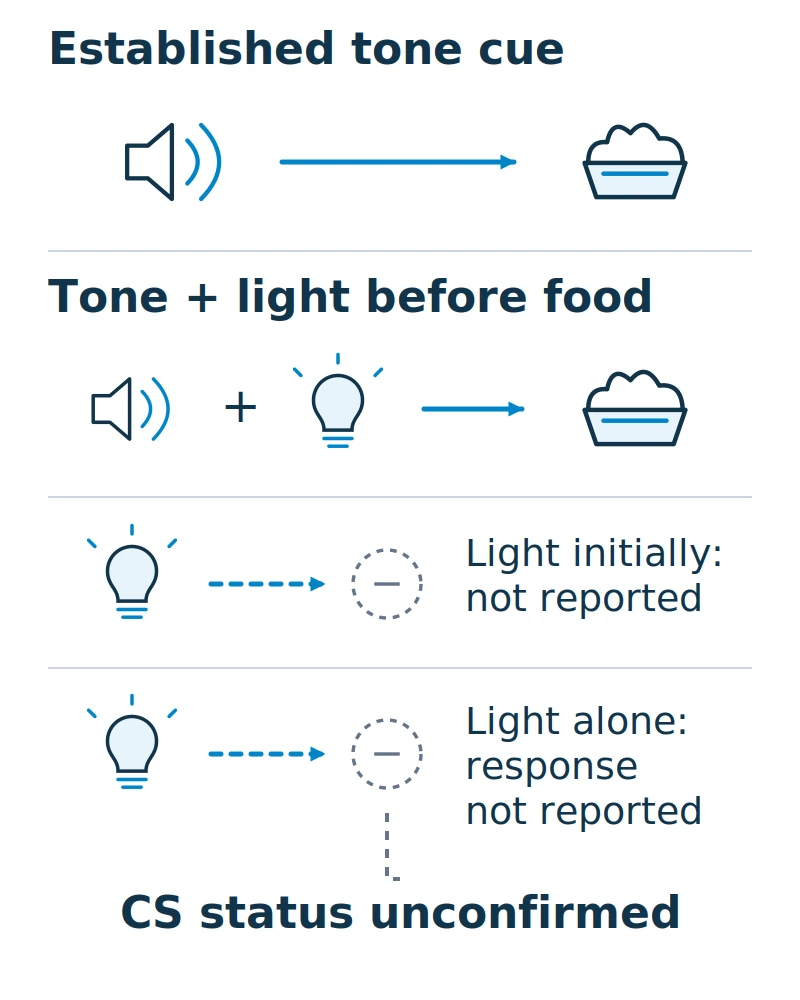
An answer needs the original stimulus–response pair, the cue’s history, and a later response to that cue. A missing cue-only response leaves the learned outcome unresolved.
- A — Food and tone. A fictional dog salivates when food is in its mouth. Initially, a quiet tone does not elicit salivation. After the tone has preceded feeding repeatedly, the tone alone elicits salivation.
- B — Music and ice cream. In a fictional story, Sam’s mouth waters when eating chocolate ice cream. Truck music initially does not cause mouth watering. After experiences pairing the music with ice cream, Sam’s mouth waters on hearing the music before eating anything.
- C — An added light. The dog in A already salivates to the tone. A light is then switched on alongside the tone before food. Nothing is reported about the dog’s response to the light before this phase or to the light alone afterward. Can you confirm that the light became a CS?
For each complete case, write a short reason for every role rather than copying four abbreviations. For C, separate the known food relationship from the unresolved light relationship.
Answer key with reasons
Scroll across to check the reason for each role.
| Case | UCS and reason | UCR and reason | Cue: NS-to-CS reasoning | CR and reason |
|---|---|---|---|---|
| A | Food in the mouth: it elicits salivation before tone–food learning | Salivation to food: the stated unlearned response | Tone: initially no salivation, then a food-paired cue that elicits salivation alone | Salivation to the tone alone: it follows the learned cue without food |
| B | Chocolate ice cream in the mouth: it elicits the original mouth watering | Mouth watering to the ice cream: the response to that UCS | Truck music: initially neutral for mouth watering, then associated with ice cream and effective before eating | Mouth watering to the music before a bite: the response now follows the learned cue |
| C | Food: its role from A is still stated | Salivation to food: that unlearned relationship is still known | Light: initial neutrality for salivation is unreported; pairing is stated, but learned CS status is unconfirmed | A CR to light alone is not reported. Insufficient information; do not infer success from pairing |
C also leaves the established tone relationship intact: the tone was already a CS in A. Blocking is one reason the added light might fail to acquire control, but the incomplete exercise does not establish that blocking actually occurred.
How should you use mistakes to choose what to review?
Record the specific role or relationship you missed, then revisit a prompt that tests that distinction. Treat a practice score as bookkeeping for this exercise.
An explicit calculation can track checked labels:
Correct-label fraction = correctly labeled roles ÷ roles checked
Worked example, hypothetical: If 3 of the 4 roles in A are correct, 3 ÷ 4 = 0.75 = 75% of those checked labels are correct. This is arithmetic on assumed answers, not a measured learning gain, a pass threshold, or a clinical or ability score. Score the NS-to-CS explanation separately if you choose to check it too.
A small review ledger makes the extra work visible:
| Error in the attempt | Extra study work it creates | Next action |
|---|---|---|
| Stimulus placed in a response cell | Rechecking definitions and repairing the affected cells | Rewrite each cell as either an event or a response |
| Tone labeled UCS | Retracing the before-learning phase | Explain what food elicited before the tone was predictive |
| CR inferred from pairing alone | Returning to the history and finding the missing outcome | Write what response to the cue alone would need to be supplied |
| Correct label without a reason | Checking whether the answer transfers to another case | Change the cue in a paper scenario and explain the same relationship |
The cost here is time spent rereading and correcting answers; no measured minutes or monetary savings are available. For a way to organize the next attempt, use the retrieval-practice explain-and-check routine. Return to classical vs operant conditioning when the confusion concerns a behavior’s consequence rather than the four classical roles.
Method and sources
The role definitions, phase map, and worked examples follow OpenStax Psychology 2e, section 6.2. Mark E. Bouton’s Noba module Conditioning and Learning supplies the alternative US/UR notation and the qualifications about conditioned responses and blocking. Both publisher-hosted pages were accessed 19 October 2026. They are educational explanations rather than datasets from experiments conducted for this page.
The paper prompts, answer explanations, review ledger, and assumed score calculation are original study aids. The advertising CR cell is an application of the definition to the textbook’s simplified analogy, with its assumptions stated beside the table. This material supports psychology study; it does not provide diagnosis or treatment advice.
Last updated: October 2026.