Treating a classroom recall count as a measure of someone’s ability can lead to a wrong conclusion. Use memory demonstrations to compare a clearly defined task, record what happened, and separate that observation from an explanation.
Examples of memory psychology experiments can explore encoding instructions or differences between recall and recognition. The original classroom cards below translate those ideas into low-equipment learning activities with word lists, blank records, and discussion prompts. They are proposed demonstrations, not replications of a named experiment, validated tests, or treatments. They need not produce a predicted pattern to support a discussion of measurement and limits.
- Choose a concept before choosing a word list.
- State the instruction and scoring rule in advance.
- Keep participation optional and avoid public rankings.
- Explain what the observation leaves unresolved.
Tables scroll sideways on narrow screens.
What do these memory demonstrations measure?
The demonstrations record responses to specified materials. They do not directly reveal an internal memory process. OpenStax’s how-memory-functions section distinguishes encoding, storage, and retrieval and describes recall and recognition. Use those concepts to interpret the task without assuming a missed response identifies one particular failure.
| Proposed card | Concept focus | Task change | Record | Do not conclude |
|---|---|---|---|---|
| A: word instructions | Encoding | Letter-focused versus meaning-focused instruction | Correctly recalled studied words | One instruction always improves memory |
| B: answer format | Retrieval | Produce words versus identify words among candidates | Correct recall, hits, and false alarms separately | Recognition and recall are equivalent scores |
The record is a task response, not a direct reading of a memory system. At a glance: Task response and concept · Conceptual path · Encoding · Storage · Retrieval · Observe a response · Do not diagnose ability.
The research-methods practice questions help distinguish a changed condition from a measured outcome. For a paper-only activity that needs no participant responses, use the social-influence scenario worksheet.
Takeaway: Define the observable task before interpreting it through a memory concept.
How can you run the original encoding card?
Card A changes the instruction applied to a word list and then uses the same recall task. Its purpose is to make the comparison visible, not to establish a universal learning strategy. Read it as a proposed classroom procedure; the words and logistics are editorial choices without a tested effect claim.
OpenStax describes Craik and Tulving’s encoding-question experiments: participants processed words using different kinds of questions before a memory task. Card A borrows the conceptual contrast between questions about form and meaning. Its words, openly explained task, chosen timings, and scoring are original teaching choices; it is not a replication and does not inherit the published experiments’ results. This historical summary is textbook-attributed, not a claim that the original paper was fully reviewed here.
Original demonstration words: spoon, cloud, ladder, lemon, drum, pillow, bridge, candle.
Letter-focused instruction: “For each word, write whether it contains the letter L.”
Meaning-focused instruction: “For each word, write whether it names something you might find in a kitchen.”
Recall instruction: “After the words are hidden, write the studied words you remember, in any order.”
Set the display interval and recall interval before starting, and keep them the same between conditions. Record the chosen intervals in the blank table; no required duration is claimed here. Present the words in the same order and format. Do not announce a “winning” strategy in advance.

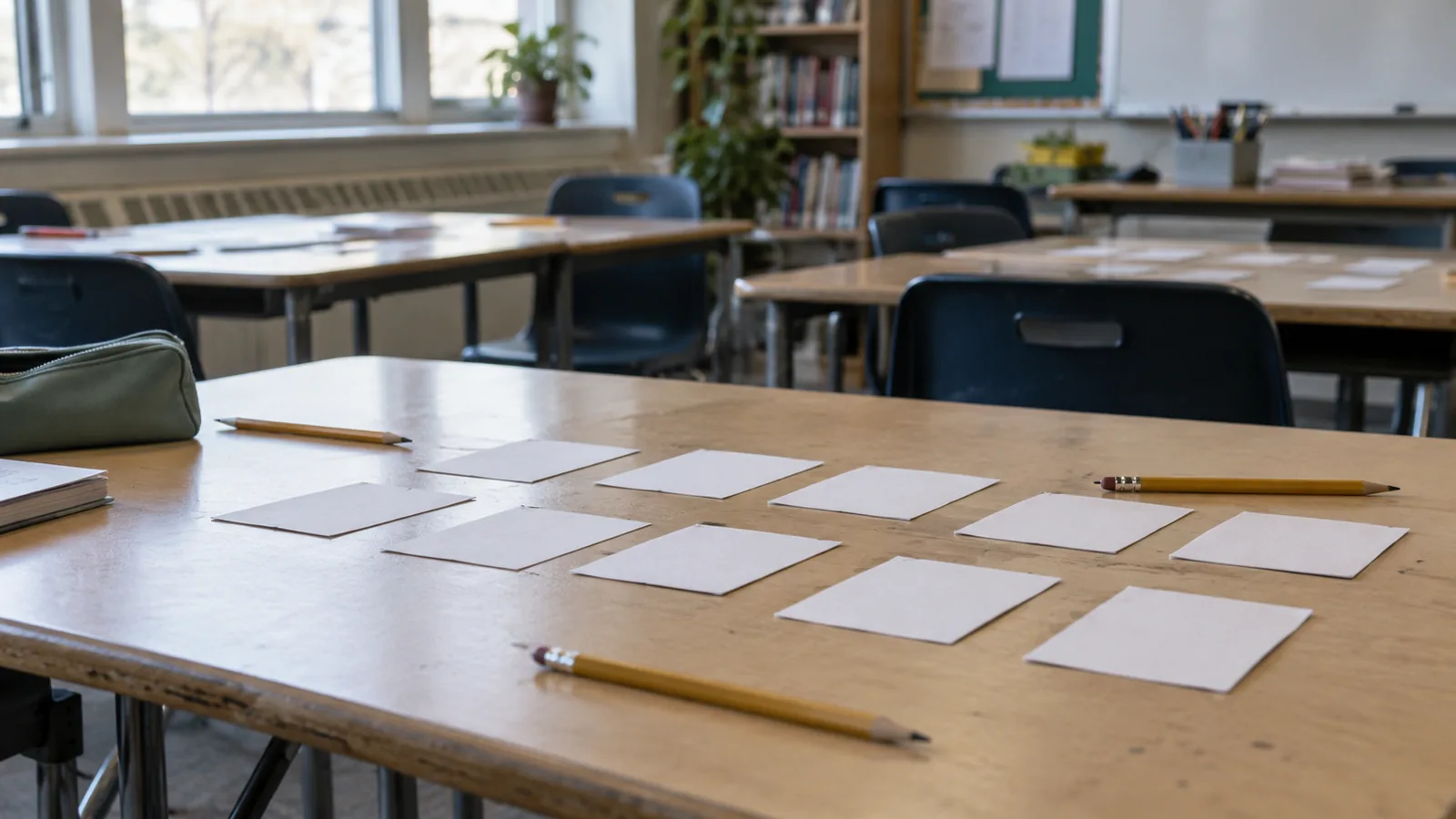
Illustrative photo — generated editorial image, not a real classroom study, participant or result.
Card A illustrates instruction differences; the words are original demonstration materials, not a standardized list. At a glance: Card A keeps the same word list (spoon, cloud, ladder, lemon, drum, pillow, bridge, candle) and changes only the instruction — letter-focused (“Contains L?”) or meaning-focused (“Found in a kitchen?”) — before the same recall task.
If an instructor chooses to run a class comparison, explain the task openly and let learners observe or use the fictional record instead. Keep responses unnamed and private. A chance allocation of willing participants to conditions is an assignment procedure; it does not make the class a randomly sampled population. The sampling and assignment explanation distinguishes those decisions.
Avoid having each learner do both instructions on this same list and then treating the second attempt as independent. Familiarity with the words would have changed. Using different lists introduces a different difficulty: list content also varies. Note the design tradeoff rather than claiming either arrangement automatically resolves it.
Common mistake: Giving one group extra viewing time, then attributing the difference only to meaning-focused instruction. The comparison changed more than the stated factor.
Takeaway: Keep the material and logistics comparable, and record every change that accompanies the instruction.
How can you compare recall with recognition?
Card B contrasts producing a studied word with identifying one when alternatives are shown. The format changes what the learner is asked to do. Do not treat equal-looking totals as interchangeable measurements, or use recognition after recall as an independent test of the same untouched memory.
Original study words: basket, river, pencil, window, peach, helmet, garden, ribbon.
Recall card: “Hide the study list. Write any studied words you remember.”
Recognition card: “Mark the words that were on the study list.”
Original candidate list: basket, ocean, pencil, curtain, peach, bicycle, garden, button, river, window, helmet, ribbon.
The unstudied candidates are ocean, curtain, bicycle, and button. A selected studied word is a hit; a selected unstudied word is a false alarm. Count those separately. A recall response counts as correct when it identifies a studied word; decide how to handle spelling variants and repetitions before seeing responses.

Illustrative photo — generated editorial image, not a real classroom study, participant or result.
Card B distinguishes response formats and includes unstudied alternatives so false alarms remain visible. At a glance: Card B: response formats · Recall · Produce studied words · Recognition · Select studied words · If selected · Studied words · Unstudied words · Hits · False alarms.
For a concept lesson, show the cards on paper and ask students how each would be scored without running a comparison. For an optional live illustration, use separate study, test, and instructor-key sheets rather than giving learners the complete article page. Before starting, choose and record the study exposure, study-to-test delay, and each response interval; these are editorial choices, not standard durations. Show the study words, hide them before either test, and keep the instructor key out of view. Withhold the candidate list until recognition begins.
One proposed comparison assigns willing participants to a single test format after the same study exposure, with comparable delays and response intervals. Alternatively, use both formats only as a sequential concept demonstration: record the order and acknowledge that the first test changes what happens next. Seeing the candidate list supplies information that changes a later recall attempt. Use the design-ambiguity practice item to discuss why a changed task order complicates interpretation.
Takeaway: Record the response format and error type; do not collapse every response into one “memory score.”
What should go in the observation record?
Record the materials, instructions, timing choices, response format, and scoring decisions alongside any counts. Complete a separate sheet for each unnamed response and condition so the two Card A instructions do not get merged. One optional scoring convention is to count each accepted studied word once, accept an unambiguous spelling variant, and record repeated words without counting them again; choose and write the convention before reviewing responses. An empty field means “not recorded,” not zero. This makes the observation interpretable without inventing information about why a particular learner responded as they did.
| Field | Card A record | Card B record |
|---|---|---|
| Materials version | ______ | ______ |
| Condition and test format | ______ | ______ |
| Instruction used | ______ | ______ |
| Study exposure interval | ______ | ______ |
| Study-to-test delay | ______ | ______ |
| Recall response interval | ______ | ______ |
| Recognition response interval | Not this task | ______ |
| Actual recalled/selected words | ______ | ______ |
| Condition allocation or task order | ______ | ______ |
| Scoring rule for variants/repeats | ______ | ______ |
| Correct recall | ______ | ______ |
| Recall intrusions (unstudied words) | ______ | ______ |
| Recognition hits | Not this task | ______ |
| Recognition false alarms | Not this task | ______ |
| Interruptions or changed procedure | ______ | ______ |
Do not combine participants’ names with results in this teaching sheet. The paper-case evidence table provides a companion format for keeping observations and interpretations in separate columns. If preparing a talk instead, the presentation planning template can organize the concept, illustration, and limit.
Takeaway: A count becomes useful when the record identifies exactly what was counted and under which procedure.
How should you interpret the result and close discussion?
Start with a task-specific observation, then list alternative explanations and the information needed to distinguish them. Do not turn an illustrative count into a conclusion about a person. The same discussion works when there is no clear difference between conditions.
Invented record for discussion, not classroom data: one unnamed fictional response to Card B correctly recalls four studied words. Its recognition response marks six studied words and two unstudied words. These assumed counts illustrate reporting only; they are not a benchmark or a claim about expected performance.
Invented raw responses: recall = basket, river, pencil, peach; recognition selections = basket, river, pencil, window, peach, helmet, ocean, button. Counting each studied word once yields four correct recalls and six recognition hits; ocean and button are the two false alarms. The raw responses allow the scoring to be checked against Card B rather than treating the totals as unexplained data.
A careful description is: “This fictional record contains four correct recall responses, six recognition hits, and two recognition false alarms under the described tasks.” An unsupported description is: “Recognition doubled memory quality.” The tasks and their errors differ, and no causal design or quality measure supports that wording.
Discussion checklist for the invented record; no performance thresholds are shown. At a glance: Interpret a task record · Observation · Alternative explanation · Missing information · Bounded statement.
Ask learners:
- Which words were available at each stage?
- Did task order provide new cues?
- Which scoring decision could change the count?
- What statement survives after the explanation is removed?
Common mistake: Explaining a low count as poor effort, impairment, or a personal trait. The record contains a task response, not evidence for those judgments.
For broader practice, the research-methods answer key shows how to reject an unsupported inference. Browse Core Topics for the site’s concept resources and Research Methods for introductory design and inference resources.
Takeaway: End with a bounded observation and an unresolved question, rather than a ranking or ability label.
When this does not apply
These activities do not assess intelligence, diagnose memory conditions, recommend treatment, or demonstrate a lasting training effect. They do not supply standardized materials, norms, required timings, or research approval. Keep examples neutral and avoid asking learners to disclose personal difficulties.
If collecting information for a study beyond ordinary teaching, follow the applicable institutional process; OpenStax’s ethics chapter introduces review, consent, and debriefing. The site is an independent educational resource, with no affiliation to former domain maintainers or a school.
Takeaway: Use the cards to discuss concepts and measurement, while keeping personal assessment outside their scope.
Method and sources
The word lists, instructions, observation table, fictional record are original materials for this page; the photos are generated illustrations. The concept checks use OpenStax Psychology 2e, sections 8.1, 2.3, and 2.4, accessed October 8, 2026. The procedures have not been classroom tested, and no expected score or teaching benefit is asserted.
Takeaway: Distinguish textbook concepts from this page’s untested demonstration design.
Related reading
- Research-methods practice — Identify variables, assignment, and causal limits.
- Social-psychology paper cases — Use fictional material when live participation is unnecessary.
- Developmental presentation planning — Build a sourced explanation around one bounded question.
Takeaway: Choose a follow-up that addresses the design or explanation problem your record exposes.