Piaget’s stages of cognitive development are sensorimotor, preoperational, concrete operational, and formal operational. They describe changes in how children represent objects, coordinate transformations, and reason about possibilities. Classic tasks make those changes observable, but interpreting an answer requires knowing the task conditions.
The useful question is: What did this person do, and what reasoning does that response support? Age provides context; the task provides evidence. Here, “diagnostic tasks” means tasks used to distinguish reasoning patterns in the theory. Use them to analyze psychology examples, rather than as clinical assessments of a child.
Start with the stage table, then follow each task from setup to interpretation. The observation checklist at the end can be copied into study notes. For connections to other introductory concepts, explore Core Topics.
The four stages: approximate ages and task evidence
The stage labels describe forms of reasoning, while the age bands summarize the historical model. Piaget and Inhelder’s The Psychology of the Child develops these distinctions across its chapters on infancy, representation, concrete operations, and adolescent thought.
| Stage and approximate age | Central change in the model | Task example and evidence to examine |
|---|---|---|
| Sensorimotor: birth–2 years | Knowledge develops through perception and action; objects become represented as persisting beyond immediate perception. | Hidden-object search: where does the infant look or reach after an object disappears? |
| Preoperational: about 2–7 years | Symbols and mental representations expand; reasoning can focus on one salient aspect of a situation. | Conservation: does a taller water level or longer counter row determine the answer? |
| Concrete operational: about 7–11/12 years | Logical operations coordinate concrete quantities, relations, and reversible transformations. | Conservation and class inclusion: can the child explain unchanged quantity or relate a subset to its whole? |
| Formal operational: from about 11/12 years | Reasoning can systematically consider hypotheses and possible relationships. | Pendulum: does the learner isolate variables and use comparisons to test an explanation? |
An operation is a coordinated mental action, such as mentally reversing a transformation. The distinction between concrete and formal operations concerns the organization of reasoning: handling a physical apparatus can involve either, depending on the strategy used.
Object permanence and the A-not-B error
Object permanence concerns an object’s continued existence while hidden. Search tasks make that idea observable through attempts to recover the object. The A-not-B task adds a competing history of successful searches:
- The infant finds an object repeatedly at location A.
- The infant watches it being hidden at location B.
- The observer records the next search. Reaching back to A is the A-not-B error.
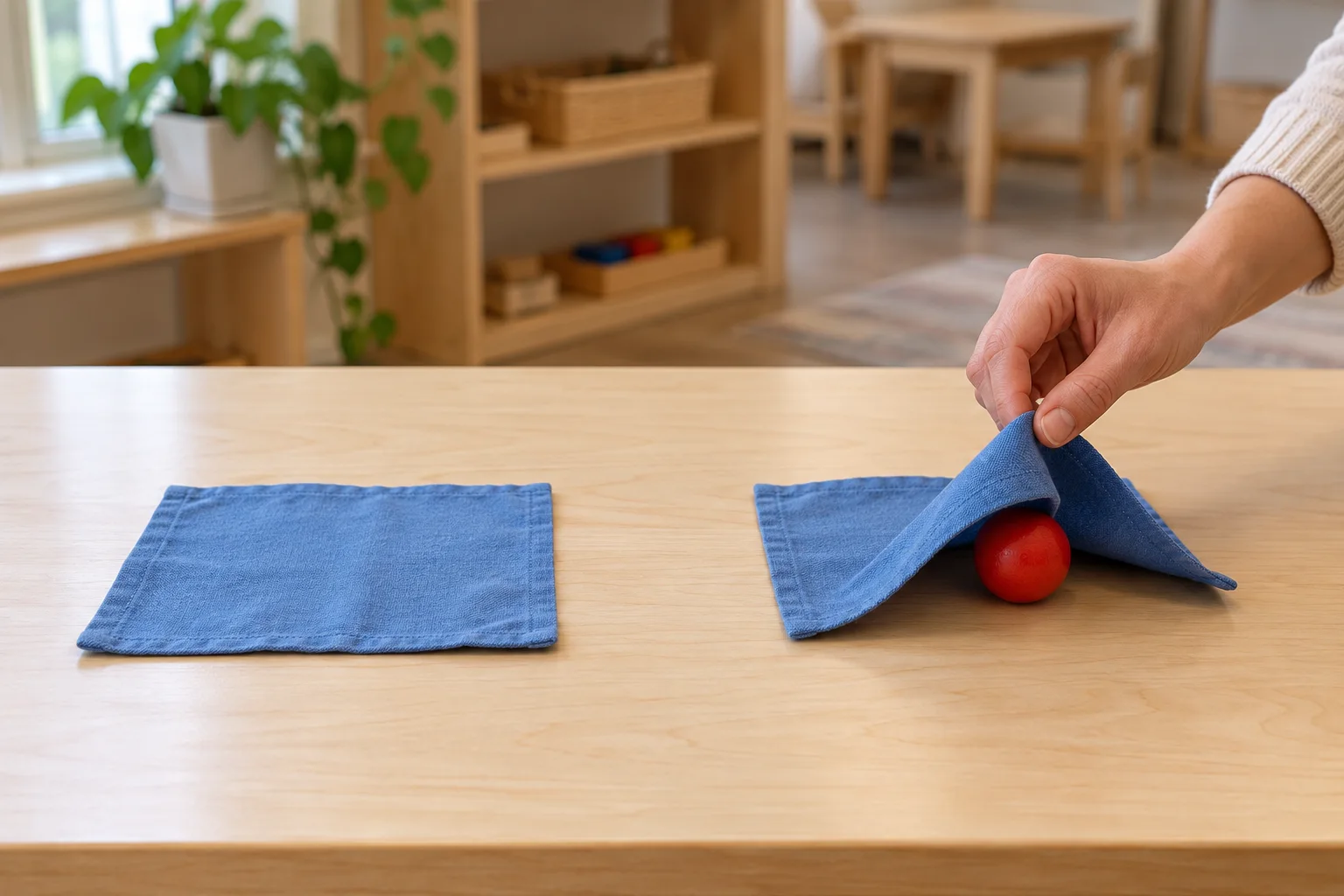
The response is a perseverative reach: a return to the previously used location. In their 1999 paper on A-not-B task dynamics, Linda Smith and colleagues examined how reaching history, body position, spatial cues, and delay affect performance. Their account connects the error to the processes that organize action. A useful observation therefore records the preceding searches and the conditions of the move to B alongside the final reach.
Why looking and reaching can give different evidence
Looking-time studies use a different response. In Baillargeon, Spelke, and Wasserman’s 1985 experiment, five-month-old infants looked longer at a screen event that appeared to pass through a hidden box than at a physically possible event. The authors interpreted the difference as evidence of expectations about object persistence and solidity.
The recorded behavior was looking duration; the expectation was the interpretation. Reaching also requires organizing an action toward a location. Keep those measures separate when comparing studies: a failure to search leaves more than one explanation open. The guide to reading a psychology study helps separate a measured response from the explanation offered for it.
Conservation: why a taller glass can invite the wrong answer
Conservation is understanding that a quantity stays constant through a transformation that changes its appearance. A liquid-conservation task begins with equal amounts in identical containers. One amount is transferred into a container with a different shape. If all the liquid is transferred without adding or losing any, the amounts remain equal even when the levels differ.
In the psychology conservation task, a judgment that the taller level means more liquid illustrates centration: focusing on one dimension while overlooking relevant relations. Decentration involves coordinating those relations, such as height and width. Piaget and Inhelder describe this contrast in chapter 4, “Notions of Conservation.”

Three explanations for the same conservation answer
The answer “same amount” is more informative when accompanied by a reason. Piaget and Inhelder’s account distinguishes these explanations:
| Explanation | What the reasoning preserves | What to listen for |
|---|---|---|
| Identity | The amount remains unchanged through the transfer. | Recognition that the transfer adds and removes no liquid. |
| Reversibility | The transformation can be mentally undone. | An explanation of why returning the liquid to the original container would restore its earlier level. |
| Compensation | Changes in different dimensions offset each other. | Coordination of the higher level with the narrower container. |
Physically pouring the liquid back gives another observation; explaining the reversal in advance gives evidence about a mental operation. Record the answer and the explanation separately.
Number conservation: spacing versus count
For number conservation, moving counters changes the length or density of a row while leaving its count unchanged. Samuel and Bryant’s 1984 study included rows of six and six counters, as well as six and five. One row was spread out or bunched up.
This distinction matters when interpreting examples. With initially equal rows and no counters added or removed, the numbers stay equal. With initially unequal rows, changing spacing preserves that inequality. Conservation means tracking what stays invariant, rather than learning to answer “same” whenever a display changes.
The question is part of the task
In Asking only one question in the conservation experiment, Samuel and Bryant studied 252 children aged 5–8½. Overall, children made fewer errors when asked only after the transformation than when asked both before and after it. They also did better than a fixed-array group that saw only the final display. Age and material affected performance too.
The authors proposed that repeating the question could suggest that a different answer was expected. That interpretation explains why the exact wording and repetition belong in an observation record. An incorrect conservation response alone does not isolate centration as its cause.
Object permanence vs. conservation
| Question | Object permanence | Conservation |
|---|---|---|
| What remains stable? | An object’s existence while it is hidden. | A quantity through a change of shape or arrangement. |
| What changes in the task? | Visibility or hiding location. | Container shape, counter spacing, or another quantity-preserving arrangement. |
| What evidence is collected? | Search behavior or a specified looking response. | A quantity comparison and, often, an explanation. |
Both involve something persisting through change, but they concern different properties and use different evidence.
Class inclusion and coordinating perspectives
Class inclusion requires relating a part to the larger class that contains it. Piaget and Inhelder give the example of 12 flowers, including six primroses. When comparing flowers with primroses, all 12 belong in the flower category, including the six primroses.
A learner may correctly name both categories yet compare primroses only with the other flowers. In this set that compares six with six, losing the whole-class relationship. The task therefore asks for more than sorting or recognizing a label: it probes whether the whole can be retained while considering one of its parts. Ask what the learner counts as a “flower” in the comparison before interpreting the answer.
The three-mountains task concerns another kind of coordination: representing how a spatial scene looks from another position. Choosing one’s own view when asked for someone else’s is an error in coordinating viewpoints. Piaget’s term egocentrism here concerns perspective; it should not be read as a judgment about selfishness or kindness. The task description in The Psychology of the Child, chapter 3, belongs to the development of spatial representation.
The pendulum task: evidence of systematic hypothesis testing
The pendulum task probes how a learner tests competing explanations. A learner can propose string length, attached weight, release height, or an initial push as possible influences on the swing. The informative step is arranging comparisons that separate those factors.

Piaget and Inhelder’s chapter 5 discussion, “The Pendulum,” focuses on separating possible causes and excluding irrelevant ones. Use the following comparisons to identify that reasoning in a task account:
| Hypothesis being examined | Change between trials | Keep consistent | Reasoning to examine |
|---|---|---|---|
| String length affects the swing. | String length | Bob, release conditions, timing procedure | Can the learner attribute a difference to the isolated factor? |
| Attached weight affects the swing. | Attached weight | String length, release conditions, timing procedure | Does the learner use the comparison to retain or reject the proposed influence? |
| Release conditions affect the swing. | One specified release factor | String length, bob, other release conditions, timing procedure | Can the learner specify which part of the release changed? |
Changing weight and length together produces an ambiguous comparison. Naming length as the answer may reflect remembered physics. Stronger evidence of hypothetical-deductive reasoning includes proposing alternatives, isolating them, and explaining what observations would count for or against each one.
Interpret the result within the apparatus and release conditions described. The learning target is the structure of the investigation, so begin by evaluating the comparisons before evaluating the conclusion.
Why age and one task do not establish a stage
Approximate ages organize the theory; they do not replace evidence about a person’s reasoning. Piaget and Inhelder’s conclusion allows variation in developmental timing. Piaget’s later essay, Intellectual Evolution from Adolescence to Adulthood, also considers how interests, experience, and specialization influence the demonstration of formal reasoning.
Three checks improve an interpretation:
- Check the response required. Looking, reaching, choosing a picture, and explaining a judgment place different demands on the learner.
- Check what changed besides the target variable. Previous actions, question repetition, and unfamiliar materials can alter what the response means.
- Check the explanation and pattern across tasks. A correct answer can arise from a remembered rule; an incorrect answer can have several causes. Compare how the learner reasons under clearly described conditions.
For an exam vignette, identify the reasoning pattern illustrated and justify it from the described behavior. For a research paper, retain the authors’ task conditions when summarizing the finding. For a presentation, use the developmental psychology topic guide to turn one of these contrasts into a focused question.
Classic-task observation checklist
Record the setup and response before writing the interpretation. Copy this checklist for a published study, a course video, or an assigned task description. Leave the response field empty until the account supplies an observation.
| Record field | Notes to complete |
|---|---|
| Task and version | Name; source or video timestamp; response required: __________ |
| Starting arrangement | Materials, positions, and evidence of equal or unequal quantities: __________ |
| Exact prompt | Wording, timing, and whether the question was repeated: __________ |
| Transformation | What was hidden, moved, poured, rearranged, or varied: __________ |
| Observed response | Actual look, reach, selection, spoken answer, or trial choice: __________ |
| Explanation offered | The learner’s stated reason, recorded separately from the answer: __________ |
| Controlled conditions | What stayed constant; what else changed: __________ |
| Supported interpretation | Reasoning indicated by this response under these conditions: __________ |
| Alternative to examine | Another explanation and the comparison that would distinguish it: __________ |
Add task-specific details where relevant:
- A-not-B: preceding searches at A, delay before searching at B, location cues, and body position.
- Conservation: starting quantities, complete transformation, any addition or removal, and question sequence.
- Class inclusion: whole class, included subclass, and which objects the learner compares.
- Perspective: viewing positions and the response options available.
- Pendulum: hypothesis, factor changed in each comparison, release conditions, and measurement procedure.
Finish with a sentence that connects evidence to reasoning: “Under these task conditions, the response supports ___ because ___; comparing ___ would help distinguish ___.” This preserves the value of Piaget’s examples while making the inference precise.
Book and essay references
- Piaget, J., and Inhelder, B. — The Psychology of the Child. English translation by Helen Weaver; original French work published in 1966. Chapters 1 and 3–5 and the conclusion provide the stage account and classic-task descriptions discussed here.
- Piaget, J. — Intellectual Evolution from Adolescence to Adulthood. English translation by J. Bliss of the 1970 FONEME address, pp. 157–164. The discussion on pp. 160–164 considers variation and specialization in formal reasoning.