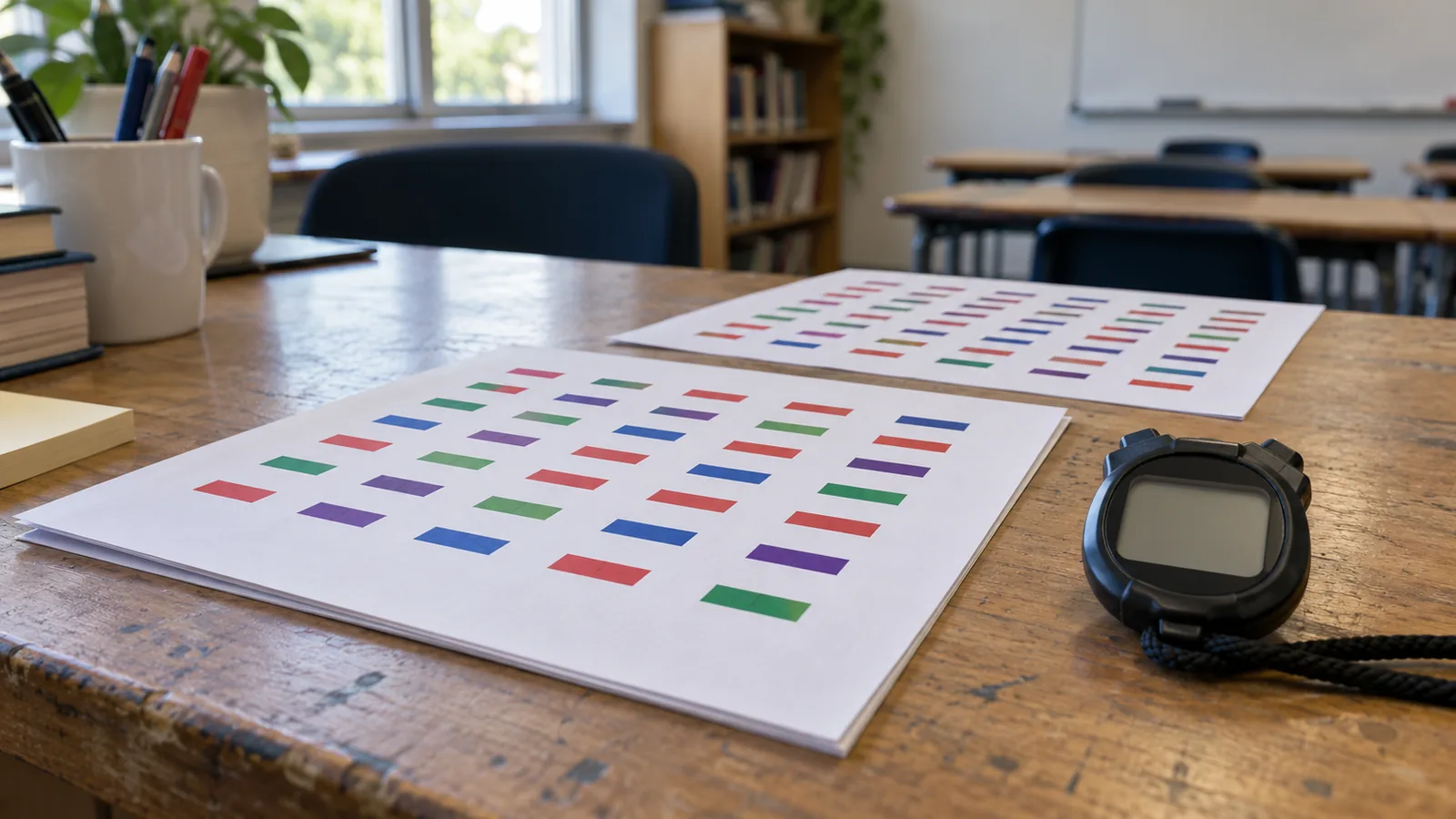
A color-naming time without its condition, order and errors can invite a misleading classroom conclusion. Plan those records before the demonstration, then discuss the observed task rather than rating anyone’s attention.
For a Stroop effect demonstration, specify which ink-color naming conditions will be compared, how their order will vary, and how total time, errors and interruptions will be recorded. The original teacher sheets below support that planning and a bounded debrief. They are not an online test, a normative scoring system or an exact replication of Stroop’s 1935 experiment. Participation can be replaced by an equivalent conceptual analysis without timed responding.
| Planning input | Source or original choice | Why it matters |
|---|---|---|
| Naming instruction | Say the ink color, not the word | Defines the response |
| Incongruent words | Word meaning and ink color differ | Supplies the conflict condition |
| Color-square baseline | Historical Experiment 2 comparison | Provides color naming without words |
| Congruent words, if included | Original optional teaching condition | Answers a different comparison question |
| Order and record rules | Instructor writes them in advance | Makes sequence, errors and timing visible |
The Perception & Cognition guide gives the wider topic route. The operational-definition worksheet helps specify what the demonstration actually records before anyone interprets it.
Choose conditions and write the naming instruction
The task is to name the ink color, including when the printed word names a different color. In Stroop’s original Experiment 2, naming conflicting color words is compared with naming solid color squares. A congruent-word condition is an optional addition in our planning tool, not a claim about an identical historical procedure.
Proposed instruction: “Name the ink color of each item in the stated reading order. For a square, name its fill color. Do not read the word aloud instead of naming its ink.” Write the reading direction and the handling of a mistake on the teacher sheet before the demonstration.
The following four-position examples are original miniature illustrations, not complete standardized stimulus lists. Each list uses the same ink order—red, blue, green, purple—to keep the intended comparison visible. They do not supply a required list length or expected time.
| Position | C: congruent word, if used | I: incongruent word | N: neutral color square |
|---|---|---|---|
| First | RED in red ink | BLUE in red ink | Red square |
| Next | BLUE in blue ink | GREEN in blue ink | Blue square |
| Next | GREEN in green ink | PURPLE in green ink | Green square |
| Last | PURPLE in purple ink | RED in purple ink | Purple square |
These miniature original examples explain the conditions; they are not a validated test sheet.
If the teacher creates longer lists, record the list length, color frequency, ink order, type size, spacing, reading direction and the words used. Keep comparable features matched where possible. Record any deliberate difference; congruent-minus-incongruent and neutral-minus-incongruent comparisons do not have identical meanings.
Takeaway: Name the comparison before choosing the cards or interpreting a difference.
Plan condition order before looking at results
Doing one condition first for everyone mixes condition with sequence. Familiarity, practice and fatigue can accompany later attempts. Stroop’s Experiment 2 varies test order across participants; our sheet uses that planning principle without reproducing its materials, sample or result.
For a paper plan using I and N only, show both I→N and N→I routes. If a congruent condition is included, the possible orders are C–I–N, C–N–I, I–C–N, I–N–C, N–C–I and N–I–C. These are possible arrangements of the named conditions, not a prescribed class size or a requirement to run every route.
| Teacher planning field | Entry before use |
|---|---|
| Learning question and chosen comparison | _____ |
| Conditions and stimulus-list versions | _____ |
| Order routes to be used | _____ |
| How willing participants receive a route | _____ |
| Practice material, if any, and whether shared | _____ |
| Pause and timing procedure | _____ |
| Factors deliberately matched | _____ |
| Unmatched features or unavoidable changes | _____ |
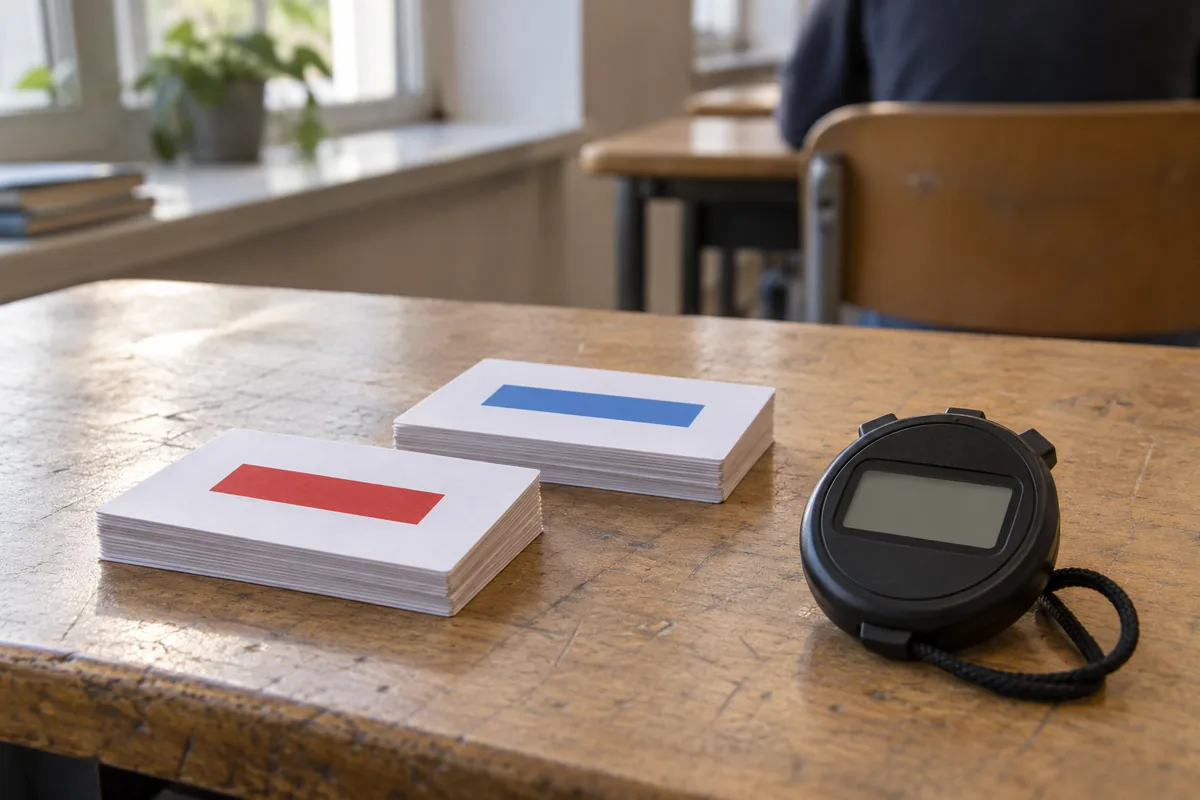
Illustrative photo — generated editorial image, not a real classroom study, participant or result.
Varying order addresses one design concern; it does not guarantee that other differences are controlled. At a glance: Keep both order routes · Incongruent / Neutral · I then N · N then I.
For conceptual teaching, let learners inspect the order routes without running a comparison at all. If a live illustration is chosen, explain it openly, make participation optional, keep records unnamed, and follow local teaching requirements. The Practice guide offers study routes for a lesson that does not need timed responding.
The Research Methods guide clarifies why assigning an order route does not make a class a randomly sampled population.
Takeaway: Record which condition occupies each sequence position instead of treating the first-to-second change as a pure condition effect.
Record total time, errors and interruptions separately
For a paper list, define a total list-completion measure rather than calling a stopwatch total a trial-level reaction time. One proposed convention is to start at the agreed start signal and stop after the final spoken color name. Keep the convention identical across lists and record the actual elapsed time in seconds.
Decide before use whether a learner continues after an error, how self-corrections are noted, and what invalidates an attempt. An illustrative rule is to continue naming, record uncorrected naming errors and self-corrections separately, and mark an interrupted attempt as unsuitable for the planned timing comparison. This is an editorial convention, not a standard scoring protocol.
| Anonymous record | Condition and version | Sequence position | Total time, seconds | Uncorrected errors | Self-corrections | Interruption or rule deviation |
|---|---|---|---|---|---|---|
| _____ | _____ | _____ | _____ | _____ | _____ | _____ |
| _____ | _____ | _____ | _____ | _____ | _____ | _____ |
| _____ | _____ | _____ | _____ | _____ | _____ | _____ |
Read a faster total alongside accuracy and the recorded procedure.
Use a separate planning record for the number of items, materials and timing method. A missing value remains blank or marked “not recorded”; it is not a zero. Do not divide a total by an assumed number of items to create a trial-level measurement that was never collected.
Common mistake: Reporting only the fastest total and ignoring more errors or a different sequence position.
The claim-and-evidence reading sheet shows why the measure and analysis unit matter in an actual public paper. For another lesson about response formats, the existing memory classroom demonstrations have separate goals and materials.
Takeaway: Keep the timing unit, accuracy record and procedural notes together.
Use a non-diagnostic debrief, including the observer option
Begin with what was recorded, then consider explanations and limits. A class pattern can prompt discussion of interference when naming ink colors, but it does not establish the reason for a particular learner’s time or measure their intelligence. An unexpected or absent difference remains a legitimate observation to discuss.
Debrief script: “What was the required response? Which stimuli differed? What changed with order or repetition? Did faster attempts have different errors? What does our record show, and what does it leave unresolved? Which conclusion would go beyond this demonstration?”
An equivalent conceptual option is to inspect the condition table, choose an order plan, identify possible confounds and write a bounded interpretation without naming colors or being timed. It meets the concept-analysis goal; it is not a substitute score that should be compared with timed participants. This option can be used for color-vision differences, language or reading differences, discomfort, or simply a preference not to participate. No disclosure of a reason is needed.

Illustrative photo — generated editorial image, not a real classroom study, participant or result.
The observer route practices the same reasoning goal without producing a timed score. At a glance: Debrief the task · Required response · Conditions and order · Time with errors · Bounded conclusion · Observer option.
Hedge, Powell and Sumner’s reliability-paradox paper distinguishes robust experimental contrasts from reliable individual differences. It does not validate our miniature lists. Use that distinction to resist interpreting a teaching demonstration as an individual assessment. The headline rewrite activity helps learners narrow an overclaim, and the retrieval routine offers a private way to revisit the concept later.
Takeaway: Debrief the response requirement and record, while preserving the option to analyze without participating.
When this demonstration does not support a score interpretation
Language familiarity, reading, color discrimination, materials, naming conventions and timing can differ across settings. The planning sheet makes some differences visible but does not standardize the task or supply norms. No cutoff for attention, impairment or performance quality is offered.
The page supplies no online testing component, diagnostic inference, expected completion time or claim of exact historical replication. Keep results private and avoid rankings. Return to the Perception & Cognition guide when a broader concept discussion is needed.
Takeaway: A teaching record supports discussion of its own task, not a diagnosis or ranking of learners.
Method and sources
The historical comparison and order principle were checked in Stroop’s original 1935 paper, Experiment 2; the distinction between group contrasts and individual-difference reliability was checked in Hedge, Powell and Sumner’s original paper. OpenStax Psychology 2e, section 2.4, supplies general participant-ethics background. Sources accessed October 8, 2026. Miniature stimuli, planning and record sheets, conventions and debrief are original editorial tools with no classroom validation or normative results.
Takeaway: Keep historical evidence separate from the original teaching choices made here.