A classroom list can file “I stopped noticing the smell” under habituation and leave the mechanism looking settled. Put that sentence in the phenomenon column, and use the other columns for the measurement, the explanations still open, and the evidence the sentence still lacks.
Sensory adaptation vs habituation examples start from the sentence a student already wrote, then mark the measurement that sentence leaves out. Webster and colleagues describe sensory adaptation as recalibration to the current stimulus environment. In their account, light adaptation begins in the receptors, and later visual stages, including visual cortex and judgments about faces, adapt as well. Their abstract uses “habituating to noise” as an example of a sensitivity change, and a later section uses a room odor that fades from awareness as an olfactory illustration. Rankin and colleagues define habituation as a behavioral response decrement from repeated stimulation that does not involve sensory adaptation, sensory fatigue, or motor fatigue. They point to dishabituation, stimulus specificity, and frequency-dependent spontaneous recovery as ways to draw that line. One subjective sentence completes none of those checks. Counts on the card, the counterexample, and the checklist are examples, not measurements.
The Perception and Cognition guide is the topic home for this page. The signal detection record sheet sorts a different paper problem, a yes-or-no trial against an answer key. The operational-definition worksheet is where a word such as noticing gets pinned to a response someone could count.
Sort the sentence on a four-column card
Write the report in the phenomenon cell, then say what was measured, which explanations remain available, and which checks are still missing.
The example sentence on this card is “I stopped noticing the smell.” Webster and colleagues, in the section Beyond seeing, describe an initially prominent room odor that becomes inconspicuous after a few moments. They present that change as adaptation filtering the ambient stimulus from awareness, and they say adaptation of this kind is characteristic of the senses generally, not only of vision. The card does not promote a student’s copy of that sentence into the review’s conclusion. The sentence and the illustration share a shape. The paragraph, as read for this page, does not report a counted response, a second odor, or a recovery interval.
Rankin and colleagues revise an earlier characteristic so that repeated stimulation produces a progressive decrease in some parameter of a response, such as frequency or magnitude, toward an asymptotic level. The decrease may be exponential or linear, and a response may rise before it falls when sensitization is also under way. The example sentence names noticing. It names neither frequency nor magnitude.
| Column | Smell sentence (example) |
|---|---|
| Phenomenon | I stopped noticing the smell. |
| Measurement | One sentence about noticing. No response frequency or magnitude is recorded. |
| Possible explanation | Sensory adaptation, habituation, sensory fatigue, motor fatigue, or a stimulus that changed. |
| Evidence still missing | A same-modality comparison stimulus, a measured response to each stimulus, and a later observation after the original stimulus was withheld. |
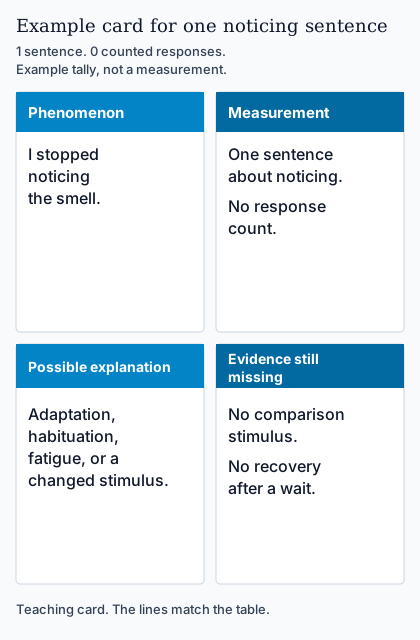
Example card for the smell sentence. The shortened lines match the table. The tally of 1 sentence and 0 counted responses was written for this card. It is an example, not a measurement.
On this example card the report contributes 1 sentence and 0 counted responses. Those two numbers were written so the empty measurement stays visible. They were not collected from a student or a study.
The explanation cell stays plural on purpose. Webster and colleagues give the fading odor as an adaptation illustration, and their abstract places “habituating to noise” among sensitivity changes under adaptation. Rankin and colleagues reserve the word habituation for a response decrement that does not involve sensory adaptation, sensory fatigue, or motor fatigue. A further possibility sits outside both papers’ mechanisms: the smell may have left the room. The sentence does not say the stimulus was still present.
Takeaway: The phenomenon cell can be filled from the sentence alone. The measurement cell waits for a response parameter.
A refrigerator note is too thin to classify
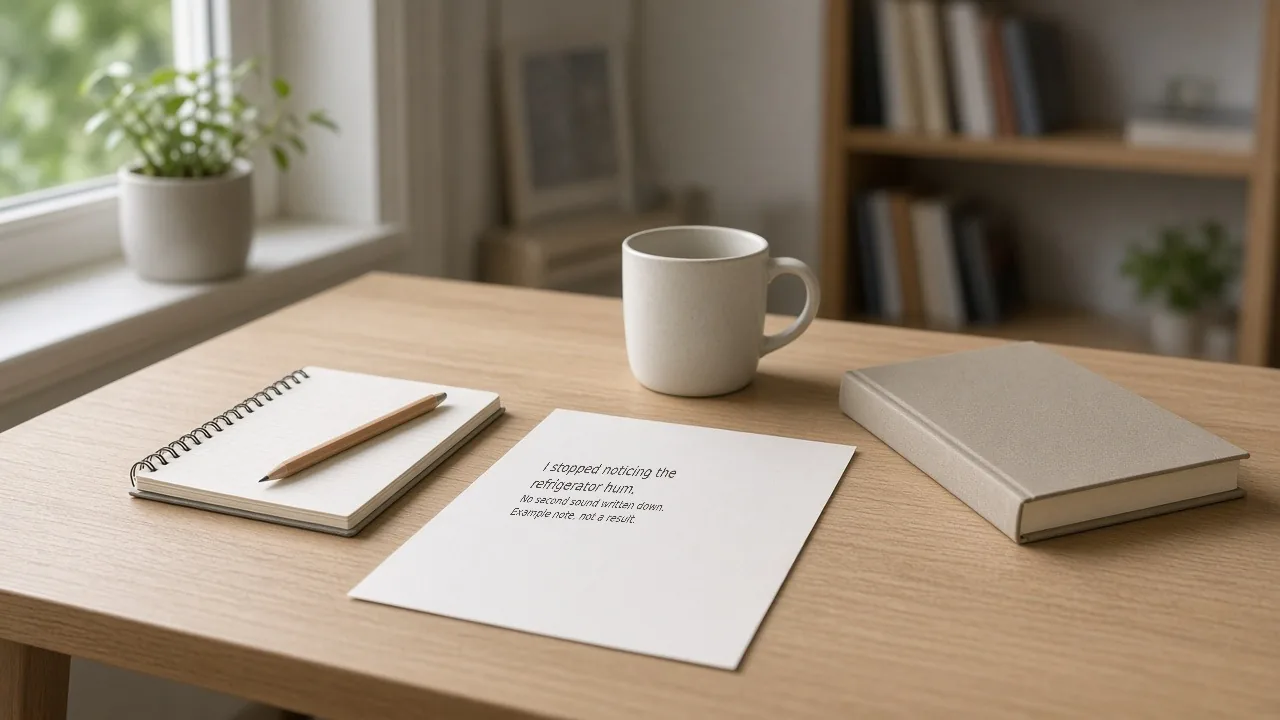
A second example, written for the sheet in the photograph, says: “I stopped noticing the refrigerator hum. No second sound written down.”
The note names one sound and then stops. It does not say the hum continued, it does not name another sound, and it does not describe a wait with the hum withheld. A list that files the hum under habituation has not recorded the exclusions Rankin and colleagues require. Webster and colleagues’ noise phrase shows the same shape used as an adaptation example. Either filing is a label. The note itself supports a phenomenon cell.
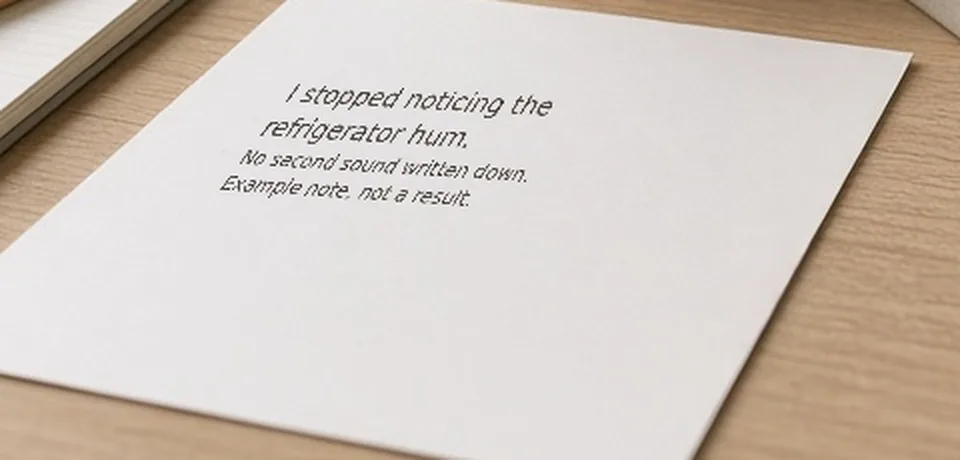
Illustration of a quiet desk and an example observation sheet. The sentences were placed on the sheet for this page. They are not a named person’s result, and the sheet is not a laboratory trace.
This example note contains 1 sentence about the hum and 0 comparison sounds. That count was written with the note. It is an example, not a measurement.
Common mistake: Placing a smell or a steady sound under habituation because noticing faded, while the specificity check and the recovery check are still blank.
The claim-and-evidence reading sheet is the next pass when a published paper uses one of these words. Ask which response was counted, and whether a comparison stimulus or a recovery interval appears in the results.
Takeaway: A thinner note, with no second stimulus and no wait, is still only a phenomenon.
Check stimulus specificity and recovery on paper
A specificity check needs a second stimulus and a comparison of responses. A recovery check needs the original stimulus withheld and at least a partial return of the measured response.
Rankin and colleagues describe stimulus specificity within a modality. The test they name is a second, novel stimulus, with a comparison between the response to the repeated stimulus and the response to the novel one. They write that this comparison can separate habituation from more general sensory adaptation or motor fatigue, which should generalize across a broad range of stimuli in that modality. In the same paragraph they write that generalization within the modality fits habituation occurring centrally rather than in primary sensory afferents. They also warn that some studies have called this comparison a dishabituation test. On their account it is a generalization test. A broad drop and a specific drop answer different questions. Neither result, on its own, assigns adaptation only to the receptor or habituation only to the rest of the brain.
Spontaneous recovery, in their revised second characteristic, has a set order. The response decreases, the stimulus is then withheld, and the response recovers at least partly during the time you are watching. They also describe frequency-dependent spontaneous recovery. When the decrement has reached an asymptotic level, stimulation at a higher frequency is followed by faster recovery than stimulation at a lower frequency. Their review summarizes Rankin and Broster (1992) on a caveat: that frequency pattern held when habituation had reached asymptotic levels, and the training frequency, rather than the level reached, the number of stimuli, or the number of missed stimuli before the test, determined the recovery rate. This page did not read the 1992 paper. The example notes here contain no frequency comparison and no statement that a decrement had leveled off.
Dishabituation is the traditional distinction they discuss. The observation they call proper is an increase in the decremented response to the original stimulus after a different stimulus is presented. An increase in response to the new stimulus alone is a different event. The new stimulus, they note, need not even trigger the response by itself. They add that the relationship between habituation and dishabituation is not fully understood, which is why they also emphasize specificity and frequency-dependent recovery, including when dishabituation is not seen. If a report says dishabituation, ask which stimulus carried the recovered response.
The checklist is for a sentence or a published report you already have. It does not ask you to present a noise, an odor, a painful stimulus, or a habituation procedure to yourself or to anyone else.
| Check | What the report needs to show | Refrigerator note (example) |
|---|---|---|
| Repeated stimulus | The stimulus that was repeated is named | Not written |
| Comparison stimulus | A second, novel stimulus in the same modality is named | Not written |
| Compared response | The same response parameter is compared for both stimuli | Not written |
| Specificity result | The record says whether the response still occurred to the novel stimulus | Not written |
| Prior decrement | A response parameter had decreased before the wait | Not written |
| Stimulus withheld | The original stimulus was withheld during the wait | Not written |
| Same response again | The same response was observed again during the wait | Not written |
| Recovery result | The record says whether the response recovered at least in part | Not written |
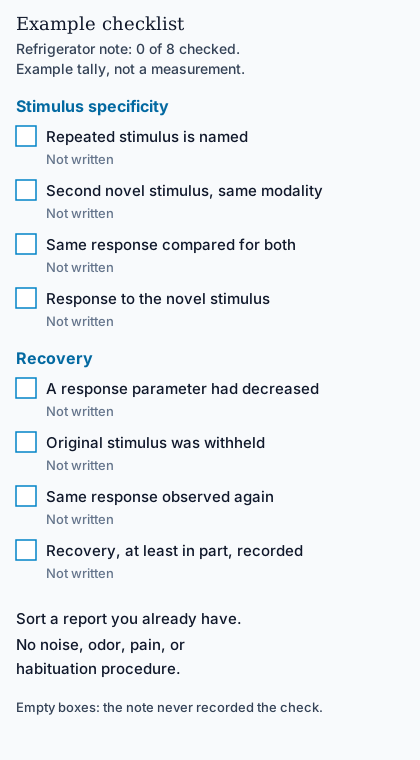
Example checklist for the refrigerator note. All eight boxes are empty because the note never recorded them. The zero is an example tally, not a measurement.
On this example note, 0 of 8 checks are marked present. That zero was written to show an empty record. It is an example, not a measurement.
Takeaway: Specificity compares two stimuli. Recovery watches the same response after the original stimulus is withheld.
Where these two papers place the change
Webster and colleagues locate light adaptation at the receptors. They then describe adaptation later in the visual pathway, in visual cortex, for the orientation and direction of lines, and for higher-level attributes such as faces. They call these later changes the same adaptive process. They describe adaptation as a beneficial recalibration that controls perception at each moment, and they set that description apart from accounts that treat adaptation as fatigue from over-taxing the visual system. In the vision portion of the paper, aftereffects are experienced as changes in the stimulus, and the observer is not aware of the adaptation state. That sentence is about visual aftereffects. It is not a finding about the refrigerator note.
Rankin and colleagues write that remarkably little is known about the neural mechanisms of habituation. They later describe a collection of cellular mechanisms recruited in different parts of the nervous system, in different neurons, and by different stimulus patterns. Responses they treat as open to habituation include reflexes, hormone release, and measures such as EEG or functional imaging. They also note that a cellular or molecular change can fail to line up with the behavior, because no single mechanism has to account for the whole decrement.
This page does not use the split that assigns adaptation only to the receptor and habituation only to the brain. Webster and colleagues already describe adaptation at later stages. Rankin and colleagues identify habituation from the response record and from checks against adaptation and fatigue. A noticing sentence supplies neither the stages nor the checks.
Takeaway: Keep a location claim inside the passage that supports it. These two papers support a record check, and they describe adaptation at more than one stage of seeing.
Method and sources
The definition of habituation, the revised characteristics on response decrement, spontaneous recovery, stimulus specificity, and dishabituation, and the discussion of frequency-dependent recovery were checked in Rankin et al. (2009), read on October 12, 2026. The description of adaptation at receptors, in visual cortex, and for faces, the abstract’s example of habituating to noise, the room-odor illustration, and the distinction from fatigue caused by over-taxing the visual system were checked in Webster et al. (2024), read on October 12, 2026. Thompson and Spencer (1966) and Rankin and Broster (1992) are cited inside the Rankin review. Those earlier papers were not read for this page. The four-column card, the refrigerator note, the desk illustration, and the checklist are original. No count on this page was collected from a student or a study.
This page is a study aid from Intro Psych Resources, an independent psychology learning site. It is not a continuation of the earlier wiki, and it is not affiliated with Los Angeles City College or Amy Sweetman. It does not assess or treat any psychological or medical condition.
Takeaway: Keep the published definitions, the example sheets, and any later study record in separate notes.