Sensation is a physical process, whereas perception is psychological. Inattentional blindness is the failure to notice something that is completely visible because the person was actively attending to something else and did not pay attention to other things.
Return to the Perception and Cognition category page to browse related perceptual and cognitive study guides. Use the comparison table below to review the core definitions before opening the signal detection outcome records guide and the sensory adaptation vs. habituation evidence guide.
| Concept | Definition or Rule in Source Text | Source Attribution |
|---|---|---|
| Sensory receptors | Sensory receptors are specialized neurons that respond to specific types of stimuli | OpenStax Psychology |
| Sensation | When sensory information is detected by a sensory receptor, sensation has occurred | OpenStax Psychology |
| Transduction | The conversion from sensory stimulus energy to action potential is known as transduction | OpenStax Psychology |
| Absolute threshold | Absolute threshold refers to the minimum amount of stimulus energy that must be present for the stimulus to be detected 50% of the time | OpenStax Psychology |
| Difference threshold (jnd) | How much difference in stimuli is required to detect a difference between them is known as the just noticeable difference (jnd) or difference threshold | OpenStax Psychology |
| Weber’s law | Proposed by Ernst Weber in the 1830s, Weber’s law states that the difference threshold is a constant fraction of the original stimulus | OpenStax Psychology |
| Perception | Perception refers to the way sensory information is organized, interpreted, and consciously experienced | OpenStax Psychology |
| Bottom-up and top-down processing | Bottom-up processing refers to sensory information from a stimulus in the environment driving a process, and top-down processing refers to knowledge and expectancy driving a process | OpenStax Psychology |
Sensation and Receptor Transduction: From Physical Energy to Action Potentials
Sensory receptors are specialized neurons that respond to specific types of stimuli. When sensory information is detected by a sensory receptor, sensation has occurred. The conversion from sensory stimulus energy to action potential is known as transduction. Light that enters the eye causes chemical changes in cells that line the back of the eye, and these cells relay messages in the form of action potentials.

During sensory transduction, physical energy such as light or a sound wave is converted into a form of energy the brain can understand: electrical stimulation.
We also have sensory systems that provide information about balance (the vestibular sense), body position and movement (proprioception and kinesthesia), pain (nociception), and temperature. Extending nearly two square meters in an average human, the skin is our largest sensory surface. The principal actors in the skin are mechanoreceptor neurons. In Goodman’s 2006 account, C. elegans nematodes are microscopic animals with a compact nervous system consisting of only 302 neurons, about 30 of which are classified as mechanoreceptor neurons.
Takeaway: Sensation is a physical process, whereas perception is psychological.
Absolute Threshold vs. Difference Threshold: Detection, JND, and Weber’s Law
Absolute threshold refers to the minimum amount of stimulus energy that must be present for the stimulus to be detected 50% of the time. In Okawa and Sampath’s 2007 estimate, on a clear night, the most sensitive sensory cells in the back of the eye can detect a candle flame 30 miles away. Under quiet conditions, the hair cells (the receptor cells of the inner ear) can detect the tick of a clock 20 feet away (Galanter, 1962). During one type of hearing test, a person listens to increasingly louder tones starting from silence, and this type of test is called the method of limits.
A stimulus reaches a physiological threshold when it is strong enough to excite sensory receptors and send nerve impulses to the brain: this is an absolute threshold. A message below that threshold is said to be subliminal: we receive it, but we are not consciously aware of it. Research evidence shows that in laboratory settings, people can process and respond to information outside of awareness, but this does not mean that we obey these messages like zombies.
Difference Threshold (Just Noticeable Difference) and Weber’s Law
How much difference in stimuli is required to detect a difference between them is known as the just noticeable difference (jnd) or difference threshold. In classical psychophysics, the JND (sometimes also called a difference threshold or difference limen) is usually defined as the smallest difference between two stimuli that can be successfully discriminated. Ernst Weber proposed this theory of change in difference threshold in the 1830s, and it has become known as Weber’s law: the difference threshold is a constant fraction of the original stimulus.

It will be much harder for your friend to reliably tell the difference between 10 and 11 lbs. (or 5 versus 5.5 kg) than it is for 1 and 2 lbs.
In early weight-discrimination experiments, the just noticeable difference (JND) was proportional to stimulus intensity value, namely JND = k ⋅ I, where k was a constant. The constant k is called the Weber fraction and it specifies the fractional increment of the value I necessary for observing the correct identification with probability p.
Fechner postulated that the principle reflected the law of human perception and stated that the relation between the change of stimulus intensity in the physical world and its perceived change in the human mind was logarithmic (Fechner’s Law). In 1976, Rabinowitz and colleagues investigated the violations of Weber’s Law in 15 experimental studies on the loudness of 1000 Hz tone pulses and concluded that the law held in the range from 10 to 40 dB.
Takeaway: Unlike the absolute threshold, the difference threshold changes depending on the stimulus intensity.
Bottom-Up vs. Top-Down Processing in Psychology and Gestalt Organization
Perception refers to the way sensory information is organized, interpreted, and consciously experienced. Perception involves both bottom-up and top-down processing. Bottom-up processing is a system in which perceptions are built from sensory input. In top-down processing, the interpretation of sensations is influenced by available knowledge, experiences, and thoughts.
Top-down processes are generally goal directed, slow, deliberate, effortful, and under your control. When reading from a top-down approach, readers can miss a repeated second “the” because having a second “the” does not make sense. One illusion that Westerners were more likely to experience was the Müller-Lyer illusion: the lines appear to be different lengths, but they are actually the same length.

Gestalt principles such as figure-ground relationship, grouping by proximity or similarity, the law of good continuation, and closure are all used to help explain how we organize sensory information.
Gestalt Principles of Perceptual Organization and Perceptual Set
In 1912, Max Wertheimer published his paper on phi motion, widely recognized as the start of Gestalt psychology. The word gestalt literally means form or pattern, and its use reflects the idea that the whole is different from the sum of its parts.
- One Gestalt principle is the figure-ground relationship, and according to this principle, we tend to segment our visual world into figure and ground.
- Another Gestalt principle for organizing sensory stimuli into meaningful perception is proximity, which asserts that things that are close to one another tend to be grouped together.
- According to the principle of similarity, things in our visual fields that are alike tend to be grouped together.
- The law of continuity suggests that we are more likely to perceive continuous, smooth flowing lines rather than jagged, broken lines.
- The principle of closure states that we organize our perceptions into complete objects rather than as a series of parts.
Our perceptions are based on perceptual hypotheses: educated guesses that we make while interpreting sensory information. We use these hypotheses to generate our perceptual set. Research has demonstrated that those who are given verbal priming produce a biased interpretation of complex ambiguous figures.
Takeaway: Bottom-up processing refers to sensory information from a stimulus in the environment driving a process, and top-down processing refers to knowledge and expectancy driving a process.
Diagnostic Traps: Separating Sensory Adaptation, Habituation, Inattentional Blindness, and Signal Detection Bias
Although our perceptions are built from sensations, not all sensations result in perception, and we often do not perceive stimuli that remain relatively constant over prolonged periods of time. Light adaptation begins at the earliest steps of seeing, adjusting sensitivity of the receptors in the eye. People with typical color vision have three types of receptors (trichromacy). Adaptation is not a consequence of over-taxing or fatiguing the visual system under artificial conditions, but is instead a beneficial process controlling perception at every moment.
On the sensory adaptation vs. habituation evidence guide, Webster and colleagues, in the section Beyond seeing, describe an initially prominent room odor that becomes inconspicuous after a few moments. Habituation is defined as a behavioral response decrement that results from repeated stimulation and that does not involve sensory adaptation/sensory fatigue or motor fatigue.
In the 2000 study by Most, Simons, Scholl, and Chabris, when a red cross passed across the screen, about one third of subjects did not notice it. Nearly one third of participants in a study did not notice that a red cross passed on the screen because their attention was focused on the black or white figures.
Signal Detection Theory: Sensitivity vs. Response Bias
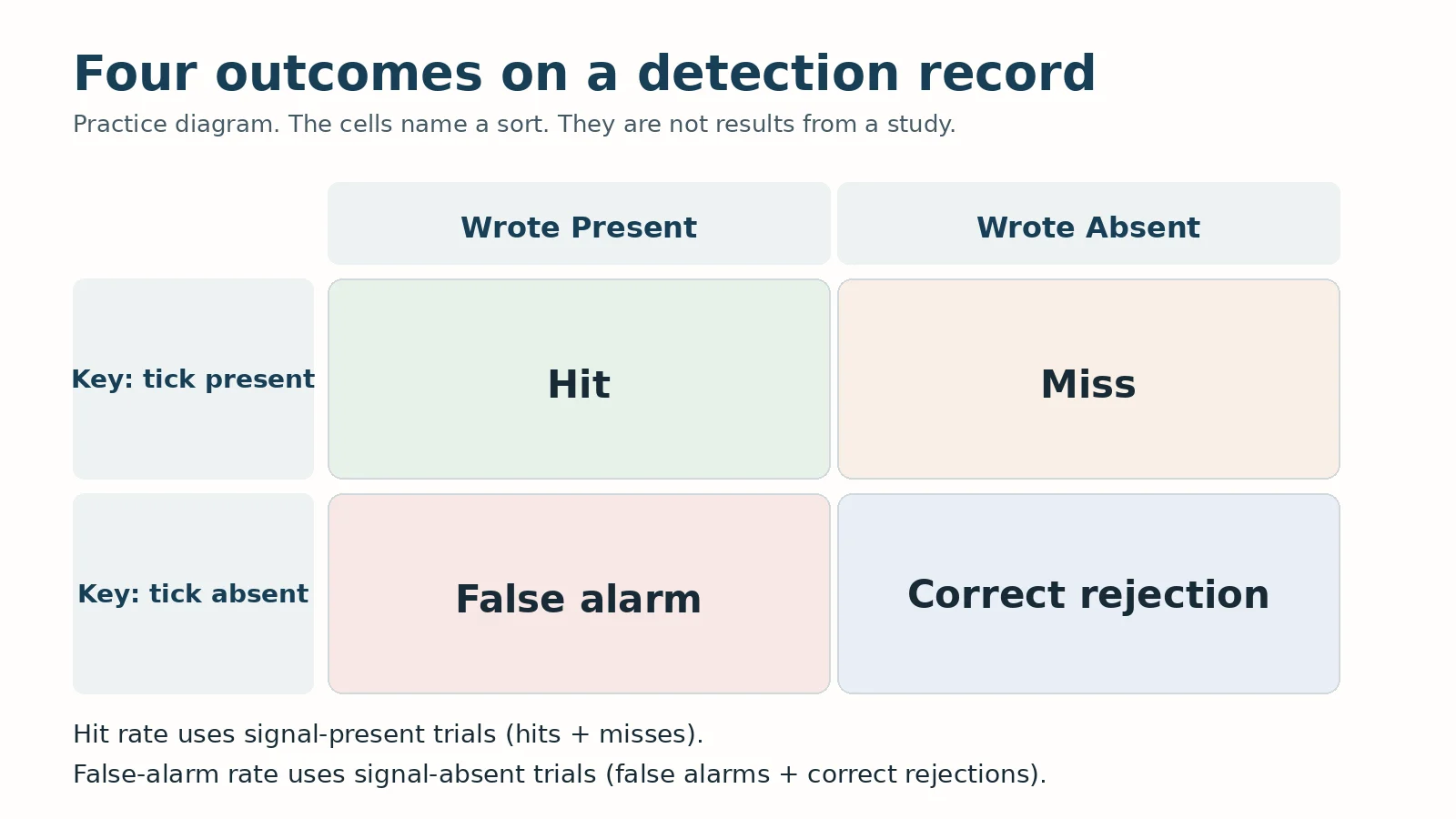
The ability to identify a stimulus when it is embedded in a distracting background is called signal detection theory. The original work of the researcher who developed signal detection theory was focused on improving the sensitivity of air traffic controllers to plane blips (Swets, 1964). The second tenet of SDT is the noise distribution, which quantifies the likelihood of experiencing different magnitudes of sensation in the total absence of any stimulus whatsoever. Correctly indicating that a sound was heard is called a hit, failing to do so is called a miss, and indicating that a sound was heard when one was not played is called a false alarm.
One dimension in Signal Detection Theory is determined by the sensory capability of the observer and the actual ambiguity of the stimulus and is called the sensitivity of the observer. A second dimension is the proclivity of the observer to judge in one direction as opposed to the other, such as indicating that the signal is present rather than absent, referred to as the observer’s response bias. On the signal detection outcome records guide, Lerman and colleagues divide hits by 40 aggression samples and false alarms by 40 ambiguous nonexamples on the 33-minute video.
Takeaway: Although our perceptions are built from sensations, not all sensations result in perception.
Three-Step Sensation and Perception Study Worksheet
Copy this worksheet into your study notes when analyzing a psychology scenario or practice question. Complete each prompt in order before selecting a concept label.
| Worksheet Prompt | Question to Ask | Student Note to Record |
|---|---|---|
| First Prompt | What physical energy is present in the scenario? | Write the stimulus energy and the sensory organ mentioned in the prompt |
| Second Prompt | Does the task present one stimulus or two stimuli to compare? | Write whether the observer detects a single signal or compares two intensities |
| Third Prompt | What prior expectation or attention task is described? | Write any priming cue, reading expectation, or counting task given to the observer |
Use these review steps to check your notes:
- Write down the physical stimulus before naming a perceptual interpretation.
- Check whether a second reference stimulus is present before applying Weber’s Law.
- Check whether hits and false alarms are separated before attributing an error to sensory sensitivity.
- Return to the Perception and Cognition guide to compare additional study examples.
Takeaway: Follow the three worksheet prompts in order when reviewing your study notes.