A study note that records only a failure to notice can attach the wrong label to the task. Change blindness, in the definition Simons and Rensink published in January 2005, is the surprising difficulty of noticing a large change to a visual scene. Inattentional blindness, in the glossary of Friedrich’s Noba Attention module, is the failure to notice a fully visible object when attention is devoted to something else.
Change blindness versus inattentional blindness examples start from the task written in the note. Simons and Rensink define change blindness as the surprising difficulty of noticing large changes to visual scenes. In their flicker task, an original scene and a modified scene alternate, separated by a brief blank, until the observer finds the change. Friedrich’s glossary defines inattentional blindness as the failure to notice a fully visible object when attention is devoted to something else. A note with a scene change, a disruption, and a find-the-change question follows the flicker structure. A note with an assigned task and a separate fully visible object follows the glossary. When the task, the event, the interruption, or the report question is missing, leave the label blank. The desk scenes are examples. No observer was tested.
The Perception and Cognition guide is the topic home for this page. The Stroop condition sheet plans a color-naming task and the records that go with it. The study reading sheet is the next pass when a published methods section uses one of these labels.
Copy four fields before choosing a label
Write the assigned task, the critical event, any interruption, and the report question in the note’s own words. Choose a label only after those cells say which structure the note actually contains.
| Field | Copy this from the note | What the field decides |
|---|---|---|
| Assigned task | The instruction given to the observer | A find-the-change instruction and an attend-to-another-event instruction support different labels. |
| Critical event | A change between views of a scene, or a separate object that stays fully visible | Simons and Rensink tie change blindness to a large change in a visual scene. Friedrich’s glossary ties inattentional blindness to a fully visible object while attention is elsewhere. |
| Interruption | A blank, an eye blink, a mudsplat, a brief occlusion, an eye movement, or a gradual change, when the note has one | Simons and Rensink write that those disruptions impair localization of the motion signal that accompanied the change. |
| Report question | The question the observer was asked to answer | Simons and Rensink separate perceiving a change from later realizing that something is different. |
Takeaway: The four cells come from the note. The label comes after the cells.
Two desk arrangements differ in the mug, the pencil, and the card
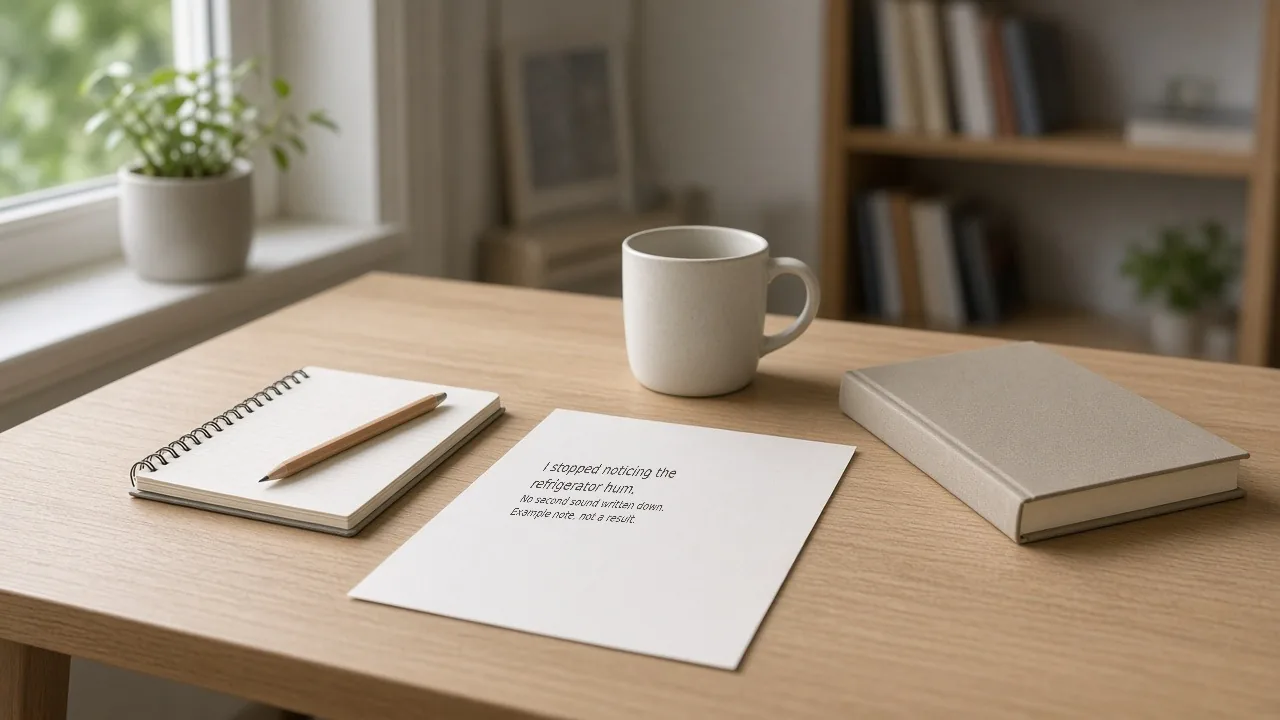
The two photographs were made for this example. They are arrangements of objects, and they record no observer.

A gray mug rests on a closed notebook. A wooden pencil lies to the right of the notebook. Daylight comes from a window.

The mug sits to the right of the notebook. A blank card stands in front of the notebook. The pencil is absent.
The written example places a raised blank card between these two arrangements, so the desktop is hidden for a moment, and then asks the observer to name what changed. The second photograph shows the card after it has been set down. It shows the card standing in front of the notebook. The desktop in that frame is visible.
A note that copies both photographs lists three differences: the mug’s place, the pencil, and the card. The assigned task is to name the change. The interruption is the raised card between the views. The report question is the name of the change. That structure matches the flicker task Simons and Rensink describe, in which an original scene and a modified scene are separated by a brief blank until the observer finds the change. They write that observers in that task eventually find most changes, and that the search can take a long time even when the change is large. This example has no observer and no search time.
A shorter note that says only “the mug moved” has left the pencil and the card out of the critical-event cell. Copy the differences the note actually states. The unlisted ones stay off the card.
Simons and Rensink also describe a 1991 photograph study in which changes were made during an eye movement. Their example is that 50% of observers failed to notice two cowboys sitting on a bench exchanging heads. This page did not read the 1991 paper. The 50% belongs to that photograph-and-eye-movement example as they retell it in January 2005. It is not a rate for the mug, the pencil, or a student.
Takeaway: A find-the-change question plus a change across a blank matches the flicker structure. A miss still needs a recorded result, and this example has none.
The plant stays visible while the pen is the assigned object
This photograph and the instruction under it are another example. The picture contains no taps and no tally.

A black pen lies on a closed notebook. A leafy plant in a clay pot sits at the right side of the desk. Both are in the same frame.
The written instruction is to count pen taps on the notebook. The plant stays in view. The report question is the tap count. The note does not ask about the plant. No taps were performed for this page, and no count was collected.
Friedrich’s glossary calls inattentional blindness the failure to notice a fully visible object when attention is devoted to something else. In the module’s summary of Neisser (1979), viewers were asked to attend to one series of actions in two superimposed semi-transparent video clips, and they often were unaware of the other clearly visible video. This page did not read Neisser (1979). The pen-and-plant note has an assigned task, the taps, and a separate fully visible object, the plant. It has no record that anyone failed to notice the plant. The task structure matches the glossary. The notice cell stays empty.
The module says Simons and Chabris (1999) extended that selective-viewing work with similar techniques. This page did not read that paper and does not reproduce its stimuli.
| Field | Mug, pencil, and card (example) | Pen and plant (example) |
|---|---|---|
| Assigned task | Name what changed | Count the pen taps |
| Critical event | Mug place, pencil, and card differ across the two views | Plant stays fully visible; the report is about taps |
| Interruption | A blank card is raised between the views | None in the note |
| Report question | Name the change | Give the tap count |
| Notice result | Not stated | Not stated |
| Structure the note supports | Flicker-style change detection | Attention on one event, with another object fully visible |
Takeaway: An assigned task plus a different object that remains fully visible matches the inattentional-blindness structure. A miss still has to be written down.
Thin notes and mixed notes stay unresolved
One example note says: “People missed something on the screen during a video.”
| Field | Thin note (example) |
|---|---|
| Assigned task | Not written |
| Critical event | “something on the screen” |
| Interruption | Not written |
| Report question | Not written |
Three of the four fields are empty. The event field names neither a change between views nor a fully visible object. Those counts describe this example sentence. Leave the label blank.
A second example note says: “After a blank, the mug was beside the notebook, and a plant was on the desk. Say what changed.”
The find-the-change question and the blank match the flicker structure. The plant supports the extra-object structure only if the note says the plant was present the whole time and that attention was on something else. This note says neither. Keep both readings in the critical-event cell, and withhold a single label.
Common mistake: Choosing change blindness or inattentional blindness from the phrase “failed to notice” while the task, the event, the interruption, or the report question is still blank.
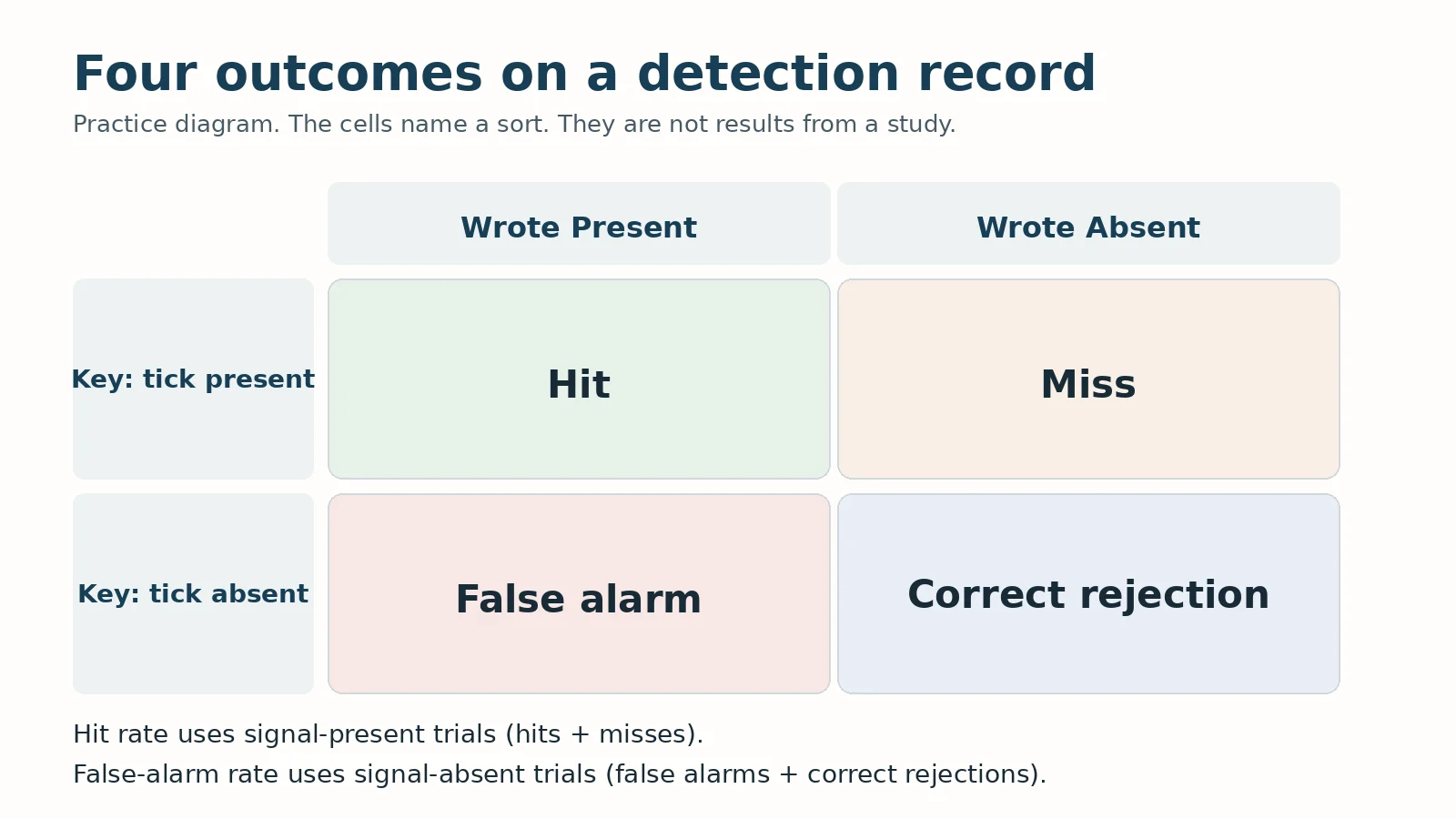
The signal detection record scores a yes-or-no trial against an answer key. It answers a different question from this card.
Takeaway: An empty field stays empty. A note that fits both structures keeps both readings.
A missed change still has to meet four requirements of scope
Simons and Rensink write that change blindness is compatible with fairly detailed and complete visual representations of a scene. They set four requirements of scope. On their account, a claim that visual representations are sparse or absent has to rule out each requirement before that claim follows from a missed change.
- Detailed representations that decay or are replaced before the comparison. They write that experiments on visual search and iconic memory indicate detailed representations last only 0.5 seconds, or until a new stimulus replaces them. They write that no change-blindness study had ruled this possibility out.
- Representations of the pre-change scene that sit in a pathway the change-perception mechanism does not use. They point to multiple visual pathways, including visuo-motor information unavailable to conscious change detection, and they write that change-blindness experiments had insufficiently addressed that split.
- Representations stored in a format that cannot be compared. They write that change blindness says nothing about representations that cannot be compared, so a conclusion then stays limited to representations that support perceiving change.
- Representations in a usable format and pathway when the comparison is still not applied. They name a time-limited task with a slow comparison, and a task that does not compel the comparison. They write that change blindness cannot rule out representations that were not accessed.
Simons and Rensink write that the failure to detect a change does not imply the absence of a representation unless all four requirements of scope are met. They write that no studies had met all four, so the work they were reviewing can say nothing about representations that support the static aspects of vision. It can speak to limits on the representations that support change detection. That assessment is theirs in January 2005. This page did not survey studies published after the article.
In the same paper they separate seeing a change from inferring one later. They describe observers who fail to notice a building disappearing gradually from a photograph over 12 seconds, then realize the building is missing when shown the initial photograph again. In that account the observers did not have a visual experience of the building changing. They realized it was different, possibly from long-term memory. A question that asks whether the building is gone is a different report from a question that asks whether the observer saw it change.
They also write that most people firmly believe they would notice such large changes, and they name that belief change blindness blindness. Confidence is not a field on this card.
Takeaway: Record a miss only when the note records one. On the 2005 account, that miss still leaves the four requirements of scope open.
Method and sources
The definition of change blindness, the flicker task, the disruptions that impair localization of a change’s motion signal, the 50% photograph example, the 0.5-second iconic-memory statement, the four requirements of scope, the 12-second building example, and the split between perceiving a change and later inference were checked in Simons and Rensink, Trends in Cognitive Sciences, Vol. 9, No. 1, January 2005. The saved text of their article was fetched on October 11, 2026, and read on October 14, 2026. Papers cited inside that article, including the 1991 photograph study, were not read for this page.
The glossary definition of inattentional blindness, the summary of Neisser (1979), and the pointer to Simons and Chabris (1999) were checked in Frances Friedrich’s Noba module Attention. The saved page was fetched on October 11, 2026, and read on October 14, 2026. The module’s own cite line reads Friedrich (2026). Neisser (1979) and Simons and Chabris (1999) were not read for this page.
The photographs, the four-field card, the thin note, and the mixed note are original. No count on this page was collected from an observer.
This page is a study aid from Intro Psych Resources, an independent psychology learning site. It is not a continuation of the earlier wiki, and it is not affiliated with Los Angeles City College or Amy Sweetman. It does not assess or treat any psychological or medical condition.
Takeaway: Keep the 2005 review, the Noba glossary, and the example notes in separate sentences.