This guide examines working memory psychology, short-term vs working memory, baddeley working memory model components, and phonological loop vs visuospatial sketchpad alongside our learning and memory study hub and our memory psychology classroom experiments guide.
In the Atkinson and Shiffrin (1968) model, a memory passes through three distinct stages to go into long-term storage: Sensory Memory, Short-Term Memory, and Long-Term Memory.
In the Atkinson-Shiffrin model, sensory memory is the storage of brief sensory events—such as sights, sounds, and tastes—lasting up to a couple of seconds.
Short-term memory (STM) is a temporary storage system that processes incoming sensory memory, is more accurately described as a component of working memory, and lasts 15 to 30 seconds.
Baddeley and Hitch (1974) proposed a working memory model in which memories are stored in three short-term systems: a visuospatial sketchpad, an episodic buffer (Baddeley, 2000), and a phonological loop.
According to Baddeley and Hitch, a central executive part of memory supervises or controls the flow of information to and from the three short-term systems, and the central executive is responsible for moving information into long-term memory.
Short-Term vs. Working Memory: Maintenance, Manipulation, and Span Tasks
For timeline diagrams showing how earlier and later learning lists compete during retrieval, see our guide on proactive and retroactive interference timelines.
The first mention Cowan reports finding of the term working memory comes from a book by Miller, Galanter, and Pribram (1960), Plans and the structure of behavior, where working memory was said to be the facility that is used to carry out one sub-plan while keeping in mind the necessary related sub-plans and the master plan.
Alan Baddeley and Graham Hitch introduced the term working memory to a meeting of the UK Experimental Psychology Society in 1972.
In Science (1992), Alan Baddeley stated that the term working memory refers to a brain system that provides temporary storage and manipulation of the information necessary for such complex cognitive tasks as language comprehension, learning, and reasoning, divided into (i) the central executive, (ii) the visuospatial sketch pad, which manipulates visual images, and (iii) the phonological loop.
Rehearsal, Trigram Decay, and Proactive Interference
Active rehearsal is a way of attending to information to move it from short-term to long-term memory, whereas elaborative rehearsal is the act of linking new information you are trying to learn to existing information that you already know.
Peterson and Peterson (1959) investigated short-term memory using three-letter sequences called trigrams (e.g., CLS) recalled after various time intervals between 3 and 18 seconds.
In the trigram delay task, participants remembered about 80% of the trigrams after a 3-second delay, but only 10% after a delay of 18 seconds, which caused them to conclude that short-term memory decayed in 18 seconds.
Keppel and Underwood (1962) examined only the first trials of the trigram task and found that proactive interference—where previously learned information interferes with the ability to learn new information—also affected short-term memory retention.
In Turvey et al. (1970) and Greene (1996), no detrimental effect of delay is observed if delays of 5, 10, 15, and 20 s are tested in separate trial blocks, whereas Baddeley and Scott (1971) tested a large number of participants for one trial each, so as to avoid proactive interference, and found an effect of the test delay within the first 5 s.
Neuropsychological, Psychometric, and Prefrontal Dissociations
Shallice and Warrington (1970) studied patients who had digit spans of around two items, implying grossly impaired STM; together with classic amnesic patients with impaired LTM and preserved STM, the two types of patient provided a double dissociation between classic amnesic patients with impaired LTM and preserved STM and the newly discovered STM patients.
In Baddeley and Hitch’s concurrent digit-load experiments where participants had to hear and repeat back sequences of digits varying in length from zero to eight digits during verbal reasoning, response times became systematically slower as concurrent digit load increased, but only by about 50% at the maximum load of eight digits while error rates remained constant at around 5%.
| Analytical Dimension | Task or Study Paradigm | Finding in Source Literature |
|---|---|---|
| Span task structure | Simple versus complex span | Typical tasks measuring STM are simple span tasks that generally require the participant to maintain a collection of symbols, elements, or spatial positions (Unsworth and Engle, 2007b), while WM is commonly measured using complex span tasks created by adding a demanding secondary cognitive task, as in operation span tasks and reading span tasks. |
| Intellectual ability correlation | Shared variance comparison | Ackerman et al. (2005) reported estimated population correlations between intellectual ability and WM and STM of 0.479 and 0.347 respectively, which is equivalent to 22% shared variance between WM and intellectual abilities and 12% shared variance between STM and intellectual abilities. |
| Higher-order factor loading | Multi-task factor analysis | In a factor analysis of 12 diverse memory span tasks in a sample of 403 participants (Colom et al., 2006b), 37% of the total amount of variance of all span tasks was explained by one higher-order factor and the average loading of the WM and STM measures on this factor was quite similar (0.65 and 0.56, respectively). |
| Prefrontal cortex stimulation | Maintenance versus manipulation | Postle et al. (2006) used rTMS to disentangle brain activity crucially involved in maintenance and manipulation, showing that rTMS on the dlPFC selectively disrupted manipulation but not maintenance, alongside a study showing an rTMS interference effect on the dlPFC for the 2-back task but not for the 1-back task (Sandrini et al., 2008). |
Baddeley Working Memory Model Components: Central Executive and Episodic Buffer
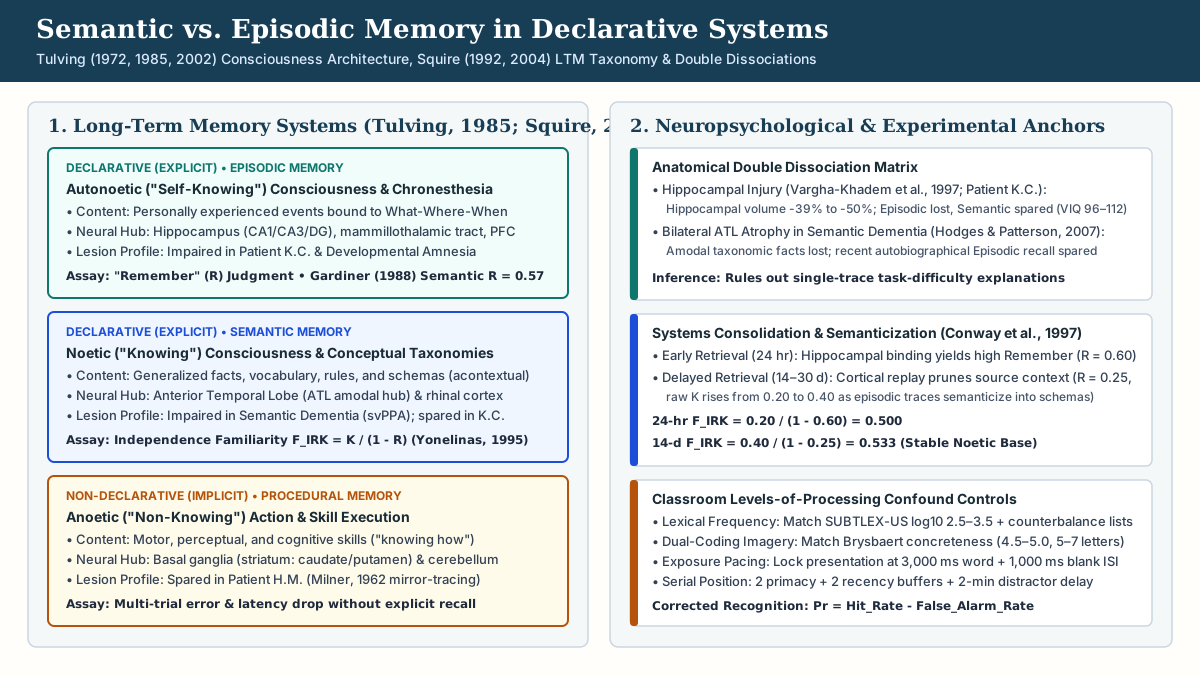
For a detailed comparison of long-term declarative systems, see our guide on semantic vs. episodic memory declarative systems.
Explicit memory is divided into episodic memory—memory about happenings in particular places at particular times, the what, where, and when of an event (Tulving, 2002)—and semantic memory—knowledge about words, concepts, and language-based knowledge and facts.
The term ‘slave’ systems was borrowed from electronic engineering, with the phonological loop in the left hemisphere around Wernicke’s area for storage and further forward around Broca’s area for articulatory rehearsal, and visuospatial processing in the right hemisphere, probably occipital for the more visual aspects and parietal for the more spatial, depending heavily with the central executive on frontal areas.
The Central Executive and Dual-Task Coordination
Baddeley incorporated the supervisory attentional system (SAS)—which Shallice attributes to the frontal lobes—as the central executive component to focus attention and to inhibit the processing of irrelevant distractors, divide attention, switch attention between tasks, and access and manipulate information from LTM (Baddeley, 1996).
In Baddeley, Logie, Bressi, Della Sala, and Spinnler (1986b), combining a visuo-spatial tracking task that was assumed to depend on the sketchpad and a verbal task of immediate recall of digit sequences produced minimum disruption of performance from the combination of the visual and verbal tasks for either the young or the elderly controls, together with a substantial decrement in Alzheimer’s disease.
In a study recruiting a total of 32 patients with well-established frontal lobe lesions, half of whom were independently categorized as showing evidence of dysfunctional behavioral problems, the group with behavioral problems was significantly more impaired on dual-task performance, while no difference emerged between groups in their impaired fluency or WCST performance.
The Episodic Buffer and Multimodal Feature Binding
In Trends in Cognitive Sciences (2000, Vol. 4, Issue 11), Alan Baddeley proposed the episodic buffer, which comprises a limited-capacity system that provides temporary storage of information held in a multimodal code, capable of binding information from the subsidiary systems, and from long-term memory, into a unitary episodic representation.
Baddeley and Wilson (2002) reported densely amnesic patients who as expected scored zero on both the Rivermead Behavioral Memory Test and on the delayed prose recall of the WMS, yet performed well on immediate recall of the short story component of the Rivermead test with scaled scores 12 and 9.5, motivating the Episodic Buffer (Baddeley, 2000).
By systematically blocking the three components of the model using dual-task methods, Hitch, Allen, and Baddeley (2020) showed that the central executive is not essential for providing access and that the process of binding typically occurs at points before accessing the buffer.
Phonological Loop vs. Visuospatial Sketchpad: Subsystems and Dissociations
The Phonological Loop: Phonological Store, Articulatory Rehearsal, and Benchmark Effects
The phonological loop encodes short-term verbal information and is divided into a passive storage component (phonological store, which is the pure storage capacity without active control) and an articulatory rehearsal process (Baddeley, 2003) that maintains information for more than a few seconds and also recodes visual input.
When Baddeley asked participants to remember sequences of five words, he found a dramatic effect of acoustic similarity with around 80% correct for dissimilar words versus 10% for similar sequences, while similarity of meaning showed a minimal effect (75% vs. 65%).
This pattern completely reversed when list length was increased to 10 words requiring several trials to learn, suggesting the simple conclusion that while STM depended on acoustic coding, LTM was semantically based.
The relationship between word length and performance breaks down when articulation is disrupted by the concurrent requirement to repeatedly utter even a single sound such as the word ‘the,’ termed articulatory suppression; such suppression of rehearsal also eliminates the phonological similarity effect, but only when presentation is visual, because visual presentation requires articulation to convert the stimulus from a visual to an acoustic code.
In Baddeley, Papagno, and Vallar (1988), patient PV, who had suffered a left-hemisphere stroke, learned pairs in her native language at a normal rate while completely failing to master any of a set of eight Italian-Russian pairs by the time all of the controls had learnt the whole set, supporting the hypothesis of the phonological loop as a language learning device.
In Gathercole and Baddeley (1990), 8-year-old children diagnosed with specific language impairment (SLI) who had the language development of 6-year-olds repeated nonwords increasing in length from two syllables (e.g., ballop) to five (e.g., altupatory), showing a marked decline in performance as the number of syllables increased.
 Photograph of over-ear studio headphones resting on an oak table beside blank white cards and a wooden metronome.
The Visuospatial Sketchpad: Visual Cache, Inner Scribe, and Spatial vs. Visual Tasks
The visuo-spatial sketchpad processes spatial, visual, and likely kinesthetic information; Logie (2011) differentiates between a static visual cache and an inner scribe for encoding spatial-dynamic information, and similarly to the phonological rehearsal process, the inner scribe may also maintain visual information via rehearsal.
Patient LE, who suffered brain damage as a result of Lupus Erythematosus, was a talented sculptor who reported losing her capacity to visualize but retaining her spatial abilities, and performance on the spatial Corsi blocks test dissociates from performance on the visual pattern span test (Della Sala et al., 1999).
| Subsystem Dimension | Experimental or Clinical Dissociation | Finding in Source Literature |
|---|---|---|
| Spoken word duration | Monosyllabic versus polysyllabic immediate recall | In the word length effect—the observation that verbal memory span is strongly dependent on the spoken length of the words to be recalled (Baddeley, Thomson, & Buchanan, 1975)—when asked to immediately recall sequences of five words, participants recalled about 90% when these were monosyllables (e.g., stick) but only about 50% when the words comprised five syllables (e.g., refrigerator). |
| Spatial tracking interference | Modality-specific dual-task disruption | Tracking disrupted the visuo-spatial but not the verbal STM task (Baddeley, Grant, Wight, & Thomson, 1973), and Robert Logie (1986) proposed that the sketchpad comprises separate visual and spatial components, a position later demonstrated more thoroughly by Klauer and Zhao (2004). |
| Imagery versus storage | Irrelevant visual input versus spatial tapping | Visual imagery and visual short-term memory are dissociated (Borst, Niven, & Logie, 2012; Logie & van der Meulen, 2009; van der Meulen, Logie, & Della Sala, 2009): irrelevant visual materials interfere with the formation of visual imagery but not with visual storage, whereas tapping in a spatial pattern interferes with visual storage but not the formation of visual images. |
 Photograph of a wooden tapping board with unpainted maple cubes arranged beside a black-and-white geometric checkerboard tile.
Working Memory Capacity Limits: Miller’s Chunks, Cowan’s Focus of Attention, and Classroom Assessment
Miller’s Seven Plus or Minus Two, Bits Versus Chunks, and Binary Recoding
Decimal digits are worth 3.3 bits apiece, and we can recall about seven of them for a total of 23 bits of information, whereas isolated English words are worth about 10 bits apiece.
Hayes (10) tried immediate memory with five different kinds of test materials: binary digits, decimal digits, letters of the alphabet, letters plus decimal digits, and with 1,000 monosyllabic words, where the lists were read aloud at the rate of one item per second.
With binary items the span is about nine and, although it drops to about five with monosyllabic English words, the difference is far less than the hypothesis of constant information would require.
By distinguishing between bits of information and chunks of information, Miller stated that the number of bits of information is constant for absolute judgment and the number of chunks of information is constant for immediate memory.
The memory span of five words that Hayes obtained when each word was drawn at random from a set of 1000 English monosyllables might just as appropriately have been called a memory span of 15 phonemes, since each word had about three phonemes in it.
Along the top of Sidney Smith’s binary recoding table is a sequence of 18 binary digits where 00 is renamed 0, 01 is renamed 1, 10 is renamed 2, and 11 is renamed 3, and when regrouped into chunks of three it is recoded from a sequence of 18 binary digits into a sequence of 6 octal digits.
Smith assembled 20 subjects and measured their spans for binary and octal digits, which were 9 for binaries and 7 for octals; after they studied the recoding until they said they understood it—for about 5 or 10 minutes—the recoding schemes increased their span for binary digits in every case.
Long-term memory reduces the working memory load by organizing and grouping information in working memory into a smaller number of units (Miller, 1956; Ericsson and Kintsch, 1995); for example, the letter series IRSCIAFBI can be remembered much more easily as a series of acronyms for three federal agencies: IRS, CIA, and FBI.
Cowan’s Four Plus or Minus One, Embedded Processes, and Classroom Working Memory
More contemporary research has found working memory capacity is 4 plus or minus 1 (Cowan, 2010).
In Behavioral and Brain Sciences (2001, Vol. 24, Issue 1), Nelson Cowan reviewed four conditions—(1) when information overload limits chunks to individual stimulus items, (2) when other steps are taken specifically to block the recoding of stimulus items into larger chunks, (3) in performance discontinuities, and (4) in various indirect effects—implicating a capacity limit averaging about four chunks (three to five chunks).
In Cowan’s framework, short-term memory is derived from a temporarily activated subset of information in long-term memory—which may decay as a function of time unless it is refreshed, although the evidence for decay is still tentative at best—and a subset of the activated information is the focus of attention, which appears to be limited in chunk capacity.
In Cowan and Morey (2007), where three seconds followed before a probe, the part of working memory preceding the cue showed modality-specific dual-task effects—encoding a stimulus set of one type was hurt more by also encoding another set if both sets were in the same modality—whereas the retention of information following the cue showed dual-task effects that were not modality-specific.
Poor working memory is a problem shared by approximately 10 per cent of children, and the Working Memory Index (WMI) of the Wechsler Intelligence Scales for Children (4th edn, Wechsler, 2004) is based on three subtest scores: forward and backward digit recall, and letter-number sequencing.
 Photograph of a rectangular dark slate on a linen cloth holding four white beans beside clipped note cards.
| Capacity Paradigm | Experimental Manipulation | Quantitative Finding in Source Literature |
|---|---|---|
| Immediate span review | Item retention across materials | In 1956, George Miller reviewed most of the research on the capacity of short-term memory and found that people can retain between 5 and 9 items, so he reported the capacity of short-term memory was the magic number 7 plus or minus 2. |
| Binary-to-octal recoding | Grouping binary digits into octal chunks | When Smith drilled himself, he could remember 12 octal digits; with the 2:1 recoding these 12 chunks were worth 24 binary digits, with the 3:1 recoding they were worth 36 binary digits, and with the 4:1 and 5:1 recodings they were worth about 40 binary digits. |
| Running memory span | Rapid presentation without rehearsal | Typically, people can recall three or four items from the end of the list, although the exact number depends on task demands (Bunting et al., 2006); individuals differ in capacity, which ranges from about two to six items in adults, and Cowan et al. (2005) relied on a running memory span procedure in which the items were presented at the rapid rate of 4 per second. |
| Paired-associate serial recall | Prior word-word pairing frequency | In Cowan et al. (2004), testing serial recall of eight-word lists composed of four pairs of words that previously had been associated with various levels of learning (0, 1, 2, or 4 prior word-word pairings) showed that the capacity limit was about 3.5 chunks in every learning condition, but that the ratio of two-word chunks to one-word chunks increased. |
| Immediate bean apprehension | Visual estimation across set sizes | In an article in Science in 1871, William Stanley Jevons reported that after 1,027 trials, he made no errors for sets of 3 or 4 beans, with some small errors for sets of 5 beans, and with increasing magnitudes of error as a function of set size thereafter, up to 15 beans. |
Working Memory Dual-Task Interference and Chunking Study Audit Sheet
The reflection prompts below help students and instructors audit a working memory demonstration or study protocol.
| Audit Dimension | Protocol Review Focus | Student Reflection Question |
|---|---|---|
| Storage versus manipulation | Separating simple maintenance from concurrent processing demands | Does the task require holding items in their original sequence or simultaneously performing a secondary cognitive operation? |
| Modality-specific interference | Identifying verbal versus visuospatial channel competition | Does the secondary activity compete with articulatory rehearsal in the phonological loop or spatial tracking in the visuospatial sketchpad? |
| Presentation modality | Checking whether visual items can be recoded into speech | Were the target items presented auditorily or visually while subvocal articulation was blocked? |
| Semantic chunking opportunity | Distinguishing raw stimulus items from familiar long-term memory groupings | Can learners group adjacent letters or digits into familiar acronyms or learned pairs before recall? |
| Retention interval structure | Controlling for inter-trial competition and covert rehearsal | Does the delay interval prevent subvocal repetition and separate prior-list interference from trace decay? |
Sources
- OpenStax, Psychology textbook section on How Memory Functions by Rose Spielman, William Jenkins, and Marilyn Lovett
- George Miller, The Magical Number Seven, Plus or Minus Two: Some Limits on Our Capacity for Processing Information, Psychological Review
- Alan Baddeley, Developing the Concept of Working Memory: The Role of Neuropsychology, Archives of Clinical Neuropsychology
- Stephan Kehl and colleagues, A comparison of working memory abilities between children with intellectual disability with non-specific aetiology and children with Down syndrome in schools for intellectual development in Germany
- Nelson Cowan, What are the differences between long-term, short-term, and working memory, Progress in Brain Research
- Nelson Cowan, Working Memory Underpins Cognitive Development, Learning, and Education, Educational Psychology Review
- Bart Aben, Sven Stapert, and Arjan Blokland, About the Distinction between Working Memory and Short-Term Memory, Frontiers in Psychology
- Susan Gathercole, Working memory in the classroom, The Psychologist, British Psychological Society
- Alan Baddeley and Lance Workman, Interview with Alan Baddeley, The Psychologist, British Psychological Society
- Alan Baddeley, Working memory, Science
- Alan Baddeley, The episodic buffer: a new component of working memory, Trends in Cognitive Sciences
- Nelson Cowan, The magical number four in short-term memory: a reconsideration of mental storage capacity, Behavioral and Brain Sciences
- Patrick Rabbitt, Common threads and fault lines, The Psychologist, British Psychological Society